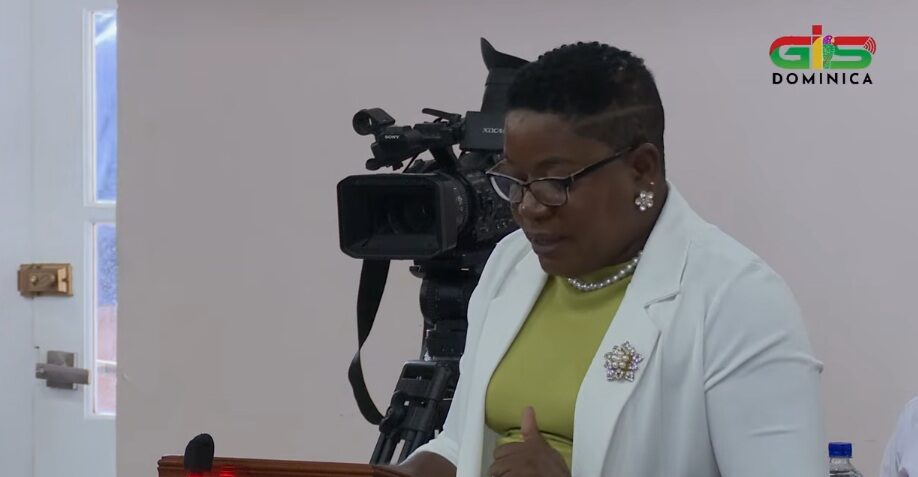
During a parliamentary address Thursday responding to the newly unveiled 2026-2027 national budget, Dominica’s Opposition Leader Jesma Paul-Victor outlined a balanced, principle-driven approach to the government’s latest fiscal plan, emphasizing that opposition cooperation hinges on transparency, tangible delivery and a shared commitment to advancing all Dominicans’ well-being.
Paul-Victor opened her remarks by stressing that the opposition is not ideologically opposed to pro-development policies. She affirmed that the opposition welcomes any genuine initiative that moves Dominica forward, strengthens its economic foundation, upgrades public services, and creates new opportunities for citizens across the country. Rejecting the idea that patriotism is the exclusive domain of any single political party, she noted that the aspirations of all Dominicans cut across partisan lines.
“Every Dominican, regardless of who they support politically, shares the same core hopes: a stronger national economy, upgraded schools, modern medical facilities, climate-resilient infrastructure, affordable energy, thriving local enterprises, and stable, secure jobs,” Paul-Victor told the chamber. She added that progress benefits everyone: when infrastructure is built, communities gain; when education improves, children and future generations gain; when healthcare access expands, every family gains; and when the agricultural sector prospers, the entire nation prospers. No opposition parliamentarian, she stressed, stands in the way of authentic development that improves public life.
“We stand ready to back every investment that lifts the lives of Dominican people and secures a stronger future for our nation,” she said. “But our constitutional duty is not simply to cheer for government project announcements. Our responsibility is to hold the executive to account: to verify that projects are executed efficiently, transparently, on schedule, within allocated budgets, and aligned with the interests of the taxpayers who fund them.”
To guide that oversight, Paul-Victor put forward three core questions that every national budget must be measured against. First, are ordinary Dominicans better off today than they were in previous years? Second, has the government delivered on all the commitments it made in last year’s budget? Third, does the current budget outline a realistic, achievable path to widespread prosperity for all citizens across the island?
She acknowledged that Finance Minister Dr. Irving McIntyre laid out an ambitious, transformative vision for Dominica in his budget address, with proposals including a new international airport, utility-scale geothermal energy development, a world-class marina, climate-resilient affordable housing, modernized road networks, a new cruise tourism village, expanded agricultural support, investment in the creative economy, digitalization of government services, and renewed engagement with the Dominican diaspora. Many of these initiatives, Paul-Victor said, are valuable and deserve broad national backing.
But she drew a clear distinction between announcing an inspiring vision and actually delivering measurable results. “Governments are not elected just to give people hope. They are elected to turn that hope into concrete, visible progress for communities across the country,” she argued. “Budgets are not judged by how eloquent the minister’s speech is. They are judged by whether the promises made in this parliamentary chamber become tangible improvements in communities from Portsmouth, Grand Bay, and Marigot to Wesley, Castle Bruce, Roseau, Soufrière, Salisbury, and every small village in between.”
Paul-Victor argued that before the nation can consider the new commitments laid out in the 2026-2027 budget, the government must first account for the promises it made in past budget cycles. She specifically referenced the wide-ranging commitments for infrastructure, housing, agriculture, tourism, education, healthcare, public sector modernization, and economic growth made in the 2025 budget, noting that Dominicans deserve more than a new list of future plans — they deserve a full public accounting of past performance.
“How many of last year’s projects are running behind schedule? How many have already exceeded their original budgets? How many have actually delivered the outcomes they were originally designed to deliver?” she asked. Echoing a common educational framework, she noted that governments, just like students, should not receive new assignments until they have completed and accounted for the work they were already given.
Paul-Victor also pointed to a critical disconnect that often emerges between top-line macroeconomic data and the daily lived experience of ordinary Dominican households. “Official numbers can show economic growth while working families still struggle to make ends meet. Aggregate investment can rise while average wages stay stuck in place. Total public spending can go up while household purchasing power keeps falling,” she explained.
For the opposition, the only true measure of a budget’s success lies in the micro-level realities facing ordinary people on the ground. “The success of this nation cannot be measured only by how many millions of dollars are allocated in budget documents,” she said. “It is measured by whether parents can afford school supplies for their children, whether young college graduates can find meaningful, well-paying work at home, whether small-scale farmers earn a fair return for their crops, whether small local businesses can stay open and grow, whether retired pensioners can afford the rising cost of food and medicine, and whether young families see a future for themselves and their children here in Dominica, rather than having to seek opportunity abroad.”