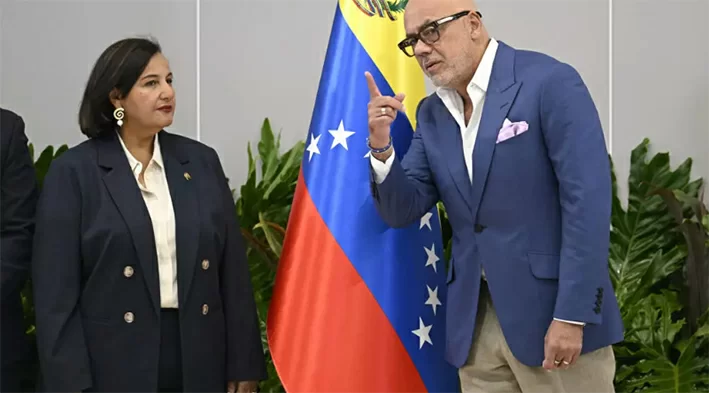
Seven months after U.S. military intervention ousted former Venezuelan president Nicolás Maduro and installed an interim government led by Delcy Rodríguez under close Washington oversight, long-awaited political negotiations between the acting administration and a faction of the country’s opposition have finally launched in Caracas, following nearly a week of postponement, representatives from both sides confirmed this week.
The talks, which are being hosted at the La Carlota military base with restricted media access allowing only photojournalists on site, are framed as a first step toward overhauling Venezuela’s political system and laying the groundwork for long-delayed democratic elections, ending a years-long period of crippling political and economic crisis that has left the South American nation deeply divided.
A notable absence from the negotiation table is Maria Corina Machado, the popular opposition leader and Nobel Peace Prize laureate who currently lives in exile and was not extended an invitation to participate. Machado claimed that U.S. President Donald Trump blocked her planned return to Venezuela to join the talks, an allegation Washington has repeatedly denied. Despite being sidelined, Machado has said she will not obstruct the dialogue process, and expressed hope the talks would deliver a full democratic transition for her home country.
The opposition negotiating delegation is led by Dinorah Figuera, a former opposition lawmaker who returned to Venezuela from exile this week. Figuera heads the opposition bloc that won a majority in the 2015 National Assembly election, the last vote widely recognized as legitimate by the international community. Upon arriving at Caracas’s international airport, Figuera told local broadcaster Televen that her core priority is the official launch of an open dialogue process aimed at restoring fully functional democratic institutions to Venezuela.
Her key demands include sweeping reforms to Venezuela’s Supreme Court and National Electoral Council, two bodies that drew widespread international criticism for validating Maduro’s contested 2024 re-election, a result the opposition rejected at the time, alleging widespread voter fraud and claiming victory for their own candidate.
Representing the interim government is Jorge Rodríguez, current president of the National Assembly and brother of interim leader Delcy Rodríguez. The official negotiating agenda covers a range of pressing domestic issues, including ongoing recovery efforts following the devastating dual earthquakes that struck the country on June 24, which killed more than 6,000 Venezuelans. Other topics on the table include strengthening democratic safeguards and expanding protections for political rights across the country.
The U.S. Department of State, which backs the negotiation process, has welcomed the launch of face-to-face talks between the two sides. “These direct discussions present a unique opportunity to move Venezuela forward,” a State Department spokesperson said in a statement, calling on all stakeholders to support efforts to deliver tangible, positive outcomes for the Venezuelan people. The spokesperson emphasized Washington’s commitment to supporting national stabilization, economic recovery, political reconciliation and a peaceful democratic transition in the country.
Trump has repeatedly publicly praised the interim government’s efforts to open Venezuela’s critical mining, electricity and oil sectors to foreign and private investment, a policy shift aligned with U.S. economic interests in the region. Writing on social platform X, Machado noted that a successful democratic transition would restore freedom and prosperity to Venezuelans, and turn the country into a “vital and reliable partner for U.S. national security and regional stability.” She added that “the Venezuelan people are enthusiastic and ready” for long-awaited political change, a sentiment widely shared across much of the country after years of ongoing crisis.