New preliminary data released by the Algemeen Bureau voor de Statistiek (ABS) confirms that construction sector costs in Suriname have continued their upward trend through the second quarter of 2026, marking one of the steepest year-over-year increases in recent years.
Compared to the same three-month period in 2025, average construction prices climbed 7.3% in the second quarter of 2026. When measured against the first quarter of 2026, prices also rose by a steady 1.4%, according to the bureau’s latest Construction Price Index report published August 7, 2026.
The ABS’ Construction Price Index is designed to track average price fluctuations for a standardized basket of materials, goods, and services required across three core construction segments: residential home building, non-residential utility construction, and civil engineering projects. To generate the most accurate reading of current market conditions, the index draws on price data collected from roughly 50 construction firms operating across Paramaribo and Wanica, covering 107 distinct products and services grouped into 16 main categories.
Detailed index breakdowns reflect the consistent upward trajectory of construction costs: the index climbed from 1236.9 points recorded in the first quarter of 2026 to 1253.7 points by the end of the second quarter, matching the 1.4% quarter-over-quarter and 7.3% year-over-year growth rates reported by the ABS.
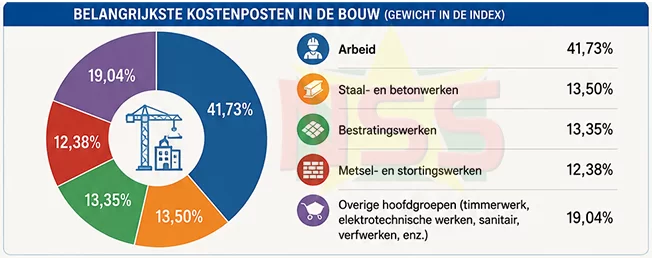
When broken down by cost category, labor accounts for the single largest share of total construction expenditure by a wide margin, holding a 41.73% weighting in the overall index. Following labor, the next biggest cost drivers are steel and concrete works at 13.50%, paving works at 13.35%, and masonry and concrete pouring works at 12.38%. Because these four segments make up more than 80% of total construction costs combined, shifts in their pricing have an outsized impact on the overall index trend.
Industry analysts warn that sustained rising construction prices will ripple through both private and public construction segments across the country. For private households, higher input costs will almost certainly translate to elevated prices for newly built residential properties, as well as higher quotes for home renovation projects. For public sector stakeholders, increasing construction costs will put additional budget pressure on infrastructure projects, including public road upgrades, new school construction, and the development of other core public amenities.