For years, Suriname has laid out a clear national goal: transitioning to a modern, fully digital economy. The country’s commercial banks have poured resources into developing new electronic payment platforms, the Central Bank has actively promoted non-cash transaction circulation, and public outreach campaigns have repeatedly encouraged Surinamese society to reduce its reliance on physical cash. This trajectory makes solid economic sense: cutting cash usage brings a long list of public and private benefits, from improved financial security and greater transaction transparency to lower logistics costs for cash transport and more efficient overall payment processing.
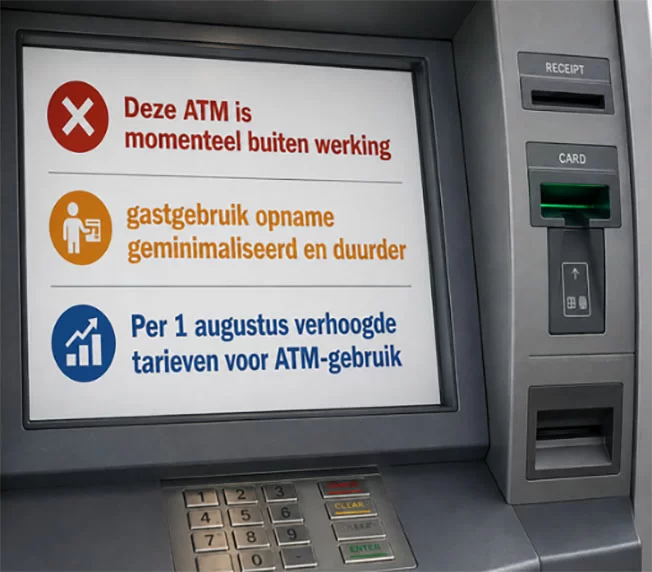
It is for this very reason that local banks’ recent decision to once again raise user fees for automated teller machine (ATM) transactions stands as a puzzling, counterproductive step that runs directly against the nation’s digitalization ambition. The issue is not whether ATM operating costs justify price adjustments — maintaining, securing and managing a nationwide ATM network does require consistent capital investment. The core problem is that this policy misaligns with the broader goal of moving Suriname toward a less cash-reliant financial system.
Human behavior is inherently shaped by financial incentives, and higher ATM costs will inevitably drive predictable changes in how people access and use their money. When frequent cash withdrawals become more expensive, most consumers will adapt by withdrawing larger sums of money less often. Once that cash leaves the formal banking system, it stays in circulation as physical currency held in personal wallets, household savings and retail cash registers, rather than flowing back into digital transactions. Ironically, the push to raise ATM fees is likely to result in *more* physical cash in active circulation across the country — the exact opposite outcome that banks and policymakers have worked for years to achieve.
A successful shift to a digital financial system requires not just affordable services, but reliable access to financial infrastructure that the public can trust. Long before the latest fee hike, most Surinamese already knew the widespread frustration of broken or overcrowded ATMs, especially around monthly salary payment periods. Consumers often wait in lengthy queues only to find that the machine is out of service or cannot process their transaction. Now that withdrawals cost more, consumers who do find a working ATM are even more motivated to take out large lump sums rather than make multiple smaller withdrawals. This only reinforces cultural reliance on physical cash, pushing the country further from its digitalization goal.
The fragmented pricing structure for cross-bank ATM use amplifies this problem. Even though Suriname has a formal nationwide ATM network, many consumers do not experience it as a unified, accessible system. Customers who withdraw cash from an ATM operated by a bank other than their own are already charged a premium rate. This leads people to travel out of their way to use an ATM from their own bank, even if another machine is located just around the corner. The result is longer wait times at popular machines, unnecessary vehicle traffic that increases carbon emissions and congestion, and inefficient underutilization of the country’s existing ATM infrastructure.
Beyond rolling back the recent fee increase, a broader reevaluation of the incentives Suriname is creating for its citizens is long overdue. If the official national goal is to accelerate the adoption of digital payments, the system must make digital transactions an attractive, simple and reliable option for ordinary people, not penalize cash access in ways that backfire.
This requires strategic investment across the financial sector: fully functional, well-maintained ATMs that work consistently when people need them, stable digital payment infrastructure that can handle widespread use, and a regulatory framework that does not discourage consumers from participating in the formal, non-cash financial system. After all, a digital economy is not built by raising barriers to access for ordinary people — it is built by earning public trust and making digital options the clear, beneficial choice for daily use.
The responsibility to correct this misalignment does not fall only on Suriname’s commercial banks. The national government and the National Assembly also have key roles to play in ensuring that policies to promote digital financial flows actually deliver on their intended goals. Real progress requires a payment ecosystem where convenience, reliability and affordability work in tandem, not against each other. Only when ordinary Surinamese consumers experience digital payments as the easiest and most cost-effective option for daily transactions will physical cash gradually recede into the background of the national economy.