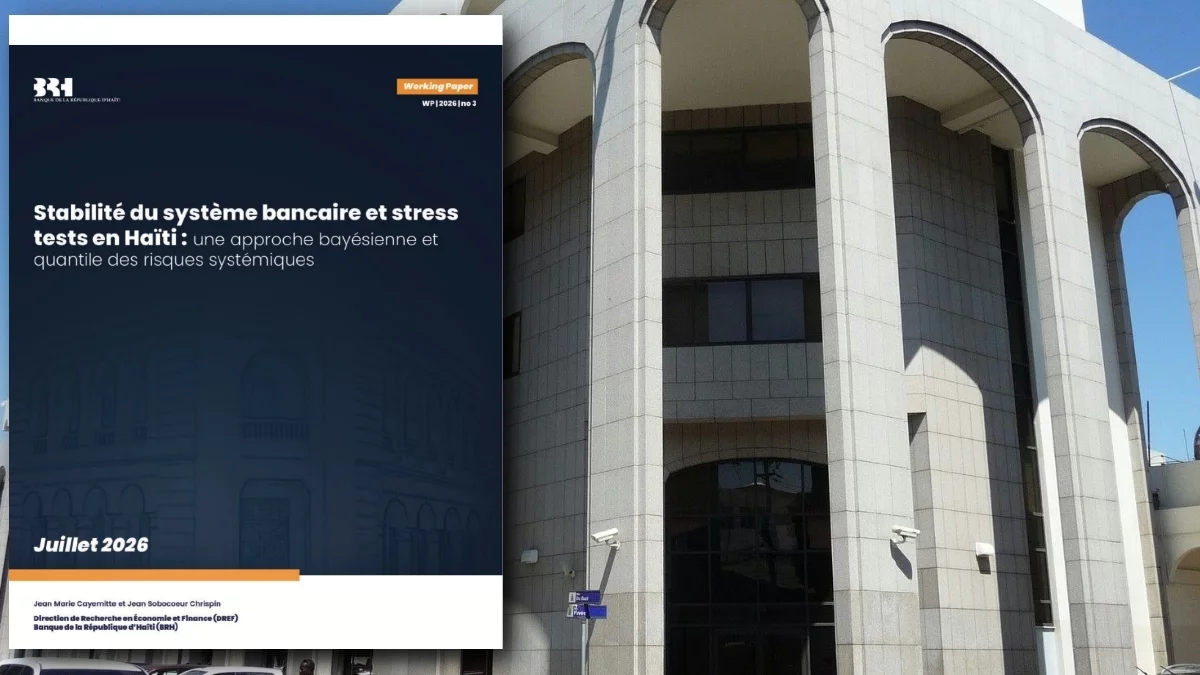
The Central Bank of Haiti (BRH)’s Research Directorate in Economics and Finance has released a groundbreaking new working paper that applies advanced analytical methods to assess the long-term stability of Haiti’s banking system, filling a critical gap in localized financial risk research for the Caribbean nation.
Authored by economists Jean Marie Cayemitte and Jean Sobocoeur Chrispin, the paper — titled *Banking System Stability and Stress Tests in Haiti : A Bayesian and Quantile Approach to Systemic Risks* — introduces a customized framework for measuring how the country’s banks hold up against the unique array of shocks that have shaped Haiti’s economy over the past two and a half decades. Drawing on comprehensive historical data spanning from 2000 to 2024, the researchers tested the system against five persistent, high-impact challenges that regularly threaten Haitian financial stability: sustained high inflation, sudden exchange rate fluctuations, broad economic contraction, prolonged political instability, and natural disasters that often cripple national infrastructure.
The study’s core findings strike a cautious balance: while Haiti’s banking system has demonstrated enough inherent strength to absorb moderate individual shocks without systemic collapse, it remains significantly vulnerable when multiple vulnerabilities overlap. Combined macroeconomic instability, paired with longstanding institutional gaps, creates outsized risk of widespread banking distress that policy makers have historically struggled to prepare for.
Building on these results, the research team outlines clear, actionable recommendations for regulators. They emphasize that regular, rigorous stress testing — rather than periodic, ad-hoc assessments — is non-negotiable for tracking emerging risks. They also call for evidence-based regulatory oversight that is tailored to the specific dynamics of Haiti’s economy, rather than adopting one-size-fits-all frameworks designed for more stable economies. Finally, the authors argue that regulators must require financial institutions to maintain dynamic prudential capital buffers that adjust to changing economic conditions, growing during expansionary phases to build resilience for inevitable downturns.
As the opening quote of the paper notes: “Financial stability depends on our ability to understand risks, anticipate shocks, and continuously adapt our monitoring tools.” This research answers two long-unresolved questions for Haitian financial policy: how to accurately measure banking system resilience amid recurring crises, and how to anticipate the impact of political upheaval, inflation surges, and sharp currency devaluation on the sector. The 34-page paper, published in French, is available for free public download via the HaitiLibre website, bringing transparent, open-access research to policy makers, banking stakeholders, and researchers across the region.