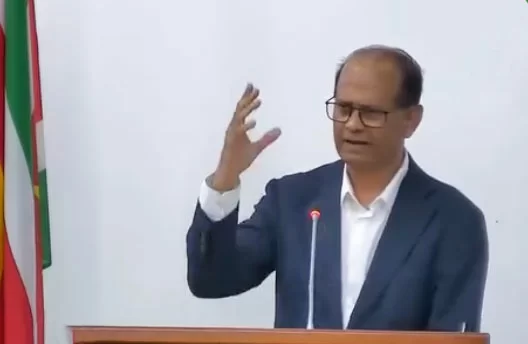
A planned trip by a delegation from Suriname’s De Nationale Assemblee (DNA) to a traditional community gathering (krutu) on Stoelmanseiland has fallen through at the last minute, triggering internal political friction over a draft border agreement with France. The public debate on the border protocol was already postponed last week to accommodate the gathering, but logistical and administrative hurdles kept the parliamentary delegation grounded in the capital Paramaribo.
Rabin Parmessar, leader of the NDP fraction and chair of the parliamentary committee overseeing the protocol, told local outlet Starnieuws that mandatory administrative pre-travel checks could not be completed on the extremely short timeline available for the trip. He emphasized that he refused to bypass formal DNA and government protocols to hastily arrange the visit, which was meant to give the committee observer status at the community discussions.
Parmessar also pushed back against criticism over the no-show, noting that the responsibility for fully updating border communities on the details of the border protocol rests first with the national government, not the national legislature. He added that the key traditional leader who requested the gathering, granman Bono Velanti, also ultimately did not attend the krutu, with only sub-chiefs and other traditional authorities taking part in discussions.
In contrast to the absent parliamentary delegation, Ronnie Brunswijk — chair of the ABOP party and vice-president of Suriname’s parliament — did attend the Stoelmanseiland gathering. Brunswijk publicly stated that Parmessar’s committee should have been present for the discussions, and confirmed that his ABOP party fraction will vote against the final border protocol with France.
Initial feedback from the krutu shows that attending traditional leaders and local residents still have a large number of unanswered questions about the agreement, and want full, detailed briefings before any further progress on ratification moves forward. Parmessar reiterated that the executive branch holds primary responsibility for organizing these information sessions and addressing community concerns.
“This gathering was convened by the granman, not the parliament. Preparations and outreach on the treaty are first and foremost a task for the government,” Parmessar explained, noting that the government is already working to compile answers for questions submitted by both border communities and DNA lawmakers.
The committee chair stressed that his panel has made broad community consultation a core priority throughout the multi-year process of finalizing the border agreement. Over both the previous and current parliamentary terms, the committee has traveled to multiple border river villages to document resident perspectives. “We cannot discuss border arrangements without consulting Indigenous communities. That has always been the starting principle for our committee,” he said.
Most community concerns do not center on the border line itself, but rather on the impacts of enforcement once the protocol is ratified, Parmessar explained. Local residents fear that French authorities will implement stricter controls along the Marowijne River, which would disrupt daily cross-border travel, small-scale artisanal gold mining, and other routine local activities that sustain border communities.
Parmessar clarified that the draft agreement is built on the previously agreed midline principle for border demarcation, and preserves free movement for residents on both sides of the river. The protocol also creates a special border pass that will allow community members to continue moving between the two countries for daily life. He did note, however, that the agreement will maintain prohibitions on illegal activity including smuggling and other criminal acts, consistent with existing rules.
Last week, DNA postponed its formal debate on the draft protocol after Bono Velanti requested that lawmakers first hold direct consultations with affected traditional authorities before moving to a vote.