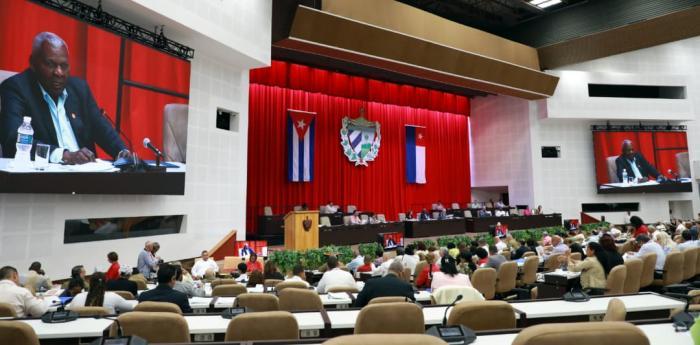
HAVANA – The 7th Ordinary Session of Cuba’s National Assembly of People’s Power (ANPP), the country’s highest legislative body in its 10th Legislature, entered its second day of deliberations on Thursday, July 30, 2026, with a packed agenda centered on updating the island nation’s legal framework and advancing core governance and economic priorities.
The session launched the previous day with notable participation across Cuban leadership: Army General Raúl Castro Ruz, leader of the Cuban Revolution, joined the opening proceedings via video conference, while Miguel Díaz-Canel Bermúdez, First Secretary of the Central Committee of the Communist Party of Cuba and President of the Republic, attended the session in person.
One of the opening day’s first formal actions was the swearing-in of 10 newly elected deputies, who will fill vacant legislative seats representing municipalities across Cuba. The new representatives bring diverse professional backgrounds to the national legislature: Alejandro Redondo Ramos, legal director of the ANPP, takes office for San José de las Lajas; Rosabel Gamón Verde, Cuba’s Minister of Justice, will represent Jobabo; Asbel Quintana Siveira for Bayamo; Yoandry Águila Molina for Abreus; Yury Triana Velázquez for Madruga; Yudixa Sarmiento Rodisio, secretary of the Health Workers’ Union, for Pedro Betancourt; William Licourt González, secretary of the Agricultural Workers’ Union, for Consolación del Sur; Jorge Legañoa Alonso, president of Prensa Latina news agency, for Rafael Freyre; Zulma Pila Gálvez for Havana’s Regla municipality; and Elvis Norys Castillo Morales for Amancio Rodríguez. The appointments follow procedures laid out in Cuba’s Electoral Law to fill legislative vacancies.
Lawmakers also advanced a high-impact rule change on opening day, voting to repeal Law No. 183, enacted in December 2025 and officially titled the Law for the Exceptional Reduction of the Current Term of Office of the Municipal Assemblies of People’s Power. The repeal reverses the previous law’s adjustment to municipal delegate term lengths, restoring the five-year term mandate written into the Cuban Constitution. Legislative officials confirmed that all municipal delegate terms will now proceed along the original five-year timeline, with scheduled elections for municipal delegates and national deputies set to take place in 2027 as planned.
Another central topic of the opening day deliberations was a progress update delivered by Manuel Marrero Cruz, member of the Political Bureau and Prime Minister of Cuba, on the organizational rollout of national Economic and Social Transformations. The update, part of the 2026 Government Program, allowed deputies to review the actions implemented since the program’s approval and align on upcoming priorities for execution.
Deputies also received a briefing on the execution of Cuba’s State Budget for the first half of 2026, and formally approved the 2025 budget settlement report submitted by Vladimir Regueiro Ale, Minister of Finance and Prices, alongside a corresponding review report from the ANPP’s Economic Affairs Committee.
In additional legislative action on Wednesday, parliamentarians passed the new Agricultural and Forestry Land Law, introduced by Ydael Pérez Brito, Cuba’s Minister of Agriculture.
As the session continues Thursday, lawmakers are set to deliberate on four landmark pieces of legislation that form a core part of Cuba’s ongoing national initiative to update and modernize its legal system: the Law on the Organization of the Central State Administration, the new Housing Law, a revised Labor Code, and the Law on the Identity and Domicile System.