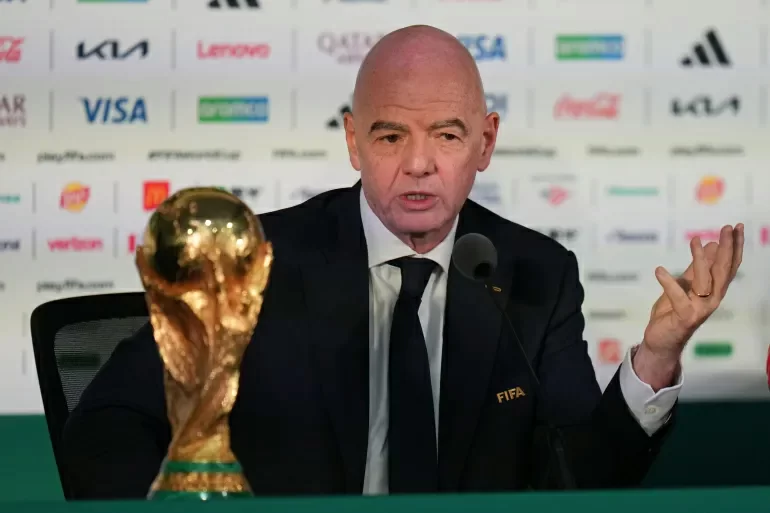
Just weeks after the final whistle of the 2026 expanded 48-team FIFA World Cup, which was lifted by Spain following a tense final win over Argentina, football’s global governing body finds itself mired in a fresh firestorm over a radical new proposal that threatens to reshape the future of the world’s biggest sporting tournament. FIFA president Gianni Infantino has put forward a plan to sell minority stakes in future World Cup editions and other FIFA events to private investors, a move that has drawn fierce condemnation from across the football ecosystem, including from his own predecessor, European football’s governing body UEFA, and Britain’s new prime minister. Even talk of a full UEFA boycott of FIFA tournaments is now on the table as critics warn the plan risks selling football’s soul to profit-driven external interests.
At the core of the proposal is the creation of a $20 billion subsidiary, FIFA Forward Enterprise (FFE), which will take over management of the World Cup and other top FIFA events. FIFA says it will retain a majority stake in FFE, keeping full control over all sporting decisions, tournament regulations, fixture schedules and governance of the sport. Up to $4.2 billion would be raised through the sale of minority shares to outside private investors, with U.S. venture capital firm Thrive Eternal—founded by Joshua Kushner, brother of Donald Trump’s son-in-law Jared Kushner—lined up as the potential leader of the investor group.
FIFA frames the plan as a natural extension of its existing revenue model, which already generates billions annually from broadcasting rights, sponsorship deals and commercial partnerships. The organization argues that all net proceeds from the share sale will be reinvested back into global football development, from grassroots amateur programs to elite international competitions, lifting the sport across all member nations. “Football is the most popular sport in the world. Some parts of the game have turned that popularity into enormous commercial value. We celebrate that success and want it to continue, because it lifts the entire sport to a higher level,” Infantino said in a statement defending the plan.
Infantino has given FIFA’s 211 global member associations a deadline of September 19 to approve the proposal, which includes a one-time $20 billion payout as part of the deal. He has described the creation of the $20 billion subsidiary as a “unique financing opportunity” and said he is fulfilling his duty to put the plan before FIFA’s membership for a vote.
But critics have lined up to reject the proposal outright, arguing it crosses a fundamental line by turning the cultural institution of the World Cup into a tradeable commodity for profit. Leading the condemnation is former FIFA president Sepp Blatter, who led the organization for 17 years until 2015, when he was replaced by Infantino. Blatter called the plan unthinkable during his tenure, warning that turning FIFA into a profit-focused enterprise will strip it of its core purpose.
“Football does not belong to any individual, nor to any institution. It belongs to the people,” Blatter told Reuters. “The World Cup is not commercial property for a handful of administrators. It is part of the cultural heritage of global football. FIFA is the guardian of the World Cup, not its owner. Modern football has survived for more than a century because it belongs to the people. That principle must never change.” Blatter added that profit-seeking investors with demands for influence are fundamentally at odds with the interests of FIFA’s member associations, arguing the plan would destroy the soul of the game.
UEFA, the European football confederation that counts 55 of FIFA’s 211 member associations, has issued an equally sharp rebuke, saying the proposal crosses a red line that football authorities should never cross. “The soul and governance of football are not trade goods, especially not without transparency over who will benefit financially. Nobody owns football. It is not FIFA’s to sell,” the organization said. UEFA will hold an emergency meeting later this week to discuss the proposal, and a boycott of FIFA tournaments is being floated as a possible response.
Britain’s newly appointed prime minister Andy Burnham has also added his voice to the criticism, writing on social media: “Football does not belong to investors, it belongs to the fans who fill stadiums every week. The World Cup is not a product, it is the biggest sports competition in the world, and it was never anyone’s to sell. If you sell a part of it, you have sold the whole of it. Football belongs to the fans, and it always will.”
Even CONCACAF, the confederation covering North and Central America and the Caribbean—host region for the 2026 World Cup—has raised concerns, saying it was not consulted on the plan and that the lack of transparency around the proposal is deeply worrying.
This latest controversy comes as criticism of FIFA’s recent decisions continues to simmer following the 2026 tournament. Even before the tournament kicked off, the biggest point of contention was exorbitant ticket and travel prices that priced out many average-income fans, continuing a long-running critique that FIFA prioritizes corporate revenue over supporter access. During the tournament, Infantino’s decision to suspend a red card issued to U.S. striker Folarin Balogun drew fierce pushback from UEFA, which said the move undermined the competitive integrity of the tournament. Even the mandatory hydration breaks introduced for the 2026 edition were criticized as commercially motivated interruptions that disrupted the flow of matches.
FIFA has drawn parallels between its proposed model and existing minority stake frameworks used in other professional sports, most notably cricket. England’s The Hundred competition, run by the England and Wales Cricket Board, sells minority stakes to investors while retaining central governance control, a structure similar to what FIFA has proposed. The Indian Premier League, which pioneered the franchise equity model in 2008, has seen its total valuation rise more than 11% this year to $20.6 billion, a growth success that FIFA appears to be aiming to replicate. Still, analysts point out that even minority shareholders almost always demand some level of input into strategic decisions—a reality that lies at the heart of critics’ concerns that outside investors will eventually reshape football governance to prioritize returns over the sport’s cultural and social mission.
With Europe accounting for just over a quarter of FIFA’s voting members and having produced six of the last eight World Cup winners, a coordinated rejection from UEFA could derail Infantino’s plan. As the football world braces for the September vote, the future of the World Cup as a global public sporting institution hangs in the balance.