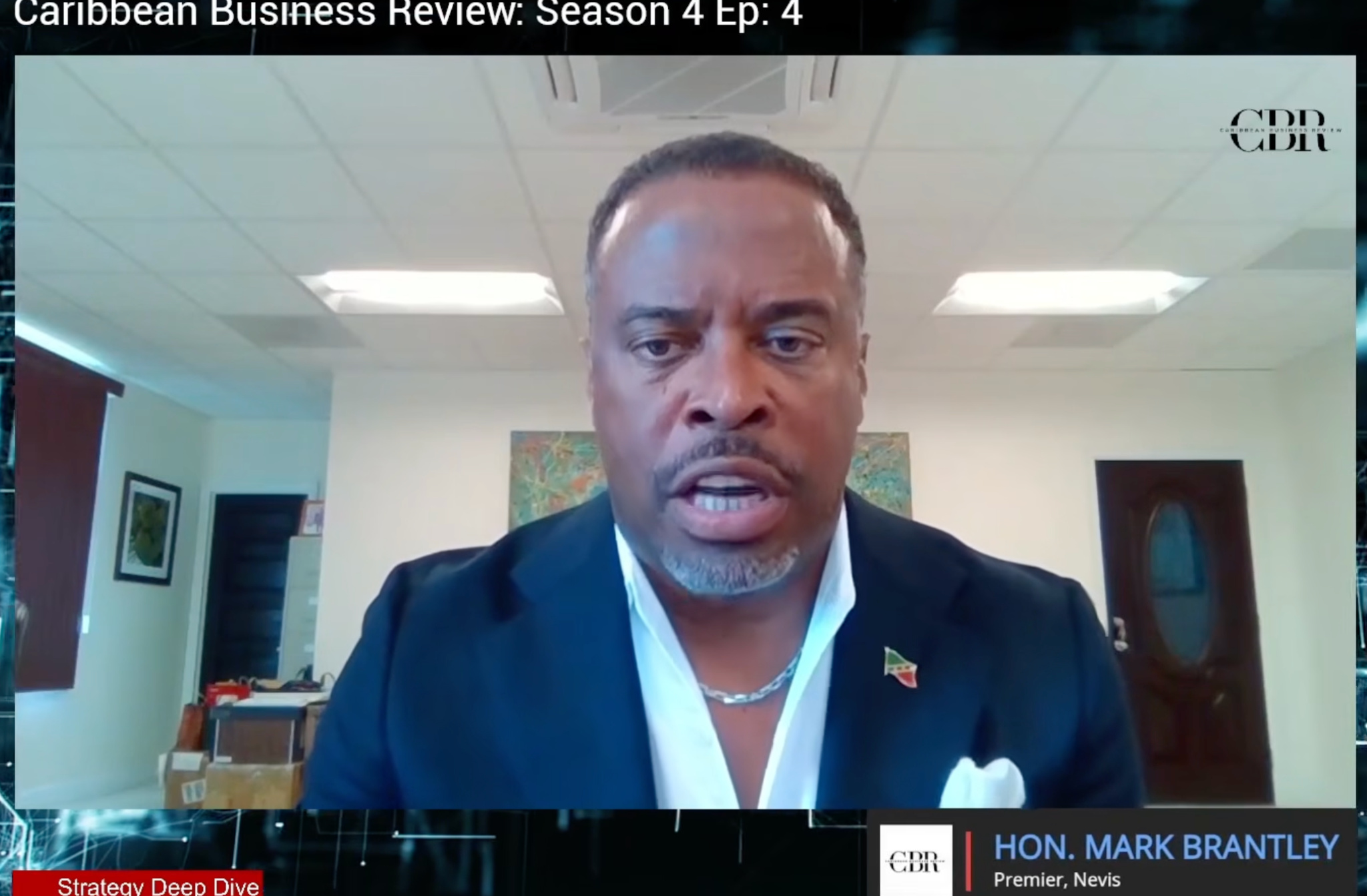
The European Union’s demand that five Eastern Caribbean nations end their Citizenship by Investment (CBI) programs has sparked a push for collective regional action, with Nevis Premier Mark Brantley arguing that Antigua and Barbuda Prime Minister Gaston Browne should not face the bloc alone. In a wide-ranging interview with Caribbean Business Review, Brantley laid out a case for coordinated pushback through existing regional bodies, warning that the loss of CBI revenue poses an existential threat to small island economies across the Eastern Caribbean.
Five Caribbean nations – Antigua and Barbuda, Dominica, Grenada, St. Kitts and Nevis, and St. Lucia – currently run CBI initiatives that grant citizenship to qualifying foreign investors in exchange for economic contributions. According to interview host Joseph Cox, the EU delivered an official correspondence to all five countries on June 25, setting a firm June 1, 2028 deadline for the permanent discontinuation of these programs. Browne has already publicly rejected the EU’s demand, stating that Antigua and Barbuda will not shut down its program until the bloc presents viable plans to replace the billions in lost annual revenue the initiative generates for the country.
Brantley expressed full alignment with Browne’s opposition to the EU mandate, but emphasized that individual nations carry far less negotiating weight when facing large global blocs like the EU alone. “I do not believe that Prime Minister Gaston Browne should be speaking for Antigua and Barbuda by himself,” Brantley noted. “What we should see is the OECS having a clear position in relation to this. What we should see is CARICOM stepping forward to tell the EU that this is an existential threat to some of our member states, and that we are ready to negotiate this as a collective.”
Currently, only Browne has taken a public, forceful stance against the EU’s demand, while the other four CBI-operating countries have remained largely silent on the issue. Brantley pushed back against framing the revenue loss as a mere strategic risk, arguing that it would upend economic stability across the region. All five affected nations rely on CBI inflows to fund critical public services and infrastructure, with dependence ranging from moderate to severe across the group. “In every country there is a high degree of dependence on citizenship-by-investment inflows,” Brantley explained. “We have a crisis on our hands because the question then would be, what do we do to substitute for that loss of revenue?”
A key point of criticism from Brantley was the omission of the CBI dispute from the agenda of the most recent CARICOM Heads of Government meeting, a gap he called a major cause for concern. He pointed to the widespread regional collective support extended to Guyana amid its ongoing territorial dispute with Venezuela as evidence that CARICOM has a precedent of rallying around members facing external threats to their stability.
Brantley argued that small sovereign Caribbean states face inherent practical limitations when negotiating independently with larger global powers. While Caribbean nations hold sovereign status and representation at the United Nations, he noted that their small size leaves them at a structural disadvantage. Echoing a natural analogy, he argued that unity is the only path to survival: “A great white shark may swim alone, but if you have minnows that swim together, their chances of survival are enhanced when they do that. We already have the regional institutions and infrastructure to speak with one voice on this issue.”
Moving forward, Brantley proposed a two-pronged strategy for the region: first, OECS member states should collectively request extended deadline from the EU beyond the current 2028 timeline, arguing that a longer transition is more reasonable than a earlier phase-out. Second, the region must accelerate efforts to diversify its economies away from heavy reliance on CBI revenue, shifting CBI models to prioritize value-added investment rather than just expanding the number of new program entrants.
Brantley identified renewable energy development as a core pillar of economic diversification that can reduce Caribbean vulnerability to global energy shocks. He highlighted Nevis’ largely untapped geothermal energy potential, noting that the island could eventually export low-cost clean electricity to neighboring islands including Antigua and Barbuda. This shift would reduce regional dependence on imported fossil fuels, insulating local economies from global price volatility caused by geopolitical conflicts in major energy producing regions.
In addition to renewable energy, Brantley called on regional governments to deepen engagement with the Caribbean diaspora, tapping into the community’s capital, expertise, and business development experience to drive new economic growth. He emphasized that Caribbean nations cannot rely on external powers to solve their economic challenges, warning that the global operating environment for small states is only growing more difficult. “Nobody’s coming to save the Caribbean,” Brantley said. “We have to save ourselves.”
Brantley concluded by reaffirming that individual claims to sovereignty do not make up for the increased negotiating power that comes with collective action. “A collective approach is a far better approach, particularly when we’re dealing with middle and large powers,” he said. “Our leverage is much, much better when we engage together.” He closed by repeating his regret over the omission of the CBI issue from the recent CARICOM agenda, calling the gap a failure that regional leaders must correct at their next summit.