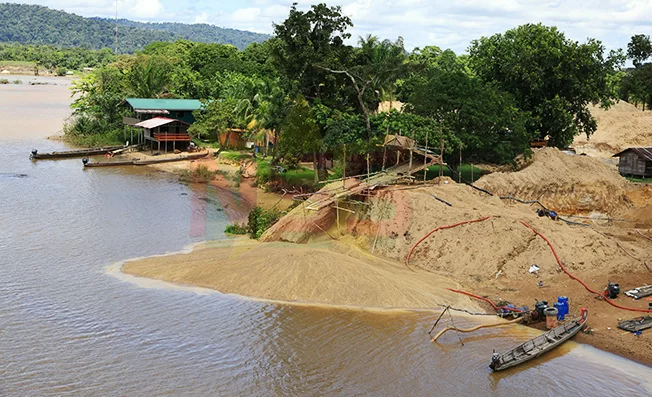
Along the Marowijne River, which forms a disputed border between Suriname and French Guiana (an overseas department of France), an unfolding environmental disaster is raising urgent alarms from French authorities, indigenous communities, and scientific bodies. More than five years after Suriname signed a 2021 border agreement for the river, the country has yet to ratify the deal, leaving the river’s hundreds of islands and unclarified border zones as safe havens for criminal networks and unregulated gold prospectors.
On the Surinamese side of the river, illegal gold miners are poisoning ecosystems with mercury and causing irreversible destruction to riverbanks and island habitats, according to on-site inspections and data gathered by French enforcement agencies. During an aerial survey organized by EMOPI – the French Guiana-based mining police unit – the scale of the damage was laid bare: miners use heavy machinery to strip riverbank terrain and rely on mercury to extract gold, leaving behind excavated shorelines, toxic standing water, widespread erosion, and heavily contaminated river water that crosses the unmarked border into French territory.
Sébastien Linares, EMOPI’s project manager based in Cayenne, explained that after Suriname dismantled 30 illegal mining barges (known locally as skalians) in 2022 – the last major crackdown on the activity praised by French authorities – prospectors simply shifted operations to Surinamese riverbanks, inland areas, and unclaimed river islands. By 2023, Linares’s team counted at least 37 active shoreline mining sites and 9 exploited islands, some of which have been in continuous operation since 2019. Today, just two to three small illegal barges remain active opposite the Gran Santi region of French Guiana.
Mercury contamination from the mining has emerged as a major public health time bomb for communities on both sides of the border. French public health officials regularly test hair samples from French Guiana residents to track mercury exposure, and have recorded a 25% increase in contamination levels in the most remote river communities since 2005. The average mercury concentration measured in residents of the Upper Marowijne region currently sits at 12 μg/g – exceeding the World Health Organization’s (WHO) safety threshold of 10 μg/g, and far outstripping the 1.5 μg/g limit French authorities set for children. This discrepancy led French Ambassador Nicolas de Lacoste to summarize the cross-border harm with the quip: “You get the gold, we get the mercury.”
Indigenous Wayana communities in southeastern Suriname are facing even more extreme contamination, documented through their own community-led monitoring program, the Wayana Biocultural Monitoring System. Jupta Itoewaki, an indigenous rights activist working with the program, shared that local tests have recorded mercury levels up to 8,469 times the WHO safety limit, and arsenic levels as high as 4,623 times the accepted standard. Wayana residents are exposed to these toxins daily through contaminated drinking water and food sources, but Itoewaki notes that the Surinamese government has failed to conduct systematic medical monitoring of affected communities, calling the state itself a contributor to the crisis.
Itoewaki added that illegal mining activity has grown visibly across southeastern Suriname along both the Marowijne and Lawa Rivers, with prospectors including Brazilian garimpeiros (artisanal miners), Surinamese nationals, and criminal actors operating from the French side. Supply chains for the illegal operations are largely run by Chinese business owners along the Surinamese riverbank, who operate stores catering exclusively to mining needs. When French authorities conduct raids on illegal sites, miners simply retreat across the unclear border to Suriname to resupply before returning to the region.
France has already enacted strict regulations to limit mining harm on its side of the river: all legal gold mining requires a strict permit that limits operations to a maximum 25-hectare area for just four years, and requires full ecological restoration of mining sites – including returning soil, waterways, and vegetation to their original pre-mining state – before operations can conclude. Mining police maintain continuous inspection authority to enforce these rules. However, French officials say the lack of action from Suriname and the unratified border agreement have rendered cross-border enforcement ineffective, describing current efforts as “mopping with the tap left open.”
Ambassador de Lacoste told reporters that urgent coordinated cross-border action is needed to protect the river’s unique ecosystem and the communities that depend on it. The French Scientific Council for the Amazon Park has also joined the call for immediate intervention, noting that contamination already affects more than 300 populated areas on the French side of the border. Ratification of the 2021 border agreement would not immediately end illegal mining, de Lacoste acknowledged, but it would establish a formal joint governance body – the Maroni River Council – and create the legal framework needed for coordinated enforcement against illegal activity. Once borders are clearly demarcated, authorities can crack down on the criminal networks that use unclaimed islands as bases for operations, he added.
Beyond illegal mercury mining, Itoewaki warns that the Wayana community now faces a new environmental threat: large-scale industrial mining permitted by the Surinamese government that would use cyanide for extraction. The Surinamese government has awarded a 102,000-hectare concession to a Canadian mining company on traditional indigenous territory, a move that is legal under Surinamese law but violates the Inter-American Court of Human Rights’ 2015 ruling requiring Suriname to obtain free, prior, and informed consent from indigenous communities for development on their lands. Itoewaki says the community’s traditional leader was only informed after the concession was granted, without translation or input into the decision.
For the Wayana, ratification of the border agreement is a necessary first step to curb cross-border illegal activity, but not a complete solution. Itoewaki argues that a bilateral agreement negotiated without including the Wayana as legitimate territorial authorities repeats the patterns of colonial control that created the current crisis. “We call for ratification of the protocol, but it must also be paired with formal recognition of our land rights,” she said. “Without that, nothing will change for our river.”
French officials also note that cracking down on illegal gold mining would also help address broader cross-border crime, including human trafficking, drug smuggling, and contraband trade that thrives in the ungoverned border zone. France has offered to support Suriname in cutting off the illegal supply lines that sustain mining operations, but says progress cannot happen until the border agreement is ratified.