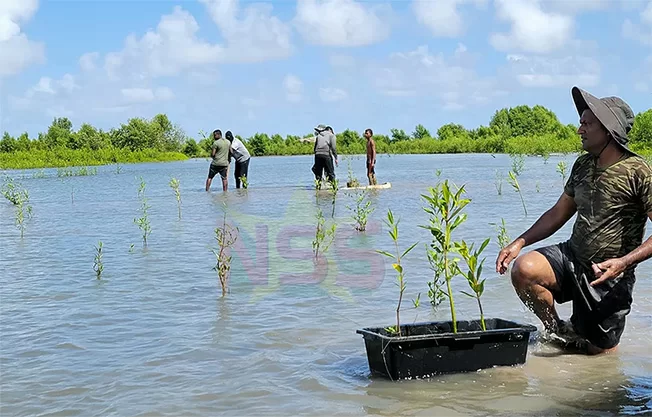
On July 26, the world observes annual World Mangrove Day, a moment that draws sharp focus to the extraordinary ecological, economic and social value of Suriname’s extensive mangrove forests – one of the largest and most ecologically critical mangrove ecosystems in the Caribbean and South American region.
Far more than just a belt of trees lining Suriname’s coastline, these unique intertidal forests deliver a wide array of irreplaceable benefits to the nation and its people. They act as a natural coastal barrier, slowing erosion and buffering inland communities from devastating storm surges and flooding. They serve as critical nursery habitats that support juvenile fish and hundreds of other wildlife species, underpinning the livelihoods and food security of thousands of small-scale fishers across the country. Perhaps most importantly in an era of accelerating climate crisis, mangroves sequester carbon far more effectively than many terrestrial forest types, helping Suriname absorb the impacts of rising sea levels and broader climate change.
Despite these critical benefits, Suriname’s mangroves face growing, multifaceted threats that are pushing these fragile ecosystems toward increasing degradation. Climate change-driven impacts including accelerating sea level rise, prolonged droughts and altered hydrological patterns have already caused measurable harm. On top of these natural stressors, unregulated human activity and inadequate ecosystem management have disrupted natural ecological processes across large swathes of mangrove habitat. Even previously robust, healthy mangrove stands are now showing signs of damage when water flow is blocked and emerging threats are not addressed in a timely manner, experts warn.
World Mangrove Day serves as a critical reminder that raising awareness alone is not enough to reverse these trends – tangible, coordinated action is urgently required. This means investing in science-based, sustainable mangrove management, developing clear long-term conservation plans, securing consistent and sufficient funding for protection and maintenance, and forging close collaborative partnerships between government agencies, ecological researchers and local coastal communities. Protecting mangroves is not just an environmental priority: it is central to Suriname’s public safety, food security and long-term economic stability. Safeguarding these ecosystems is equivalent to safeguarding Suriname’s future.
Recent, comprehensive research conducted at the Bigi Pan mangrove reserve in Nickerie – one of Suriname’s most important coastal protected areas – offers a actionable blueprint for effective conservation. The study documented strategies to restore degraded mangrove areas and strengthen protection for intact healthy forest, and put forward a series of evidence-based recommendations for improved management of Bigi Pan. These include deeper collaboration between stakeholder organizations, sustained adequate funding, regular ecological monitoring, stricter enforcement of existing conservation regulations, and expanded leadership roles for local communities that live in and around the reserve. The Bigi Pan project demonstrates that meaningful conservation outcomes are achievable when scientific expertise, indigenous and local knowledge, and proactive policy are aligned. The management and monitoring frameworks developed for Bigi Pan can now serve as a replicable model for other mangrove areas across Suriname’s coastline.
On this World Mangrove Day, the Anton de Kom University of Suriname and the Mangrove Forum Suriname are calling on the Surinamese government to elevate mangrove protection and sustainable management to a top national priority. To deliver meaningful progress, clear regulatory frameworks, defined institutional responsibilities, sustained public funding, and decision-making rooted in rigorous scientific research are all essential. Equally indispensable is the active participation of citizens and local coastal communities, who bear the closest connection to these ecosystems and depend most directly on their health.
The appeal extends beyond government: policymakers, researchers, civil society organizations, development partners and all people of Suriname are called on to unite around shared mangrove stewardship. Protecting these ecosystems is a collective shared responsibility for all stakeholders.
The future of Suriname’s entire coastline and the livelihoods of the communities that call it home are inextricably linked to the future of the nation’s mangroves. Without urgent action, Suriname will not only lose one of its most unique natural treasures: it will also face increasing damage from flooding and coastal erosion, declining fish stocks that threaten food security, and heightened national vulnerability to the impacts of climate change.
While public awareness is a critical first step, it is not sufficient to reverse current trends. Communities and individuals must speak up and contribute to decision-making that shapes the future of mangroves and the communities that depend on them. Now is the time for urgent action: the current rate of mangrove degradation must be slowed, and ultimately halted, to protect Suriname, its future generations, and all who rely on a healthy, resilient coast. Every person has a role to play, because the benefits of intact mangroves touch every member of Surinamese society.
This call to action is being amplified during the first ever Mangrove Run, held July 26, 2026 in Nieuw Nickerie. Far more than a recreational public event, the run serves as a collective call to action for all people to join the effort to protect Suriname’s mangroves. Mangroves belong to all of Suriname, their value stretching from the local coastline to global climate stability, and from the present day to the far future.
This statement is issued by Prof. dr. Sieuwnath Naipal, on behalf of the Anton de Kom Universiteit van Suriname and the Mangrove Forum Suriname.