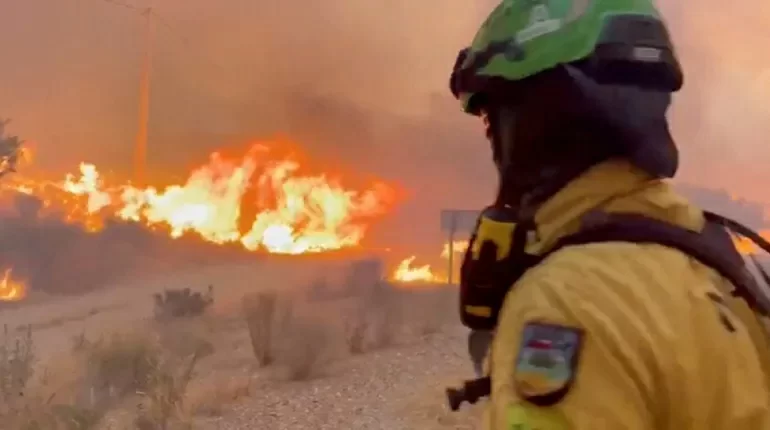
A new landmark study carried out by an international team of climate researchers has delivered a stark warning: human-driven climate change has drastically amplified drought conditions across Europe, and rising extreme heat — not falling rainfall — is the single leading cause of the continent’s record dry conditions. The research, published Thursday, confirms that warmer atmospheric temperatures have sharply increased the likelihood of severe drought and destructive wildfire outbreaks across the region.
Europe is currently grappling with one of its most severe drought events in recent history. In the wake of a historic heatwave that swept across the continent last June, countries stretching from Western Europe to Eastern Europe are facing parched rivers, mandatory water restrictions, and devastating wildfires that have burned thousands of hectares of land. The new research confirms that a warmer global climate accelerates moisture loss from soils, lakes, and river systems, dramatically raising the probability of extreme dry periods that overwhelm local adaptation capacity.
Mariam Zachariah, co-author of the study and a researcher at Imperial College London, emphasized the outsized role of rising temperatures in driving the current crisis. “Our results show that this drought is not primarily the result of low rainfall, but of a warmer atmosphere that creates far greater moisture deficits across land,” Zachariah explained. “Even in regions where rainfall has barely changed, or even experienced seasonal increases, drought risk still continues to climb.”
The mechanism behind this trend is rooted in basic atmospheric science: warmer air can hold more water vapor, with its moisture-holding capacity increasing by roughly 7% for every 1 degree Celsius of temperature rise. Since the pre-industrial era, global average temperatures have risen by approximately 1.4 degrees Celsius, a shift driven overwhelmingly by human greenhouse gas emissions from fossil fuel combustion.
Dominik Schumacher, a researcher at Switzerland’s ETH Zurich, outlined the dangerous feedback loop that turns mild dry conditions into catastrophic events. “Warm air dries out soils, which leads to even higher temperatures and even drier ground,” Schumacher explained. “This rapid drying also leaves land far more vulnerable to destructive wildfires once a spark ignites.”
To reach their conclusions, the research team compared historical weather data and modern climate model simulations of current conditions to a hypothetical pre-industrial world with 1.4 degrees Celsius lower average temperatures. The results were staggering: extreme dry soil conditions in Western Europe are now five times more likely than they would be without anthropogenic climate change, while in Eastern Europe that risk jumps to 11 times higher. For atmospheric evaporative demand — the atmosphere’s ability to pull moisture out of soils and plants — the risk in Western Europe during spring and early summer is an extraordinary 80 times higher than it would be in a pre-warming climate.
Zachariah noted that this increased atmospheric “thirst” has shifted the entire baseline for drought risk across the continent. “Because the atmosphere is now thirstier, a rainfall deficit that might not have caused drought in the past can now lead to far more severe drought conditions today,” she said.
The study’s findings underscore the urgent need for accelerated action to cut greenhouse gas emissions and strengthen adaptation measures to limit growing drought and wildfire risks across Europe and the rest of the world. As extreme heat events become more frequent and intense due to ongoing climate change, researchers warn that without immediate intervention, these catastrophic dry conditions will become the new normal for much of the continent.