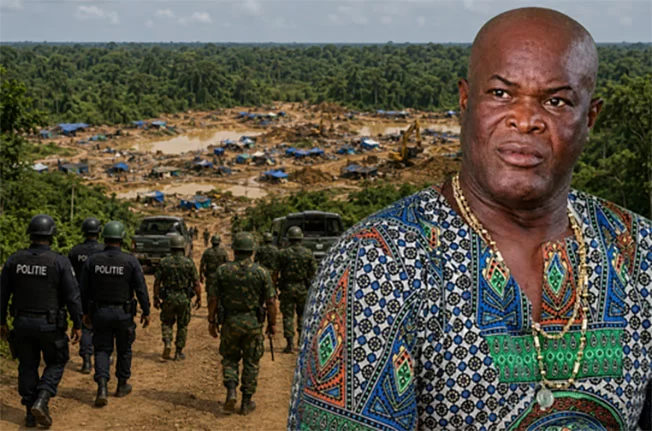
Some events carry far more weight than the official statements governments release to explain them. The July 14 security operation in Suriname’s Sarakreek region is one such case. The official account from Minister of Justice and Police Harish Monorath frames the joint police and military operation as a targeted raid on armed Chinese workers, claiming that Vice President of the National Assembly and ruling coalition ABOP leader Ronnie Brunswijk was merely a bystander who only informed authorities of the activity and happened to be in the area.
This narrative, however, directly contradicts the public footage and imagery that emerged in the wake of the operation. In those recordings, Brunswijk, not uniformed security forces, takes center stage, being cheered by crowds as if he personally led the mission to restore order. On social media, the public narrative never coalesced around an official state operation – instead, the dominant framing cast the event as a power play by a politician who also holds a gold concession, clearly positioning himself as the lead actor.
This public perception cannot be dismissed as an accidental coincidence of circumstances. Brunswijk wears multiple overlapping hats in Suriname’s gold sector: he leads a major coalition party, serves as the country’s parliamentary vice president, holds a large gold concession, and is the single most influential figure in the national gold industry. During the previous administration, he was even tasked with leading the government’s effort to formalize and regulate the sector. For him to be present on the ground during an armed state operation inside a gold concession, by its very nature, raises urgent political questions that cannot be ignored.
When a politician with massive personal economic stakes in a sector participates in an armed state operation within that same sector, the government is obligated to draw a crystal-clear line between political influence and the independent operations of police and military forces. To date, that clarity has not been provided.
An independent investigation into Brunswijk’s exact role is a necessity, given his high political office, his overlapping economic interests in gold, and his very public appearance as the celebrated “hero” of the operation. Beyond Brunswijk’s role, security forces must explain how the operation was planned, who issued operational orders, and why bystanders and unauthorized artisanal miners were apparently allowed to move freely through the operation’s camp during the action.
These questions have only grown more serious following a detailed reconstruction of background events released by the management of Sarakreek Resource Corporation. The company does not only confirm the presence of 16 Chinese workers and seized firearms; it lays out a years-long conflict over a 22,500-hectare gold concession. The claims include widespread illegal mining activity, an ongoing lawsuit against the Surinamese state, persistent security threats, stolen property, and individuals who operate as informal “landlords” in the region while openly claiming association with Brunswijk. These are serious, far-reaching allegations that demand full, independent investigation.
The Sarakreek incident is not an isolated outlier. It is just the latest in a long line of evidence proving that Suriname’s gold sector has operated outside effective state control for decades. Successive governments have launched commissions, announced formalization programs, and spent large sums of public money on regulation efforts. Years ago, a special commission was even created specifically to oversee gold sector reform, receiving substantial public funding – yet no tangible, verifiable progress toward a regulated sector ever materialized.
Illegal gold mining remains rampant, conflicts over overlapping concession claims are growing more frequent, and informal power structures continue to consolidate authority. In many mining regions, political connections carry more weight than official permits, court rulings, or government policy. This is a clear case of systemic governance failure: the Surinamese state has failed to establish sustained rule of law, state authority, and legal certainty across the country’s gold mining regions. This vacuum has allowed a parallel, unregulated system to emerge, where concession holders, illegal miners, local factions, brokers, speculators, and politicians all advance their own claims through informal power and competing influence.
The damage of this failure extends far beyond lost state revenue from gold sales. Unregulated mining has devastated local ecosystems through widespread deforestation, mercury contamination, and river pollution. Rural village communities have been torn apart by conflict, and traditional governance structures have been eroded. More often than not, access to mining territory is determined by wealth and violence, not legal right. Where state control is absent and huge volumes of gold and untraceable cash circulate, organized criminal activity has flourished. As a result, the broken gold sector is not just an economic liability for Suriname – it is a growing national security threat and a direct challenge to the country’s rule of law.
Without full transparency, and most importantly without genuine political will to reform the sector, “gold sector formalization” will remain nothing more than a buzzword governments use to signal progress, while the interior continues to operate by a separate, unregulated set of rules.
Real formalization requires difficult, deliberate choices. It means auditing and enforcing concession rights, ending all illegal mining activity, clearly codifying historical and traditional land rights, mandating public disclosure of political figures’ private economic interests in the sector, allowing police and military to operate independently of political influence, collecting owed taxes and royalties, enforcing environmental protection rules, and ensuring court rulings are enforced regardless of who holds the most local influence.
What unfolded in Sarakreek is far more than a conflict over a single gold concession. It is an indictment of a government that has allowed control of one of the country’s most important and economically sensitive sectors to slip away for far too long.