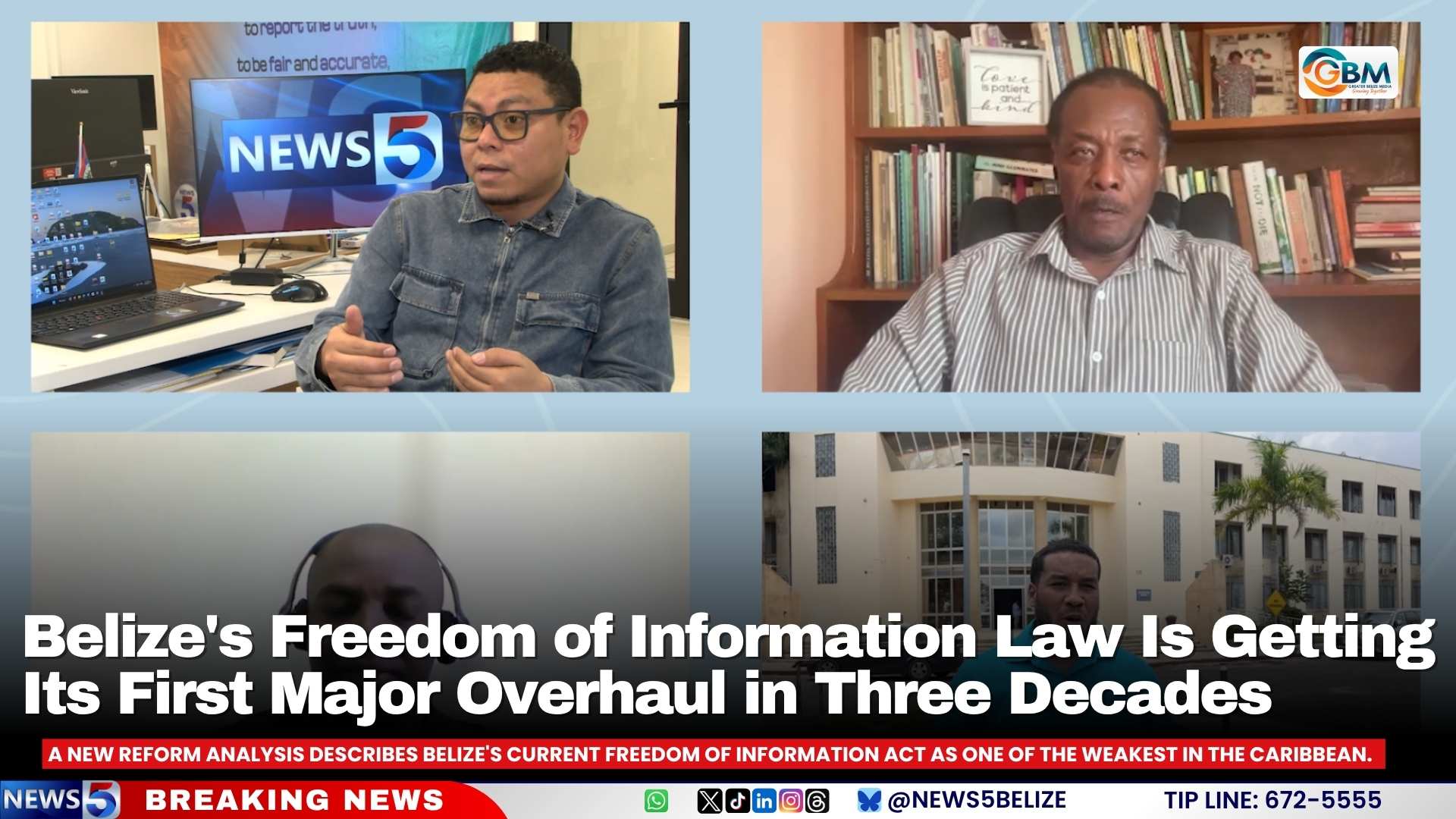
Three decades after Belize first enshrined a legal right for citizens to request government records, systemic flaws have left that right largely unfulfilled for countless journalists, activists and ordinary people. Now, the Belizean government is moving forward with the most substantial rewrite of the 1994 Freedom of Information Act (FOIA) in the law’s history, aiming to address chronic delays, overly broad exemption clauses and toothless enforcement that have blocked access to public information for generations.
When the original FOIA came into force, it established a formal process for citizens to seek access to government-held documents, from official spending reports to agency data to policy records. Under the current framework, any requester must submit a formal application to gain access to details the government has not published voluntarily, and relevant agencies are given two weeks to issue a response. In recent years, demand for public information has surged: Attorney General Anthony Sylvester notes that Belize is currently seeing the highest volume of FOIA requests in the law’s 32-year history.
That growing demand is being driven largely by watchdog groups and journalists, who rely on the FOIA to hold public officials accountable for public spending. Hipolito Novelo, Digital Editor at Greater Belize Media, has been filing public records requests for more than a decade, and he argues that all information tied to taxpayer funds, from contract awards to grant allocations, should be automatically available to the public rather than requiring individual requests. “Everything that has to do with the public purse, every taxpayer’s money, how contracts are awarded, how grants are awarded, that should be public information,” Novelo said, calling for every government ministry to launch a public portal that automatically publishes this data proactively.
But in practice, requesters face constant barriers to obtaining the records they are legally entitled to access. Agencies regularly deny requests by classifying documents as exempt, even when clear public interest favors disclosure, and multiple high-profile cases illustrate the scope of the problem.
Novelo personally encountered this block when he requested detailed records of COVID-19 vaccine spending from the Ministry of Health and Wellness. He left the process empty-handed: “I did not get what I asked for. The vast majority of it, I did not get from the Ministry of Health and Wellness.”
Public Service Union President Dean Flowers hit an identical wall in June 2026, when he requested financial records tied to two high-profile controversies: the Mira Millions affair and a Ministry of Defense procurement scandal. The Auditor General’s office refused to confirm whether it would review the case through the official Smart Stream accountability system, and declined to name the finance officers linked to the suspicious payment pattern in question.
Social activist Jerry Enriquez also faced denial when he sought records of government legal fees spent to defend recent constitutional cases. The Attorney General rejected his request on the grounds that disclosure would compromise ongoing litigation and pose what the government called “serious risk to the Government of Belize.” Even a 2025 request to the Ministry of Public Service for basic information about office space rental costs, filed by News Five journalist Paul Lopez, failed to produce the requested records.
Independent analysis of Belize’s current FOIA framework pulls no punches, labeling it one of the weakest freedom of information laws in the entire Caribbean. The analysis identifies multiple critical flaws: penalties for noncompliance that are too weak to deter agencies from ignoring requests, no independent oversight body to monitor compliance, no legal requirement to proactively publish contracts or spending data, and exemption categories so broad that agencies can hide almost any document they choose to keep secret.
Currently, all FOIA disputes are processed through the Office of the Attorney General. When an agency classifies a document as exempt, requesters can ask the Ombudsman to review the decision, and either party can bring the case to the High Court if they disagree with the outcome. But the Ombudsman’s authority is severely limited: the office can review complaints, but it cannot force agencies to release hidden records, and it has no power to bring criminal charges against officials who deliberately withhold information.
The proposed reform package would address these gaps with sweeping changes. A core provision would create a new independent Information Commission, modeled after similar successful bodies in the Cayman Islands and Mexico, that would be able to issue binding, enforceable decisions rather than non-binding recommendations. Agencies that refuse to comply with disclosure orders could face fines as high as $100,000, and responsible officials could even face prison time for deliberate noncompliance.
The reform also requires the government to build a national open data portal, where core public records including government contracts, departmental budgets, public official asset declarations and political financing records would be published automatically, rather than requiring citizens to submit individual requests for each document.
Even with these sweeping proposed changes, however, some veteran public records requesters remain skeptical that reform will overcome deep-seated resistance to transparency. Novelo argues that political interference will continue to block access even with new rules in place: “The minute a minister, a CEO, or any high government official, somebody connected to what you want to know, don’t want you to know something, they will block you at every step of the way. Not now, not ever. We are going to court, everything, but you are not getting it, and that is unfortunate.”