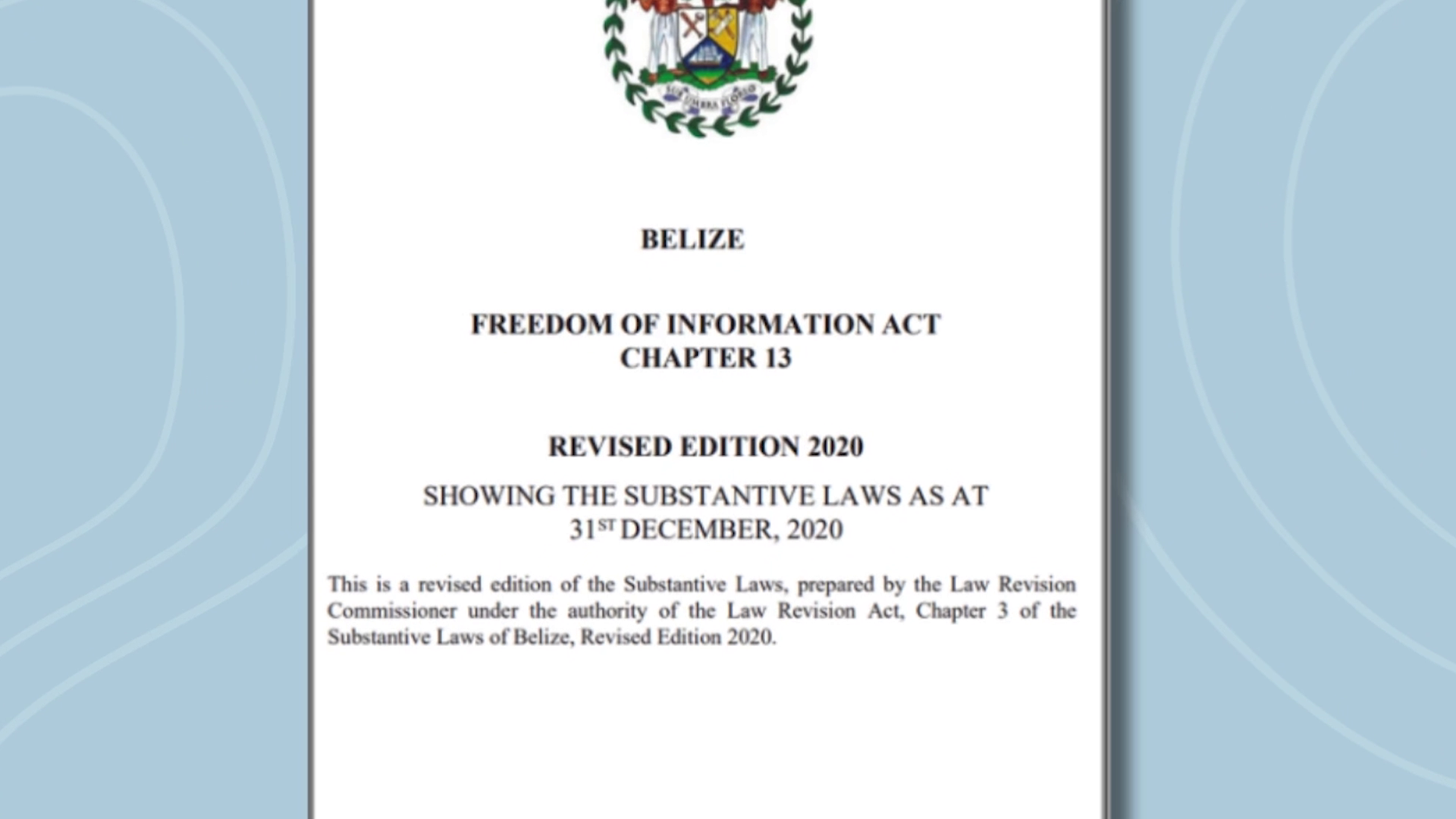
For more than three decades, Belize’s Freedom of Information Act (FOIA) has existed on paper as a legal guarantee of public access to government records — but in practice, systemic delays, overbroad exemptions, and toothless enforcement have continuously blocked Belizeans from accessing information they are entitled to. Now, three decades after the original law was enacted in 1994, the Belizean government has tabled the most sweeping overhaul of the legislation in its history, a package of reforms aimed at tearing down longstanding barriers to government transparency. This report examines the failures of the current framework, the proposed changes, and what the reform could mean for public accountability in the small Caribbean nation.
Under Belize’s existing FOIA framework, any member of the public seeking access to government records — from official spending documents to procurement contracts — must submit a formal written request, after which the relevant agency is legally required to respond within two weeks. In recent years, the country has seen a historic surge in the number of FOIA requests filed, according to Attorney General Anthony Sylvester, reflecting growing public demand for government accountability.
Journalists, labor leaders, and activists have been at the forefront of this movement, using the FOIA to shine a light on public spending and potential corruption. But nearly all who file requests report running into insurmountable obstacles. Hipolito Novelo, digital editor at Greater Belize Media, has repeatedly turned to FOIA to obtain details about how taxpayer dollars are allocated and contracts awarded. Novelo argues that all information related to public funds should be proactively published via dedicated online portals for every government ministry, rather than requiring citizens to file formal requests just to access basic public information.
Even when requests are filed, full disclosure remains rare. When Novelo sought records of COVID-19 vaccine-related government spending from the Ministry of Health and Wellness, he only received a small fraction of the information he requested, with most of the records withheld.
He is far from the only one to face this outcome. In June 2026, Dean Flowers, president of Belize’s Public Service Union, filed a FOIA request with the Auditor General’s office seeking financial records connected to the high-profile Mira Millions and Ministry of Defense procurement scandal. Flowers’ request was stonewalled; the Auditor General refused to confirm whether she would review payment patterns through the Smart Stream financial system, identify financial officers involved in questionable practices, or release the names of any officials connected to the scandal.
Social activist Jerry Enriquez encountered the same barrier when he requested records of taxpayer-funded legal fees for recent high-profile constitutional cases from the Attorney General’s office. His request was denied, with officials claiming disclosure would compromise ongoing cases and create unspecified risks for the Government of Belize. Even this report’s own author, investigative journalist Paul Lopez, hit a wall when he filed a FOIA request in 2025 seeking records of government office space rental payments.
Independent analysis of Belize’s current FOIA regime confirms what requesters have experienced for decades: Belize’s law ranks among the weakest freedom of information frameworks in the entire Caribbean. Key flaws identified include near-inexistent penalties for non-compliance, a total lack of independent oversight to enforce public access rules, no requirement for proactive publication of routine public records like contracts and spending data, and exemption categories so broad they allow agencies to withhold almost any document they choose.
Currently, when an agency classifies a record as exempt, requesters can file for a review with the national Ombudsman. But even if the Ombudsman rules in favor of disclosure, the office has no legal authority to force agencies to release records or bring criminal charges against officials who intentionally conceal public information. Any further appeal requires going through the High Court, a long and costly process that puts justice out of reach for most ordinary Belizeans.
The proposed reforms aim to fix these gaps by drawing on successful transparency models from other jurisdictions. A centerpiece of the overhaul is the creation of an independent Information Commission — modeled after similar bodies in the Cayman Islands and Mexico — that would have the power to issue legally binding decisions ordering the release of records. Agencies or officials that refuse to comply with the commission’s rulings would face fines as high as $100,000, and could even face criminal prison time in severe cases of intentional non-compliance.
The reform package also includes a requirement for the government to launch a national open data portal, where all public records including government contracts, departmental budgets, official asset declarations, and political financing records would be proactively published for free public access, eliminating the need for many FOIA requests entirely.
Critics like Novelo remain cautiously skeptical, noting that for years, connected government officials have been able to block access to information at every stage of the process, even when requesters pursue costly court action. Still, the proposed overhaul marks the most significant shift in Belize’s transparency regime in a generation. For supporters, the FOIA is far more than just a procedural law: it is the foundation of open government, giving Belizeans a clear view into how their leaders make decisions and how their tax dollars are spent. Whether the reforms will deliver on that promise remains to be seen as the proposal moves through the legislative process.
Reporting for News Five, Paul Lopez