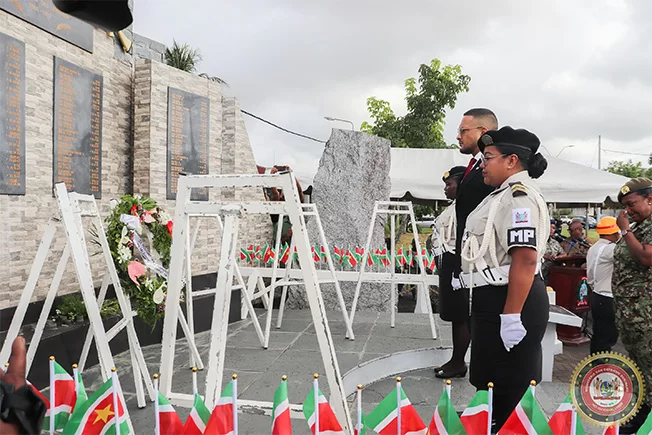
On July 22, during an official memorial ceremony honoring the 72 Surinamese service members killed in the country’s 1986–1992 internal civil conflict, Defense Minister Uraiqit Ramsaran announced a landmark policy change: the resettlement allowance and disability pension for surviving veterans of the war will be doubled, marking a 100 percent increase to both monthly benefits.
Ramsaran emphasized that the current administration has prioritized supporting veterans since taking office, who are organized under the Association of Surinamese Veterans and Ex-Servicemembers. In the first phase of the government’s support plan, officials focused on resolving long-standing delays in monthly benefit disbursements, ensuring veterans received the payments they were owed on time. The 100 percent benefit increase, the second phase of the plan, represents formal national recognition of the sacrifices and service of all surviving veterans.
Beyond benefit adjustments, Ramsaran added that the Ministry of Defense is developing new long-term initiatives to keep former service members connected to the armed forces after they leave active duty, including ongoing wraparound support and post-service care.
The annual memorial gathering brought together Defense Ministry leadership and representatives of the Surinamese National Army to honor the lives of the 72 troops who died during the conflict. Addressing attendees, Ramsaran noted that collective remembrance is not merely an act of reflection on the past, but a guide to building a more stable future. “A people that forgets its history risks repeating it,” he stated, adding that the fallen service members fulfilled their duties under extremely difficult, uncertain conditions, and extended his deepest gratitude to the families and next of kin of the deceased.
Mitchell Labadie, Brigade Commander of the National Army, described the 1986–1992 internal conflict as a traumatic, complex chapter that left deep, lasting scars on Surinamese society. For the armed forces, he said, the yearly memorial is far more than a ceremonial event: it is an opportunity to reaffirm the core values that guide the nation’s military.
Labadie stressed that the sacrifices of the fallen impose a permanent obligation on the National Army to uphold standards of professionalization, operational readiness, and ongoing strengthening of Suriname’s democratic constitutional order. The memorial should serve as a catalyst for national unity rather than division, he added. “Thirty-some years after the end of the conflict, it is our collective responsibility as a nation to learn from the past and commit to peace, justice, and mutual respect for all,” Labadie said.