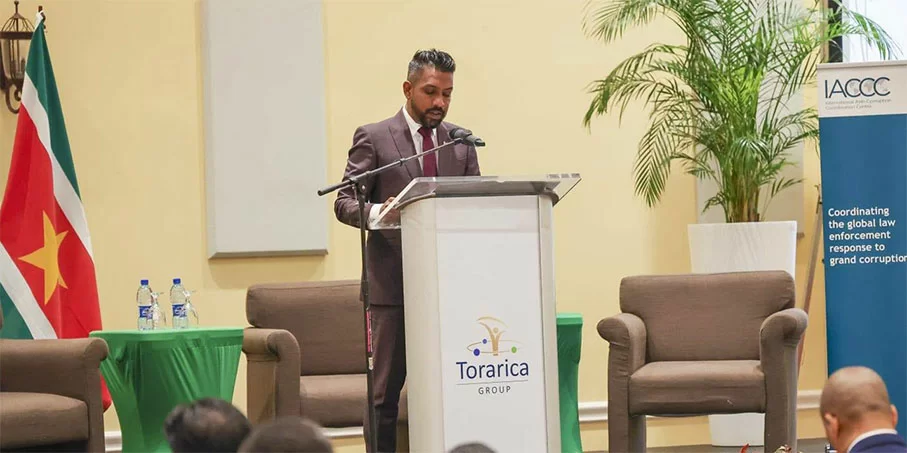
On July 22, at the opening of Suriname’s national Anti-Corruption Congress, Minister of Justice and Police Harish Monorath laid out a new, multi-pronged approach to combating systemic corruption, arguing that detection and prosecution alone are not enough to root out the problem. Speaking to an audience of national and international experts, Monorath emphasized that long-term success in the fight against corruption requires targeted investment in prevention, institutional strengthening, transparency, and a widespread societal culture rooted in integrity.
“Corruption poses a severe threat to every democratic rule of law, and it holds back the socio-economic development of our nation,” Monorath stated during his opening address. He stressed that anti-corruption work cannot fall solely to the government; it requires shared responsibility across the private sector, civil society organizations, and individual citizens. An accountable, integrity-driven governance culture can only take hold, he argued, when every segment of Surinamese society fulfills its distinct role in upholding ethical standards. The minister also expressed appreciation for the congress, which brought together specialists from across borders to exchange knowledge, best practices, and lived experience in designing effective anti-corruption frameworks.
Monorath confirmed that the Surinamese government is currently advancing a more robust, impact-oriented national anti-corruption agenda, with core priorities including modernizing outdated anti-corruption legislation, strengthening the capacity of state institutions, and embedding integrity standards across all levels of the public sector. He revealed that dozens of new legislative proposals from the Ministry of Justice and Police are currently in preparation or under parliamentary review, all designed to further reinforce the country’s rule of law framework.
International cooperation remains a central pillar of Suriname’s strategy, Monorath noted. The country aligns its national policies with the United Nations Convention Against Corruption (UNCAC), which provides a globally recognized framework for corruption prevention, criminal prosecution, cross-border collaboration, and the recovery of assets gained through corrupt activity.
The minister highlighted that public officials bear a unique responsibility to model ethical behavior, noting that integrity, transparency, and accountable leadership must be visible in the daily work of government. To embed this standard, the administration is pushing forward new initiatives focused on ethical leadership training, formal codes of conduct for civil servants, and binding legal protections for whistleblowers who report corrupt activity.
Repeating his core argument, Monorath emphasized that preventive measures are ultimately more effective at reducing systemic corruption than purely punitive action. The government’s anti-corruption strategy rests on six core pillars: greater transparency, open government practices, institutional strengthening, whistleblower protection, international collaboration, and active civil society engagement. He also called for expanded investment in integrity education, to help young people understand the value of fair governance and the rule of law from an early age.
In closing, Monorath called on all Surinamese citizens to take personal ownership of building an integrity-focused nation. “Integrity starts with personal responsibility. It is a choice we make, even when no one is watching,” he told attendees. Only when corruption is no longer normalized, and public trust in government and its institutions is strengthened, can Suriname achieve truly sustainable development, he added.