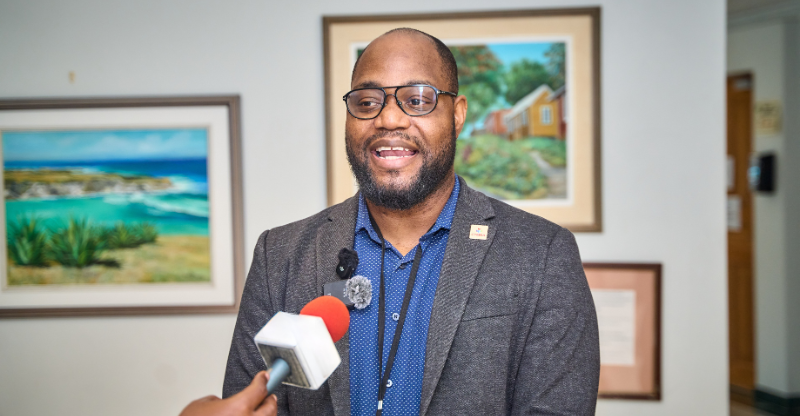
As climate change drives increasingly intense and destructive storm activity across the Caribbean, regional disaster management leaders are pressing national governments to abandon the long-standing practice of using repurposed schools and community centers as temporary emergency shelters, and redirect funding toward constructing purpose-built facilities designed to safely accommodate all displaced people, particularly vulnerable groups such as people living with disabilities.
The urgent call was delivered on Monday by Mandela Christian, Programme Manager for Preparedness and Response at the Caribbean Disaster Emergency Management Agency (CDEMA), during the opening of a regional train-the-trainers workshop hosted at the UN House. The event is a key component of the Resilient Caribbean project, a €1.1 million (equivalent to $2.5 million) initiative funded by the European Union that supports 13 CDEMA member states. The project’s core goals are to boost regional disaster preparedness, strengthen cross-national collaboration and response capacity, and guarantee inclusive, accessible support for the Caribbean’s most at-risk populations. The workshop, which also received backing from the United Nations and CDEMA, is equipping emergency shelter officials from across the region with training in cutting-edge, inclusive shelter management practices.
Christian told reporters that CDEMA has spent years pushing governments to reevaluate how emergency shelters are designed and used, driven by two key factors: the growing severity of climate-fueled natural disasters, and the wide range of unique access and support needs of people seeking refuge during emergencies. “We work proactively to embed inclusion across every part of our shelter planning, we examine the full spectrum of vulnerabilities that displaced community members face, and we have shared clear guidance on how existing public buildings can be retrofitted to better accommodate people with disabilities and other at-risk groups,” Christian explained.
However, he also emphasized that retrofitting older, non-purpose-built structures has hard limits that many national governments are now recognizing. “More countries are coming to the conclusion that relying on existing buildings like schools and community centers is not the optimal long-term solution, simply because these spaces were never designed to function as emergency shelters,” he said. “We are now seeing a growing shift toward investing in purpose-built shelter facilities that come equipped with accessible infrastructure, including proper washroom facilities, clear entry and exit routes for people with mobility impairments, and other critical accessibility features.”
Christian added that CDEMA is advising governments to integrate accessibility and inclusion requirements into the initial design of all new public infrastructure, including new schools, multi-purpose community facilities, and dedicated emergency shelters. “Whether countries are retrofitting older shelters or breaking ground on new schools and community spaces, these accessibility needs have to be prioritized from day one,” he noted. “That means guaranteeing clear access for disabled residents, installing adequate sanitation facilities, building structures strong enough to withstand severe storms, and building in security features from the design phase.”
Beyond physical accessibility, Christian stressed that modern emergency shelters must also provide a safe, dignified environment for all people displaced by disasters, regardless of their background. “We cannot remove people from one dangerous situation only to place them in another,” he said. “It is non-negotiable that every person entering a shelter feels comfortable, secure, and protected.”
He added that high-quality emergency shelters must meet basic needs for food, clean water and sanitation, while also putting robust safeguards in place to prevent sexual exploitation and abuse, and ensure no resident faces exclusion based on their religion, gender, gender identity or any other personal characteristic.
These new calls for infrastructure reform come as climate change continues to amplify the intensity of hurricanes, tropical storms and other natural hazards across the Caribbean, making resilient, inclusive emergency shelter a increasingly critical pillar of regional disaster preparedness. Christian also shared that CDEMA is currently collaborating with the University of the West Indies to develop updated, climate-resilient building code frameworks that will help reduce the damage hurricanes and other extreme weather events inflict on national building infrastructure across the region.