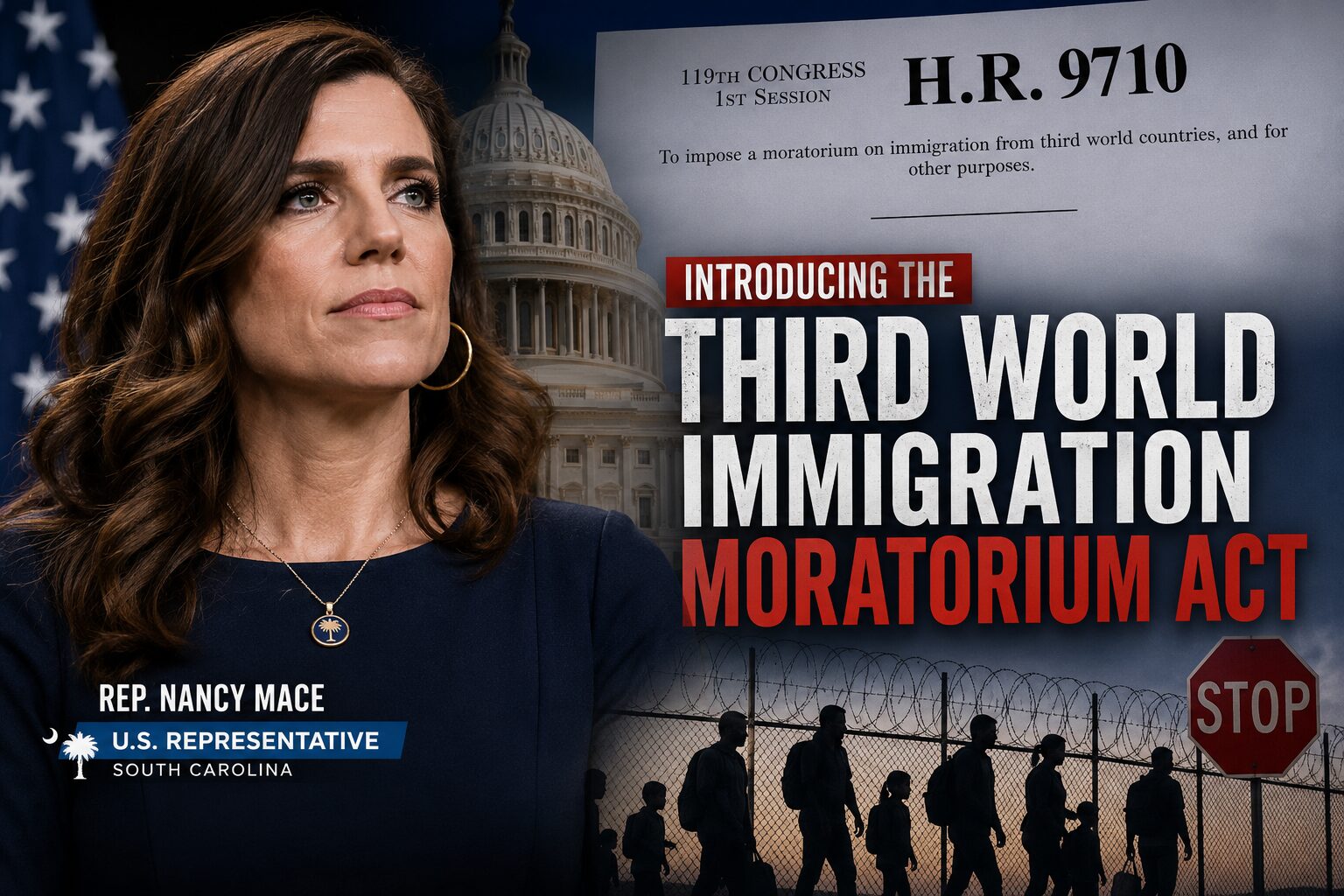
A controversial new immigration restriction bill introduced in the U.S. House of Representatives has placed two Eastern Caribbean nations in the crosshairs of sweeping entry prohibitions targeting 40 countries labeled as security risks to the United States.
Introduced July 15 by South Carolina Republican Congresswoman Nancy Mace, the Third World Immigration Moratorium Act — officially numbered HR 9710 — would bar entry to the U.S. for any national of the 40 designated “countries of concern,” as well as travelers carrying documents issued by the Palestinian Authority. The explicit stated goal of the legislation is to block foreign nationals from identified high-risk nations from entering American territory.
Among the 40 nations listed, Dominica and Antigua and Barbuda stand out as the only two member states of the Organization of Eastern Caribbean States (OECS) to be included in the proposed restrictions. Other prominent countries named in the bill include Haiti, Cuba, Venezuela, Iran, Somalia, Sudan, Yemen, Nigeria and Zimbabwe, among dozens of others.
Mace framed the proposed legislation as a direct extension of the restrictive entry policy first rolled out under former President Donald Trump, which sought to limit immigration from select nations to protect U.S. national security. In her official statement announcing the bill, Mace argued that all nations included on the list meet one or more high-risk criteria: they have refused to cooperate with U.S. deportation orders, fail to share sufficient background information for adequate traveler vetting, face widespread internal instability, are linked to terrorist activity, or are governed by regimes hostile to U.S. interests.
“The American people are done playing games and so are we. For too long, Washington has looked the other way while bad actors exploited every gap in our system and American families paid the price. Those days are over,” Mace said in her address accompanying the bill’s introduction. She emphasized that the legislation codifies the principle that entry to the U.S. is a privilege, not an inherent right, and positions the entry ban as a critical tool to keep “dangerous aliens” out of the country while pressuring listed nations to address U.S. security concerns.
The bill includes a series of narrow exceptions to its broad entry prohibition. The restrictions do not apply to U.S. lawful permanent residents, dual nationals who hold citizenship of an undesignated country, accredited diplomatic and NATO personnel, athletes and their support teams traveling to major international sporting events including the FIFA World Cup and Olympic Games, certain classes of special immigrant visa holders, and individuals granted immigrant visas due to documented ethnic or religious persecution in Iran. It also grants the U.S. Secretary of Homeland Security authority to issue individual case-by-case waivers for travelers whose entry would serve a critical U.S. national interest.
If the bill is eventually passed into law, it would also mandate a regular bi-annual review process: every 180 days, the U.S. Secretary of State, in consultation with the Attorney General, Secretary of Homeland Security and Director of National Intelligence, would be required to submit a report to Congress recommending whether the restricted country list should remain unchanged, be modified, expanded, or terminated entirely.