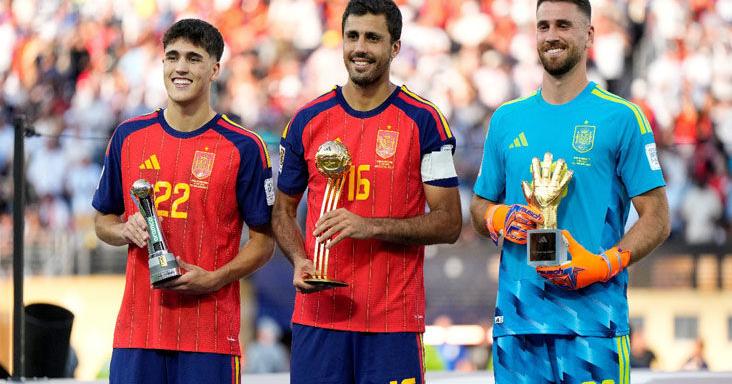
The 2026 expanded 48-team World Cup, hosted across the United States, Canada and Mexico, closed out its historic 104-match tournament with a groundbreaking extra-time final that cemented Spain’s place as the undisputed new powerhouse of global football. Substitute Ferran Torres delivered the moment of a lifetime, netting the game-winning goal in the 106th minute to seal a 1-0 victory over defending champion Argentina, ending Lionel Messi’s bid for a back-to-back title in what is widely expected to be his final World Cup appearance.
Torres’ decisive strike came after he pounced on a bouncing ball inside the Argentine penalty area, firing a clinical left-footed shot that skimmed just under the crossbar and found the back of the net. Speaking after the match, the goalscorer framed the moment as a victory for the entire Spanish nation, saying, “It was a goal scored by 47 million people” — a nod to his country’s population.
The win marks Spain’s second men’s World Cup title, adding to the trophy the nation first claimed in 2010. Beyond the individual victory, Spain etched its name into the history books by becoming the first country ever to hold both the men’s and women’s World Cup titles simultaneously, following the Spanish women’s squad’s 2023 World Cup victory.
From the opening whistle, the final was a story of total Spanish domination, despite the narrow 1-0 scoreline. La Roja registered 20 shots on target before Argentina even managed its first attempt on goal, which did not come until the second half of extra time, when the defending champions were desperately chasing an equalizer. Spain won nine of the game’s first 10 corner kicks, and only a World Cup final-record 12 saves from Argentine goalkeeper Emiliano Martinez kept Messi’s side in the game until the final minutes.
Argentina’s challenge was further hampered when Enzo Fernandez was sent off in second-half stoppage time after picking up a second yellow card for a reckless tackle on Spanish defender Pau Cubarsi, leaving the side to finish the match with 10 men. A late chance to level the score did fall Argentina’s way in the final minutes, when Messi’s corner kick fell to reserve Giuliano Simeone, but the young forward sent his effort high over the crossbar, leaving him stunned on the pitch.
Along with the team’s historic dual titles, Spain set multiple other tournament records throughout the run. The side conceded only one goal across eight matches, breaking the record for the fewest goals allowed by a World Cup champion. The victory also extended Spain’s unbeaten streak to 38 matches (29 wins and nine draws), the longest such run ever recorded by a European men’s national team — surpassing the previous 37-match record set by Italy between 2018 and 2021, which Spain itself ended.
At 65 years old, Spain head coach Luis de la Fuente also made history as the oldest manager ever to lead a men’s side to a World Cup title. “We are world champions,” de la Fuente said after the match. “It was together we reached this stage.” When asked about the team’s mindset heading into the final, he added, “I spoke to my players, and they said: ‘Look, we’ve won everything, coach. We’ve won everything.’ And that is beautiful.”
A moment of post-match pushing and shoving was quickly resolved, and Spain’s team showed great sportsmanship by forming an honor guard for Argentina’s squad as the defeated side walked to the stage to receive their runner-up medals. The final also made history off the pitch, hosting the first ever halftime show in World Cup history, attended by dozens of A-list celebrities from across film, music and sport, including Brad Pitt, Tom Cruise, Serena Williams, Kevin Durant, David Beckham and Zinedine Zidane. The match was watched by a sold-out crowd of 80,000 fans in-stadium, with an estimated 2 billion viewers tuning in from around the world.
For Messi, the defeat brings a likely close to an unprecedented international career that has cemented his status as one of the greatest players to ever step onto a football pitch. The 39-year-old Inter Miami star has long hinted that this tournament would be his final World Cup, having previously indicated a 2025 home qualifier against Venezuela would be his last competitive match for Argentina on home soil. An emotional Messi, who was brought to tears after receiving his runner-up medal, acknowledged Spain’s superiority after the match. “I feel sad,” he said. “They were better, to be honest.”
Over his two-decade international career, Messi amassed a historic list of accolades: the 2022 World Cup title, 2008 Olympic gold, two Copa América titles (2021 and 2024), and 16 Argentine Player of the Year awards over 19 years, winning the honor as a teenager and still claiming it into his late 30s.
Argentina head coach Lionel Scaloni echoed Messi’s assessment of the match, praising his squad’s effort while acknowledging Spain’s better performance. “There is sadness, but also the knowledge that we gave it our all,” Scaloni said. “I could say a lot about how we got here, but it’s not worth it. I am eternally grateful to these guys; they competed right to the end. The other team was better.” He added, “We are gracious in victory, and we must be gracious in defeat.”
Spain entered the tournament ranked among the pre-tournament favorites, and delivered on expectations by executing their simple but flawless game plan: dominate possession, stifle opposing attacks, and deny opponents any clear scoring chances. This strategy worked from the group stage all the way to the final, and helped Spain block Argentina’s bid to become the first men’s team to win back-to-back World Cups since Brazil achieved the feat in 1958 and 1962. Speaking after his winning goal, Torres acknowledged the pressure of facing the greatest player of his generation, but credited Spain’s collective identity for the win. “When you have Messi on the other side, well, you are nervous,” Torres said. “At the end of the day, we always depended on us. We always come up with our football, and we showed it again.”
This expanded 2026 World Cup also set new overall records, with more than 300 goals scored across the tournament — averaging nearly three goals per match, more than any previous edition of the competition. As the confetti cleared on the final, Spain stands alone as the new dominant force in global men’s and women’s football, with a record-breaking run that will be remembered for generations.