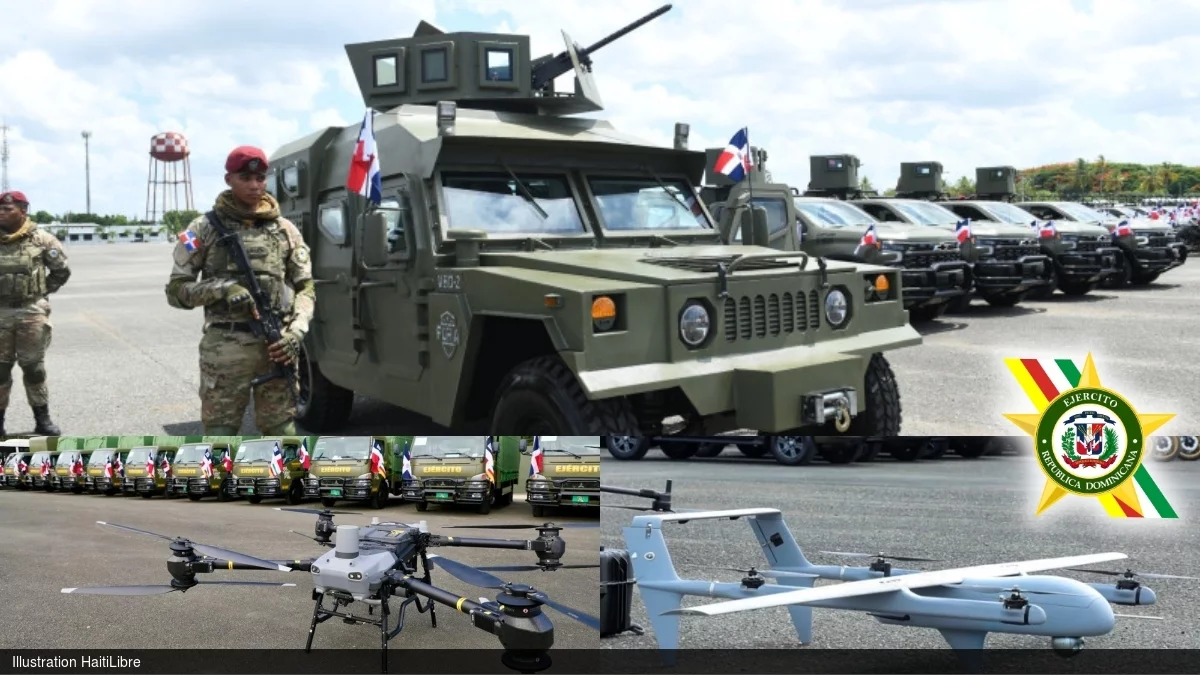
In a major step to upgrade its military capabilities and harden border security along its shared frontier with Haiti, the Dominican Republic has formally received a large shipment of new military hardware – much of it developed and built domestically – in a ceremony held on July 17, 2026. The delivery, coordinated by the country’s Ministry of Defense, includes a diverse array of cutting-edge equipment designed to enhance surveillance, rapid response, and multi-domain defense capabilities across the nation’s border regions and strategic installations.
Among the new assets delivered are five unmanned vertical takeoff and landing drones, a mobile unmanned surveillance unit mounted on an all-terrain vehicle, 10 indigenously developed Centauro tactical vehicles, and 179 additional ground vehicles of varying types. The acquisition package also includes a full structural renovation and re-equipping of seven key facilities at San Isidro Air Base, a major operational hub for the Dominican armed forces.
The highlight of the ceremony was the public unveiling of the FURIA VBD-2, the latest armored fighting vehicle fully developed and assembled by the Dominican Republic’s domestic military industrial sector. Boasting military-grade ballistic protection, a full 360-degree rotating turret, and advanced battlefield operational capabilities, the first completed FURIA VBD-2 is the inaugural unit of a planned 18-vehicle production run. Once completed, these armored vehicles will be deployed to reinforce second-line defense brigades stationed along the country’s shared land border with Haiti, where security concerns have grown in recent years.
Breaking down the full roster of new ground vehicles, Defense Minister Carlos Fernández Onofre outlined that the shipment includes 76 purpose-built patrol trucks, 25 heavy trucks for troop and supply transport, seven minibuses designed for secure personnel movement, four minivans, and 67 motorcycles for rapid patrol operations in diverse terrain.
President Luis Abinader, who attended the official handover ceremony, used the occasion to frame the new equipment delivery as a landmark milestone for the country’s growing military industry. He emphasized that domestically developed hardware like the FURIA VBD-2 and Centauro tactical vehicles serves as tangible proof that the Dominican Republic now boasts a leading military industrial sector across Central America and the Caribbean. “Today, we have an exemplary military industry in Central America and the Caribbean, and we are at the forefront. It rivals the most advanced countries. We are on track to reach the level of the highest-performing Latin American countries,” Abinader told attendees.
Minister Onofre echoed the president’s remarks, noting that the acquisition and domestic production of this new generation of equipment marks significant progress in the armed forces’ push for technological modernization. He added that the shift toward domestic assembly and production of key military assets – including upcoming drone production that is set to begin in the near future – will generate substantial long-term savings for the national government budget.
“ The Armed Forces of the Dominican Republic continue to move resolutely toward technological advancement, consolidating a permanent surveillance capability, increased responsiveness, and multi-domain defense, in line with the challenges of the 21st century, all in service of the security, sovereignty, and defense of the Nation,” Onofre said.
The upgrade comes amid ongoing regional security focus on the Haiti-Dominican Republic border, where the Dominican government has stepped up efforts to control irregular migration, counter smuggling, and protect territorial sovereignty in recent years.