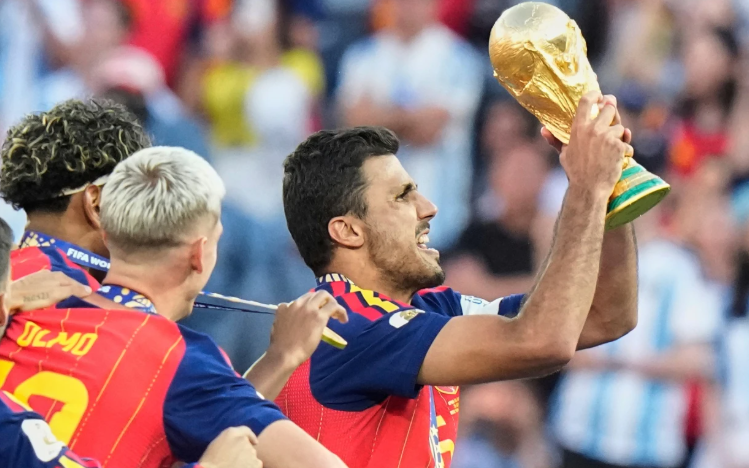
EAST RUTHERFORD, N.J. – Soccer history was written on Sunday, as Spain claimed its second men’s FIFA World Cup title with a dramatic 1-0 extra-time victory over defending champion Argentina, ending Lionel Messi’s bid for a second straight crown in what he has signaled was his final World Cup appearance.
The decisive moment came in the 106th minute, when second-half substitute Ferran Torres, netting his first goal of the entire tournament, latched onto a loose bouncing ball inside the Argentina penalty area. The forward fired a clinical left-footed strike that nestled just under the crossbar, securing what he calls the most important goal of his career.
Reflecting on the winning strike after the final whistle, Torres framed the achievement as a collective win for his entire nation, saying: “It was a goal scored by 47 million people” — a nod to Spain’s total population. Beyond the individual moment, the result was a testament to Spain’s tournament-long defensive masterclass that held firm one last time after Torres’ go-ahead goal.
Across eight matches on their road to the trophy, Spain’s backline conceded just a single goal, setting a new World Cup record for the fewest goals allowed by any men’s tournament champion. This title marks Spain’s second men’s World Cup crown, following its 2010 win in South Africa.
At 65 years old, Spanish head coach Luis de la Fuente also made history, becoming the oldest manager ever to lift the World Cup trophy. Speaking after the win, he expressed overwhelming pride in his squad’s effort. “Accompanying them on this journey is an honour,” de la Fuente said.
The men’s title completes a groundbreaking milestone for Spanish soccer: paired with Spain’s 2023 FIFA Women’s World Cup victory, the nation is now the first in history to hold both the men’s and women’s World Cup titles at the same time.
For Argentina and Messi, the result brought heartbreak. The Argentine captain, who was visibly emotional after accepting his runner-up medal and was seen tearfully gazing at sections of the stadium packed with Argentina supporters, acknowledged his side gave everything despite the loss. “I feel sad,” Messi said. “But I am aware that we played our hearts out.”
Alongside the trophy and championship rings, the 2024 World Cup champion will take home $51 million in prize money, per FIFA’s official prize structure. Runners-up Argentina will earn $34 million, while third-place England receives $30 million and fourth-place France takes home $28 million. Each quarter-finalist that finished between fifth and eighth place in the tournament will claim $20 million in prize money.
Individual awards were spread across top performers after the final. France’s Kylian Mbappé claimed the Golden Boot as the tournament’s top scorer, finishing with 10 goals — one ahead of Messi, who was held scoreless in the final. Mbappé also broke the all-time World Cup career scoring record, now holding 22 total goals across his tournament appearances, one more than Messi’s 21.
Spanish players dominated the remaining individual honours. Captain Rodri took home the Golden Ball, awarded to the tournament’s best overall player. Unai Simón claimed the Golden Glove for his standout performances in goal throughout the competition, while 19-year-old Pau Cubarsí won the Best Young Player Award, beating out his fellow 19-year-old Spanish teammate Lamine Yamal for the honor.