Growing geopolitical friction in the Middle East is emerging as a dual threat: not only does it risk further destabilizing already jittered global energy markets, but it also carries far-reaching economic repercussions for small island nations across the Caribbean, leading regional economists have warned.
New concerns have been triggered by a fresh uptick in international crude oil prices and growing instability around transit through the Strait of Hormuz, one of the world’s most critical energy chokepoints. Roughly 20% of the global oil supply passes through this narrow strategic waterway on a yearly basis. In a dedicated analysis of the Middle East conflict’s spillover effects on global energy markets and the world economy, the International Energy Agency (IEA) has emphasized that prolonged disruption to shipping through the strait poses a major risk to global energy security. The agency’s report details how even limited disruptions in this corridor can ripple out to push energy prices higher, stoke renewed inflationary pressures, and erode energy affordability for households and businesses across every region of the world.
For most Caribbean countries, a sustained jump in oil prices would trigger immediate, direct economic harm. The vast majority of regional economies are heavily reliant on imported fossil fuels to power electricity generation, public and private transport, and industrial production. As a result, higher energy costs pass through almost instantly to rising household living expenses, pushing up food prices and transport fares for everyday consumers.
Beyond broader cost-of-living pressures, the region’s core economic engine — tourism — also faces significant downside risk. More expensive fuel increases operating costs for international airlines and cruise lines, which typically pass these extra expenses on to consumers in the form of higher ticket prices. That makes travel to Caribbean destinations less affordable for international visitors, which can ultimately dampen tourist arrivals and cut into the billions of dollars in annual revenue the sector generates for local economies.
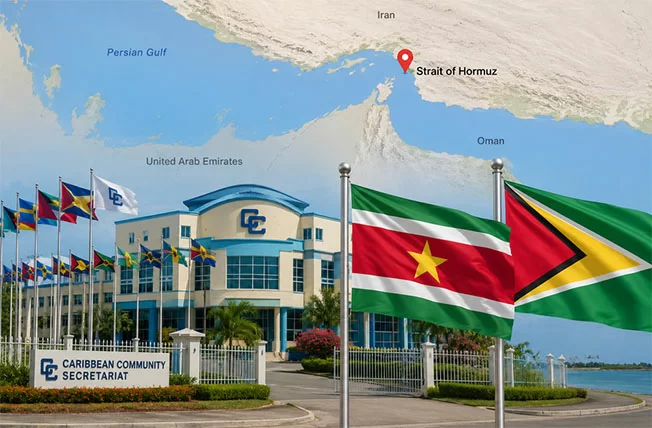
The outlook is more nuanced for two regional outliers: Suriname and Guyana. While Suriname will still face higher prices for imported goods and transport services if tensions worsen, it ranks alongside Guyana as one of the Caribbean’s emerging oil producing nations. A prolonged period of elevated global oil prices could, over the longer term, boost expected revenue from Suriname’s developing offshore oil production projects. Guyana, which has rapidly grown to become a major net oil exporter over the past several years, is already reaping the benefits of current high crude prices.
Earlier reporting from Reuters confirms that recent Middle East tensions stand to further increase Guyana’s oil export revenue, even as the surge in production creates new challenges for sustainable economic development and management of its fast-expanding petroleum sector. For Suriname, where first commercial offshore oil production is still being prepared for launch over the coming years, the current global situation underscores how critical it is for policymakers to plan for prudent management of future oil revenues. At the same time, until domestic production scales up, Suriname remains highly vulnerable to rising import costs and fuel price spikes.
Economists stress that while higher global oil prices will eventually deliver extra revenue for producing nations in the region, these benefits will only materialize once full-scale production is operational. In the interim, if the Middle East conflict continues to escalate, Suriname’s households and businesses will overwhelmingly feel the negative impacts of higher transport and import costs. The unfolding crisis makes clear just how interconnected global markets are: events thousands of kilometers away can quickly translate into tangible economic shifts across the Caribbean’s small, open economies.