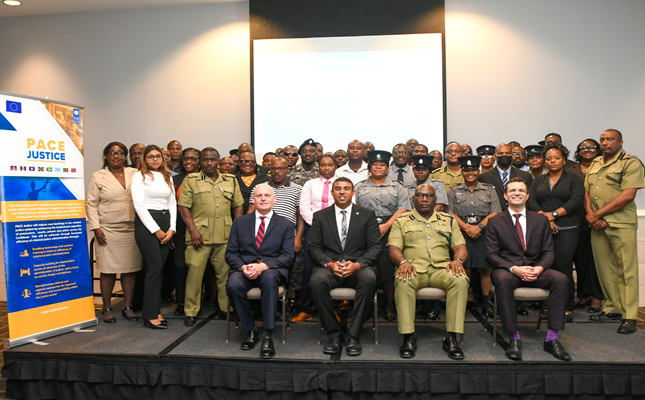
BASSETERRE, St. Kitts and Nevis — July 15, 2026 — The nation’s Ministry of Justice and Legal Affairs, in partnership with the UNDP PACE Justice Project and the United Nations Office on Drugs and Crime (UNODC), is hosting a four-day capacity-building training for the new Diversionary Caution System, a landmark initiative to reshape the country’s criminal justice sector through more proportional, restorative practice. The training, which runs from July 13 to 16 at a venue in Royal St Kitts, is split into two targeted phases to equip key stakeholders with the knowledge to roll out the reform.
The first phase, concluded on July 14, brought together roughly 60 frontline police officers to learn the legal parameters and operational protocols of the new framework. The ongoing second phase, which concludes July 16, gathers an additional 50 stakeholders representing a cross-section of justice and support institutions, including the national judiciary, the Office of the Director of Public Prosecutions, the private legal profession, court administration, His Majesty’s Prison, public social service agencies, contracted rehabilitation providers and other relevant government bodies.
At its core, the Diversionary Caution System establishes a legally structured, regulated alternative to traditional prosecution for eligible, low-level offenders. Rather than automatically pursuing court processing for minor offences, the system directs qualifying cases toward timely, proportionate accountability through a range of tailored interventions. These can include victim reparation, financial compensation, formal apologies, therapeutic counselling, targeted rehabilitation programming, restorative justice practices, educational courses, social support services and other evidence-based interventions approved under the framework.
The initiative prioritizes restorative justice and rehabilitation over punitive processing for eligible cases. Its core goals extend beyond responding to the offence itself: it aims to address the harm caused to victims and communities, support lasting behavioural change, cut rates of recidivism, and help eligible offenders successfully reintegrate into their families and local communities. Critically, the system retains formal prosecution for serious offences, repeated offending, violent crimes, exploitation cases, and any matter that requires full court intervention, ensuring public safety remains a central priority.
A diversionary caution can only be granted if strict legal criteria are met. These requirements include sufficient evidence to support a prosecution, a voluntary admission of responsibility by the offender, informed consent to participate in the diversion process, and a formal assessment confirming diversion serves the public interest. The framework also mandates meaningful victim engagement, standardized official record-keeping, regular monitoring of compliance with intervention conditions, clear consequences for breach of terms, and ongoing institutional oversight to ensure consistent, accountable application across all cases.
Opening the initial police training session, Attorney General Garth Wilkin emphasized that the reform is not intended to excuse criminal behaviour. Instead, he explained, the system is designed to ensure the justice system delivers the right response for each individual case. Wilkin reiterated that diversion must operate within a transparent legal framework, anchored in evidence, voluntary consent, victim input, proper documentation, ongoing oversight, and clear consequences for noncompliance. He added that successful national rollout will require disciplined practice and coordinated collaboration across all relevant institutions, from law enforcement and prosecution services to judicial bodies, social service providers and government ministries.
Deputy Commissioner of Police Cromwell Henry echoed Wilkin’s remarks in his opening address to participating officers. “The Diversionary Caution System represents a modern approach to policing and justice,” Henry stated. “For the Royal St. Christopher and Nevis Police Force, this initiative reinforces our commitment to fair, proportionate, and evidence based policing.” He also stressed that it is critical all law enforcement officers fully understand the legal requirements and operational responsibilities tied to the new framework to ensure consistent implementation.
To support practical implementation, the reform will be backed by a national Directory of Programmes and Service Providers. This centralized resource will help authorized officers and justice institutions quickly identify vetted, appropriate services to match the intervention conditions attached to a diversionary caution, including counselling, rehabilitation, restorative justice programming, education, social support, and employment readiness training. The directory ensures intervention conditions are not just procedural formalities, but are connected to real-world services that address the underlying drivers of offending, support accountability, and enable effective monitoring of compliance.
The Ministry of Justice and Legal Affairs has credited the UNDP PACE Justice Project with playing an instrumental role in advancing the reform from policy development to operational readiness. The project has provided financial, programmatic, and institutional support to help the ministry build out the framework and prepare for national launch. UNODC, meanwhile, has served as a key technical partner, leading the design and delivery of the four-day training program. UNODC worked closely with local officials to adapt training content to align with St. Kitts and Nevis’ unique legal, institutional and operational context, and provided hands-on guidance and support to both police officers and senior justice sector stakeholders.
The combined support from UNDP and UNODC has ensured the reform is not only enshrined in national legislation, but also backed by the institutional expertise, operational guidance, and cross-sector partnerships required for effective, sustained implementation. The Diversionary Caution System forms a core part of the St. Kitts and Nevis government’s broader agenda to modernize justice administration, strengthen the rule of law, expand access to justice, reduce unnecessary case backlogs and pressure on the court system, and build a criminal justice system that is firm, fair, proportionate, restorative, and trusted by the public. The ministry extended gratitude to all national, regional, and international partners that have contributed to advancing the reform.