On July 16, 2026, Antigua and Barbuda’s National Parks Authority (NPA) gathered to mark a landmark decade: 10 years since the Antigua Naval Dockyard and Related Archaeological Sites earned a coveted spot on the UNESCO World Heritage List. Originally inscribed at the 40th session of the UNESCO World Heritage Committee held in Istanbul, Turkey, on July 16, 2016, this 10-year milestone brings a decade of global recognition for one of the Caribbean’s most culturally significant landscapes.
This anniversary arrives on the heels of two other momentous milestones for the region’s heritage sector: the NPA celebrated its 40th year since formal establishment in December 2024, and the dockyard itself will mark its 300th founding anniversary in September 2025. Collectively, these overlapping celebrations honor a site whose layered history stretches across three full centuries.
Founded in 1725, the Antigua Naval Dockyard stands as a defining example of Georgian naval architecture adapted to the unique tropical conditions of the Caribbean. For nearly 200 years, it functioned as a strategic hub of maritime power, military engineering, and imperial strategy. But beyond narratives of empire and conflict, the site also bears powerful witness to the labor, ingenuity, and resilience of both free and enslaved African people, whose work carved the landscape and built the structures that survive to this day.
After the Royal Navy withdrew from the base in 1899, the dockyard entered a new phase of transformation. Locally-led conservation efforts by the Friends of English Harbour, paired with the rapid growth of the Caribbean yachting industry in the 1960s, turned the once-abandoned naval outpost into a thriving global heritage destination. In 1984, the government of Antigua and Barbuda formally established Nelson’s Dockyard National Park and created the National Parks Authority to steward a 16-square-mile interconnected network of terrestrial and marine habitats stretching from Mamora Bay to Carlisle Bay.
Over the past four decades, the NPA has grown into one of the Caribbean’s leading heritage management institutions. Its mandate has expanded far beyond basic maintenance of historic structures, now encompassing archaeological research, environmental conservation, sustainable tourism development, public education, and deep community engagement. Signature restoration projects, including the full rehabilitation of Clarence House and structural stabilization work at the Blockhouse Military Complex, demonstrate the organization’s commitment to preserving the site’s historic authenticity while keeping heritage assets accessible and active for modern visitors. All projects are led by skilled local craftspeople, reflecting the NPA’s investment in local capacity, community partnership, and the core belief that heritage conservation acts as a catalyst for inclusive socio-economic growth.
The 2016 UNESCO inscription formally recognized the site’s Outstanding Universal Value as an exceptional example of 18th and 19th-century British naval infrastructure, and as a living cultural landscape that weaves together histories of naval innovation and the lived experiences of the free and enslaved people who built the dockyard. In the 10 years since that designation, the NPA has expanded its stewardship work to address pressing modern challenges, including climate change adaptation, disaster risk reduction, full archaeological documentation, long-term sustainable development planning, and enhanced visitor experiences that center local narratives.
Community-focused initiatives, such as the 8th of March Project, have reshaped how the site’s history is shared, placing local voices, ancestral traditions, and lived experiences at the core of its public narrative. This shift ensures the dockyard is recognized not just as a collection of historic stone structures, but as a site shaped by the people whose stories continue to give it meaning today.
“Today, the National Park is far more than a monument to the past. It is a living heritage landscape where history, culture, nature, commerce, and community coexist,” explained NPA Parks Commissioner Ann Marie Martin. “It remains an engine of sustainable tourism, a center for research and education, and a source of national pride and identity.”
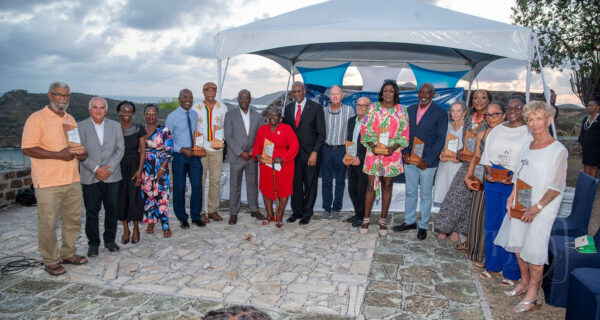
During the July 16 anniversary ceremony, held under the official theme “A Decade Celebrating Centuries,” the NPA honored 12 individual contributors and community groups whose longstanding dedication has been critical to the site’s success. Recognized honorees included Franklyn Braithwaite MBE, GOH, OLY, Jean Weste, Paul Deeth, Elizabeth Jordan, Althea Joseph, Karl James MBE, Jennifer Byerley Bentley, Capewell William Greene II, Louise Edwards, Marinus Smith, Leslie Roberts, and the Shirley Heights Lookout community group.
Honourable E.P. Chet Greene, the cabinet minister responsible for the National Parks Authority, used the occasion to issue a renewed call for collective commitment to heritage stewardship. “This cultural landscape is the people’s place, and beyond words, we are committed to ensuring its protection through sound policy and legislation, preserving it for future generations,” Greene said. “We remain dedicated to safeguarding our rich African heritage and ensuring that young people understand, embrace, and value the cultural legacy that surrounds them. The protection of spaces such as this demonstrates the importance of our heritage today and its continued significance for tomorrow.”
As Antigua and Barbuda marks 10 years of UNESCO World Heritage status for the dockyard, the milestone is both a celebration of decades of progress and a renewed pledge to protect the site for future generations. Heritage conservation is an ongoing responsibility that demands ongoing innovation, cross-sector collaboration, and adaptive resilience in the face of evolving global challenges from climate change to shifting tourism patterns. The Antigua Naval Dockyard and Related Archaeological Sites belong first to the people of Antigua and Barbuda, and through its UNESCO designation, to the wider world. The National Parks Authority remains steadfast in its mission to protect, preserve, and promote this extraordinary legacy for generations to come.