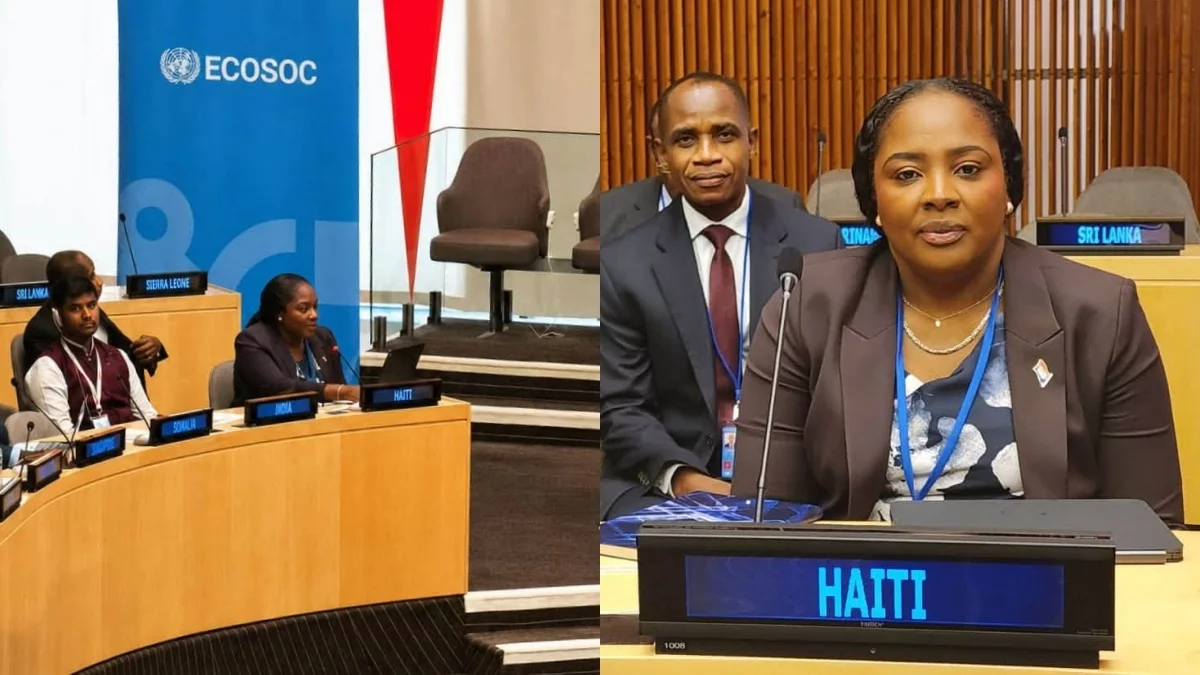
In a high-stakes address at the United Nations Economic and Social Council (ECOSOC) Ministerial Panel on July 16, 2026, Haiti’s Minister of Planning and External Cooperation Sandra Paulemon has issued a clarion call for sweeping reform to the global framework for Sustainable Development Goals (SDGs), arguing the current structure fails to account for the unique challenges facing fragile and developing nations.
The panel, convened to speed up delivery on the 2030 Agenda for Sustainable Development, provided Paulemon a platform to lay out a blunt assessment of global progress to date. She warned that advancement toward the 17 shared goals remains woefully inadequate, geographically uneven, and increasingly undermined by the cascading overlapping crises that disproportionately impact low-income and vulnerable states.
Aligning her remarks with the core governance priorities of Haitian Prime Minister Alix Didier Fils-Aimé’s administration, Paulemon pushed for a fundamental reimagining of international development financing. “There can be no credible acceleration of the SDGs without economic justice,” she stated. “There can be no sustainable progress without accessible financing, debt relief, equitable access to technology, national capacity building, and reform of the international financial architecture so that developing countries have a stronger voice in global economic governance.”
At the heart of her proposal is a call for a context-aware redesign of SDG implementation, not a weakening of the global goals themselves. Paulemon argued that revisiting the framework is critical to making it more operational, tailored to individual national circumstances, and responsive to the layered vulnerabilities many developing nations navigate. The SDGs must remain a universal shared ambition, she emphasized, but implementation strategies must directly address the interconnected security, climate, humanitarian, economic, and institutional shocks that constantly destabilize fragile states.
Paulemon drew specific attention to the Caribbean region, and Haiti in particular, stressing that the multidimensional vulnerability of small island and Caribbean developing states is often overlooked in global financing access mechanisms. For Haiti, she noted, overlapping crises across security, humanitarian, social, economic, and climate domains demand a holistic, integrated response that unifies efforts to restore security, drive recovery, stabilize institutions, advance territorial planning, and unlock productive investments.
She acknowledged that pervasive insecurity in Haiti has disrupted every sector of daily life, from population mobility and access to public education and health services to market activity, agricultural output, and social cohesion. But Paulemon stressed that Haiti is not approaching the international community only to highlight crisis: the nation comes with a clear, actionable development vision centered on reframing public action around strategic planning, policy coherence, localized implementation, and measurable results.
True SDG progress, Paulemon argued, must be rooted in local action, embedded at every level from municipal governments and neighborhood communities to production hubs, schools, health centers, local infrastructure projects, and frontline essential services. She outlined Haiti’s immediate national priorities: restoring baseline security conditions, strengthening strategic territorial planning, investing in social and economic infrastructure, expanding job opportunities especially for young people and women, supporting smallholder agriculture and small and medium-sized enterprises, bolstering local supply chains, and aligning all external cooperation with Haitian-led national priorities.
A core demand from Paulemon is greater accountability and effectiveness for international cooperation. She emphasized that external assistance must prioritize strengthening Haitian national institutions rather than sidelining them, and deliver tangible, sustained benefits for the Haitian population. “Haiti needs partners, but above all, structured partnerships that respect its priorities and are capable of supporting national institutions over the long term,” she said.
Closing her address, Paulemon announced that Haiti plans to launch a national voluntary self-assessment of SDG progress in 2027. The process will evaluate gains made to date, map remaining systemic challenges, and strengthen the integration of the 2030 Agenda into all levels of national development planning.