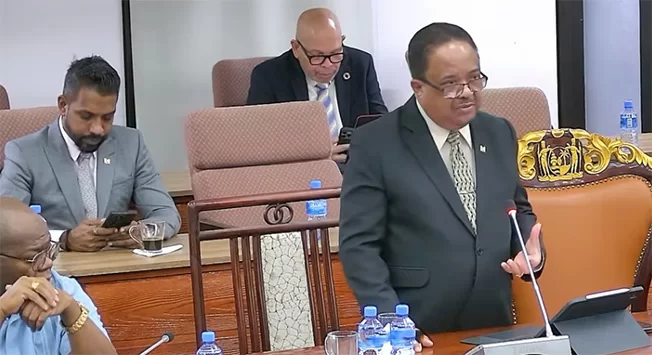
One year after Suriname’s current administration took office, parliamentary factions gathered this Thursday to assess the government’s first 12 months in power, delivering a spectrum of assessments ranging from cautious optimism to sharp criticism of unfulfilled campaign pledges. The debate, opened with an address to the National Assembly by Vice President Gregory Rusland, laid bare competing narratives about the government’s progress on core national priorities.
Leading the ruling coalition’s assessment, NDP (National Democratic Party) faction leader Rabin Parmessar argued the current government inherited a nation grappling with cascading challenges across nearly every policy sector. In its first year, Parmessar said, the administration has prioritized stabilizing public finances and restructuring national debt, achievements he credited with restoring calm and social cohesion after years of tension. He noted that ethnic polarization, a long-running divisive force in Suriname’s politics, has diminished over the past year, and called for cross-party collaboration to advance the nation’s development. “There is no room for rigid divides between opposition and coalition here, because this work is about unlocking the vast natural wealth that belongs to all of Suriname,” Parmessar told the assembly.
The largest opposition party, VHP (Vereenigde Hindoestaanse Partij), pushed back against the coalition’s positive framing. VHP representative Dew Sharman argued that while the current government inherited a more financially stable foundation thanks to the previous administration’s debt restructuring efforts, ordinary Surinamese citizens have yet to see tangible improvements in their daily lives. Sharman claimed that rates of violent crime and poverty have risen over the past year, leaving most households stuck in ongoing economic uncertainty. He added that the government’s signature campaign promise of “Kenki a Systeem” (Change the System) and its pledge to build a new culture of governance have so far failed to materialize in any visible way.
NPS (Nationale Partij Suriname) faction leader Jerrel Pawiroredjo echoed the opposition’s concerns, framing the first year of government as a moment for reflection rather than celebration. Pawiroredjo voiced deep alarm over the rapid growth of violent organized crime, particularly in Suriname’s interior regions, saying a growing share of the public now believes the state is losing its authority in large swathes of the country. He pointed to illegal gold mining, drug trafficking, heavily armed criminal gangs, and what he called a broken immigration policy as key failures, and called on the administration to deliver a clear, actionable plan to reverse these dangerous trends.
Other coalition-aligned parties offered more measured assessments. ABOP (Algemene Bevrijdings- en Ontwikkelingspartij) representative Edgar Sampie gave the government a “slight passing grade,” noting that while the administration has not yet delivered on all its goals, it has laid the critical groundwork for future progress. He urged coalition partners to continue protecting internal unity and collaborative decision-making. A20 faction leader Steven Reyme similarly called the first year “a good start,” pointing to restored financial stability, the launch of a national housing construction program, and accelerated processing of land title documents as early wins. Even so, Reyme shared concerns about insecurity in the interior, persistent underfunding of education and healthcare, a continuing brain drain of skilled Surinamese professionals, and the stalled implementation of long-planned decentralization reforms.
BEP (Broederschap en Eenheid in de Politiek) faction leader Ronny Asabina argued the administration has not yet earned congratulations, noting that the cost of living remains unsustainably high for most Surinamese families, and economic conditions remain far too tight for working households. Even so, Asabina expressed hope that the government would deliver on its campaign promises in the coming years, so that the public can eventually benefit from the administration’s policy changes.
Addressing the assembly in closing, Vice President Gregory Rusland acknowledged that one year is a short period to deliver sweeping change, but emphasized it has set a critical direction for Suriname’s long-term development. Rusland acknowledged the government inherited years of accumulated backlogs, unsustainable financial obligations, and long-standing administrative bottlenecks when it took office, rather than starting from a blank slate. Instead of avoiding these long-running problems, he said, the administration chose to take responsibility and address them head-on.
Rusland framed the coalition’s greatest achievement not as any single infrastructure project or policy change, but as the successful establishment of a collaborative, collective governing culture. He noted that while the Council of Ministers holds vigorous, open debates on policy disagreements, all final decisions are made collectively by the coalition, avoiding the gridlock and partisan infighting that plagued previous administrations. Beyond governance reform, Rusland highlighted progress across a wide range of sectors: expanded social safety nets, investments in education and healthcare, renewed economic growth, improved diplomatic relations, new climate policy frameworks, and preliminary preparations for the development of Suriname’s emerging oil and gas sector. He also pointed to the launch of the national housing program as a key milestone that will deliver tangible benefits to working families in coming years.
At the same time, Rusland openly acknowledged areas where improvement is needed: administrative procedures remain too slow, major projects need accelerated timelines, and collaboration between the executive branch and the National Assembly must be strengthened. For these reasons, he said, the first year of government is not an endpoint, but a solid foundation that the administration will build on over its remaining term. “We have not come as far as we would have liked in just 12 months, but we have proven that collaboration, national stability and responsible governance are possible for Suriname,” the vice president stressed.