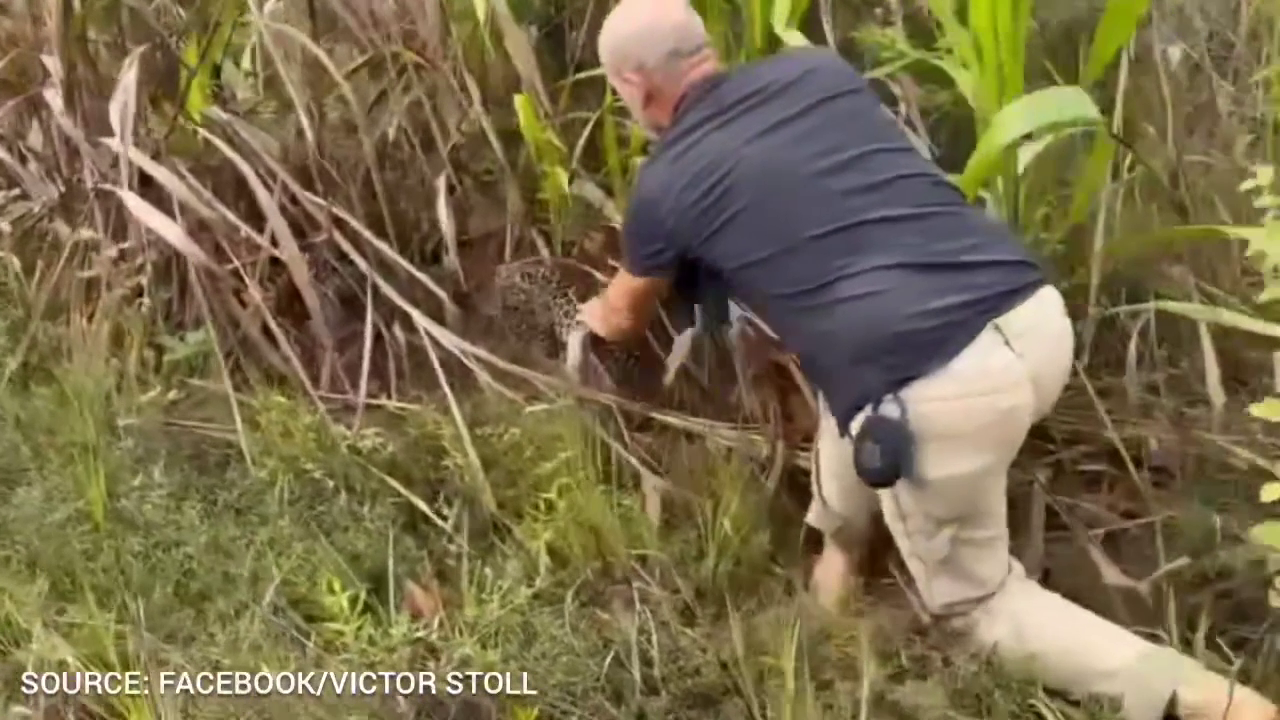
A viral social media video showing a group of tourists illegally approaching and touching a wild jaguar cub in Belize has sparked criminal proceedings and reignited calls for stricter wildlife protection enforcement across the Central American nation.
The footage, recorded in the protected Mountain Pine Ridge Forest Reserve, captures one man reaching out to pet the young jaguar, while another member of the group suggests lifting the cub into their arms. The interaction took place mere meters from the cub’s mother, putting both the humans and the vulnerable big cat family at severe risk.
What the group reportedly framed as a casual, memorable wildlife encounter has drawn widespread condemnation from conservation biologists, who warn that disturbing apex predators in their natural habitat can alter their behavior, break maternal bonds, and increase the likelihood of aggressive encounters with humans later in the cub’s life. The Belize Forest Department has launched a full investigation into the incident, working alongside national immigration authorities to identify the individuals involved by cross-referencing border entry and exit records. The department lacks the authority to issue formal travel alerts, so it has partnered with immigration to track the group’s movements.
In an official interview, Belize Forest Officer Victoria Chi outlined the specific charges the department intends to file against the men. “We are planning to charge them under the Wildlife Protection Act under Section 3A and C,” Chi explained. “Section 3A prohibits hunting any species listed on the act’s protected schedule. Jaguars, along with four other native wild cat species, are explicitly included in this schedule. Crucially, hunting under the law does not only refer to killing animals with firearms — it also covers any act that molests, harasses, or interferes with wild animals in their natural habitat, which clearly matches the group’s actions here.”
Chi added that Section 3C of the act reinforces these charges, as it explicitly bans any interference with immature wildlife, a criterion that is undeniably met by the interaction with the jaguar cub.
However, the case has also exposed a critical gap in Belize’s existing wildlife protection legislation: the current law, enacted in 1981, only allows for a maximum fine of $500 per violation. For the two men involved, this would bring the total combined fine to just $1000, a penalty Chi acknowledged many members of the public will see as far too lenient to deter future incidents.
That gap is set to close in the near future: a full revision of the Wildlife Protection Act has already received cabinet approval, and once the updated legislation takes effect, fines for protected wildlife interference will start at $30,000, creating a far stronger deterrent for irresponsible wildlife tourism. Until the revised law comes into force, authorities say they are limited to pursuing the lower penalties outlined in the 1981 legislation.
The Belize Forest Department is using the high-profile incident as a urgent public reminder: the country’s iconic native wildlife, including its vulnerable jaguar population, must be observed from a safe distance, rather than disturbed for viral social media content. Irresponsible interactions not only break national law but also put both humans and wildlife in unnecessary danger.