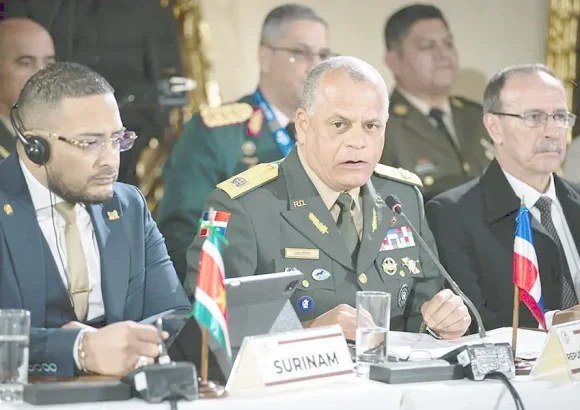
Against the backdrop of rising transnational security threats stretching across the Western Hemisphere, defense leaders from more than 30 nations gathered in the historic Andean city of Cusco, Peru, for the XVII Conference of Defense Ministers of the Americas, where top Dominican military official Lieutenant General Carlos Antonio Fernández Onofre cemented his country’s unwavering dedication to countering transnational organized crime.
In his keynote address to the assembly of regional defense heads, Fernández Onofre, who serves as the Dominican Republic’s Defense Minister, emphasized that fragmented national efforts are no match for sophisticated cross-border criminal networks that erode public safety and undermine democratic stability across the region. He called for deeper, more coordinated regional collaboration to counter these groups, arguing that shared threats demand collective, unified action.
Beyond traditional criminal challenges, the Dominican defense chief also drew attention to fast-evolving digital security risks, urging member nations to prioritize the expansion of collective cyber defense infrastructure and boost reciprocal intelligence sharing agreements. These steps, he noted, are critical to mitigating the growing frequency and severity of cyberattacks that target government institutions, critical infrastructure, and private citizens across the Americas.
By the close of the multi-day conference, participating representatives formalized their shared commitment to hemispheric security through the signing of the Cusco Declaration. This landmark framework sets out clear guidelines for expanded joint action to tackle a range of persistent cross-border threats, including maritime drug trafficking, illegal unregulated mining, and illicit arms trafficking. The declaration also embededs provisions to uphold international human rights standards and strengthen collaboration between regional defense institutions.
On the sidelines of the conference, Fernández Onofre also highlighted the Dominican Republic’s growing capacity for regional humanitarian action, showcasing the country’s upcoming Operation Quisqueya Solidaria 2026. He pointed to the Dominican Republic’s rapid, large-scale humanitarian response to the devastating 2025 earthquakes in Venezuela as a tangible example of the nation’s ability to deploy emergency disaster relief quickly, demonstrating its commitment to regional solidarity during times of crisis.