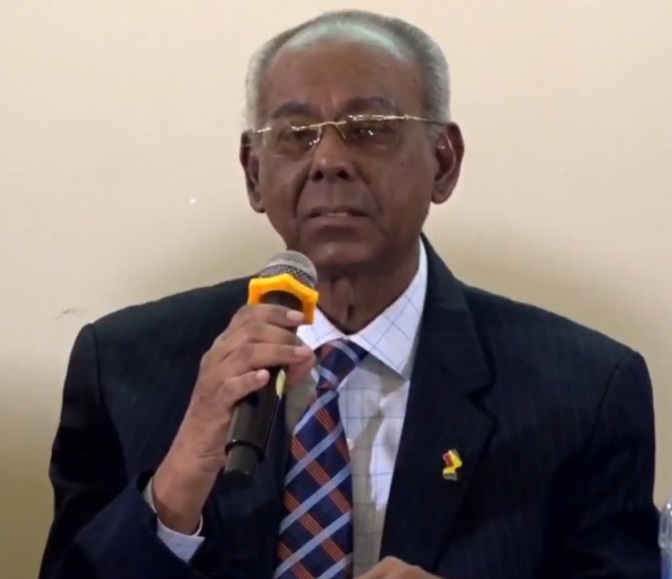
A brewing constitutional dispute over three Guyana Elections Commission (GECOM) seats aligned with the former APNU+AFC coalition has intensified, with former National Assembly Speaker Ralph Ramkarran calling for the commissioners’ immediate resignation following the 2025 general and regional elections. In his weekly Conversation Tree column published Saturday, Ramkarran argued that the three commissioners – Desmond Trotman, Vincent Alexander, and Charles Corbin – appointed on the recommendation of a previous opposition leader no longer hold any moral or legitimate claim to their posts after the 2025 vote reshaped Guyana’s political opposition landscape.
The 2025 general election installed We Invest in Nationhood (WIN), a new 16-seat opposition party founded by Azruddin Mohamed and his father Nazar “Shell” Mohamed, as the official main opposition, replacing the 12-seat APNU bloc that originally backed the three sitting commissioners. Ramkarran, a senior counsel and former executive member of the ruling People’s Progressive Party Civic (PPPC), noted that while the principle that an opposition leader should be able to recommend their own representatives to the election commission is widely undisputed, Guyana’s constitution contains no clear framework for removing sitting commissioners outside of cases of death, incapacity, misconduct findings by a tribunal, or voluntary resignation. The three incumbents have so far refused to step down, creating an immediate deadlock.
The standoff has been further complicated by long-running political tensions between the PPPC administration and WIN. The Mohameds, once close allies of President Irfaan Ali and prominent PPPC supporters, broke ranks to form WIN in 2024 after the United States imposed sanctions on them over alleged financial crimes tied to their gold trading operations. Shortly after the sanctions were announced, the Guyanese government revoked the pair’s foreign exchange dealer licenses and gold sector operating permits, and forced all domestic commercial banks to close their company accounts. Relations deteriorated further when WIN contested the 2025 general elections to become the largest opposition bloc.
Ramkarran warned that the PPPC’s deep-seated hostility toward WIN will likely block any path to constitutional amendment to resolve the vacancy issue. “The government’s hostility to WIN is so deep-seated that it might prefer to have the three Commissioners retain their positions rather than amend the Constitution to have the three Commissioners unseated,” he wrote. Well-placed government sources confirmed that Opposition Leader Azruddin Mohamed’s formal request to President Ali to appoint three new nominees – Roysdale Forde, Damien Da Silva, and Siand Dhurjon – to replace the sitting commissioners has been rejected on the grounds that no official vacancies exist on the commission.
According to Ramkarran, the only remaining path for WIN to resolve the deadlock is to bring the dispute before Guyana’s judiciary. The former speaker, who specializes in constitutional and electoral law, expressed cautious optimism that courts would rule in WIN’s favor. He argued that under Article 161(3) of Guyana’s constitution, GECOM commissioners nominated by the opposition leader are required to hold the confidence of the sitting opposition leader. Since Mohamed has formally submitted new nominations, the court could find that the incumbents no longer hold that confidence and could even rule their continued occupation of the seats unlawful. At the same time, Ramkarran cautioned that the absence of explicit constitutional language for removal may lead courts to stop short of formally declaring the seats vacant, prolonging the impasse.
The ongoing stalemate already threatens to derail planned 2026 local government elections, sources familiar with GECOM operations confirmed. Retired Justice Claudette Singh, GECOM’s chair, has not convened a full commission meeting for months. While technical staff have drafted and updated a detailed workplan for the upcoming local polls, the inability of the commission to convene and make formal decisions puts the timeline for the elections at serious risk.
The sitting APNU-aligned commissioners have echoed the government’s position, stating that no vacancy exists and the deadlock can only be resolved either by a court ruling or a formal constitutional amendment. Ramkarran noted that prior to the 1992 democratic transition, Guyana’s electoral laws explicitly required the entire election commission to resign within three months of a general and regional election, a provision that was not carried forward into the current constitutional framework.