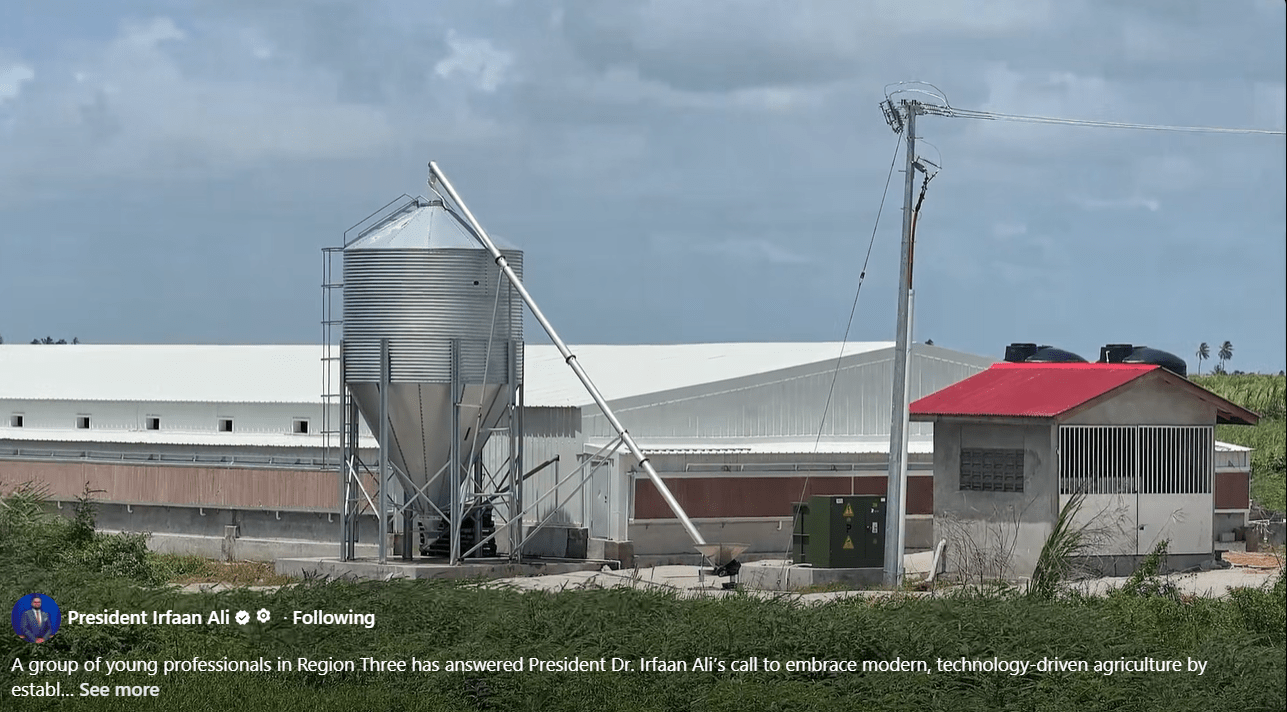
On Saturday, 11 July 2026, Guyanese President Irfaan Ali moved to reframe public discourse around ongoing questions about his personal 75-acre farm along the Linden-Soesdyke Highway by showcasing a government-backed high-tech poultry initiative led by young Guyanese entrepreneurs in Region Three (West Demerara-Essequibo Islands).
In a public Facebook post accompanying a video of the new project, President Ali explained that the cutting-edge tunnel-house poultry farm was developed through a public-private partnership: the cohort of young professionals contributed 10% of the total project cost, with the government providing targeted support and direct guidance from the President himself. The project aligns with the administration’s stated core priorities: empowering youth-led entrepreneurship, bolstering national food security, and expanding inclusive economic opportunity through modernized agricultural practices.
The project video includes testimonials from two participating entrepreneurs, who described how the President’s encouragement and formal government support made their investment in the innovative farming venture possible. Starting from an initial flock of 20,000 birds, the operation has already begun rapidly scaling its production, with President Ali framing the model as a blueprint for innovative, efficient, and sustainable poultry production across Guyana.
Even as the President highlights the new youth agriculture initiative, persistent public scrutiny continues to surround his personal private farm at Long Creek on the same Linden-Soesdyke Highway. While Ali has repeatedly denied that his private farm received any preferential treatment or special government exemptions due to his position as head of state, hundreds of commenters on his Saturday Facebook post renewed calls for full transparency around the land acquisition process, financing for the farm’s developed infrastructure, which includes a paved earthen access road and upgraded electricity distribution directly to the property.
Many commenters pressed for immediate public disclosure, with local resident Robert Bacchus Bynoe asking, “Sir when can Guyanese see and access all of the ‘Public Information’ about your farm? Tell us where to look?” Another commenter, Patrick Ali, emphasized that the public would not drop the issue, writing: “WE WANT THIS ISSUE .. THE FARM GATE MATTER .. ALL DOCUMENTS REQUIRED TO SHOW HOW ALI OWN THE FARM ? WE WILL NOT TURN OUR BACK ON THIS MATTER.”
Not all public reaction focused on the controversy, however. A number of commenters offered praise for the new youth poultry project. Rhonda Samuels Benjamin noted, “The idea is great I’m interested in having same. The technology is excellent and a great business venture,” while Fato Sharma commented, “Great to know that His Excellency Dr Mohamed Irfan Ali was always working with young professionals and will continue doing so.”
The scrutiny of the President’s farm first emerged after opposition leader Azruddin Mohamed publicly revealed details of the property. Two days after his initial revelation, Mohamed visited the neighboring Long Creek community overnight to highlight a stark equity issue: the community adjacent to the President’s farm still lacks access to consistent electricity supply.
Earlier on the same Saturday that he showcased the youth poultry project, President Ali posted separately about infrastructure development in the Waiakabra community along the Linden-Soesdyke Highway. He highlighted that his administration has directed significant investment to the area, including funding through Guyana’s national Low Carbon Development Strategy (LCDS), to upgrade public infrastructure, improve community facilities, generate local economic opportunity, and raise resident quality of life.
Mohamed has alleged that developing the President’s private farm — which includes poultry, cattle, sheep, goat and fish operations alongside a personal farmhouse — cost an estimated 2.2 billion Guyanese dollars. President Ali has yet to publicly confirm the development cost, exact acreage of the property, or any additional personal financial details, noting that all required asset disclosures have already been submitted confidentially to the country’s Integrity Commission. Under Guyana’s constitution, the sitting President is protected from civil or criminal legal action during their time in office, a provision that has added to public debate around accountability for the personal property.