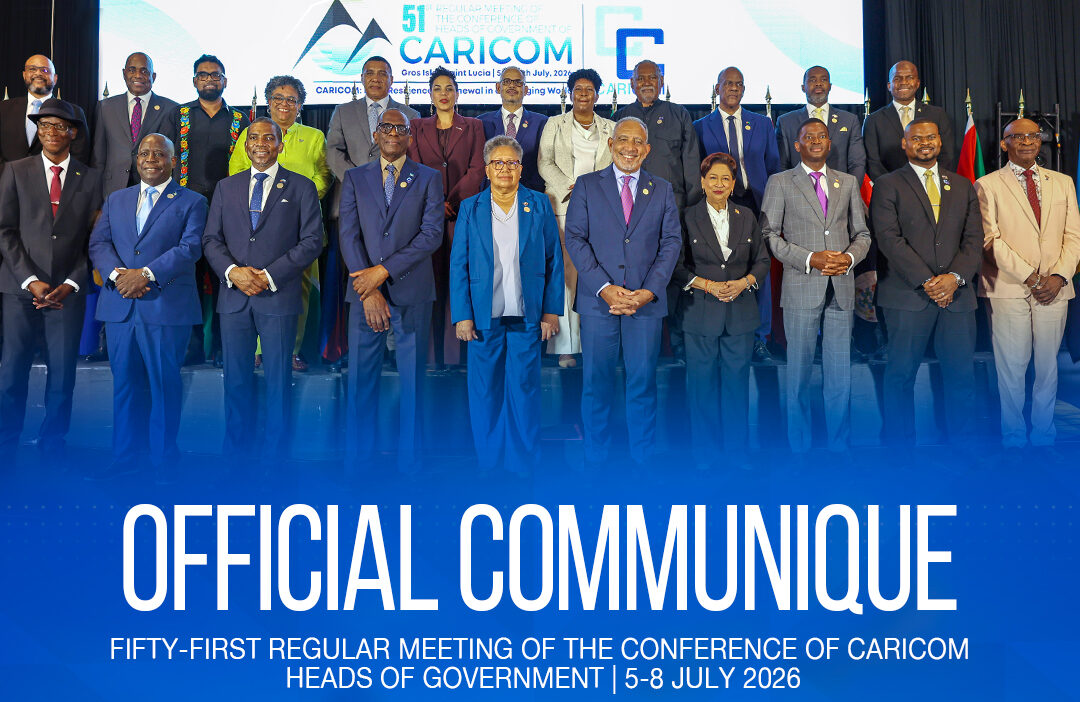
Between July 5 and 8 2026, leaders from across the Caribbean Community (CARICOM) gathered in Gros Islet, Saint Lucia, for the bloc’s 51st Regular Meeting of the Conference of Heads of Government, chaired by Saint Lucia Prime Minister Philip J. Pierre. The gathering brought together full member state leaders, observer delegates from associate members, and special guests, kicking off with a vibrant opening ceremony showcasing Saint Lucian cultural performance that centered a unifying call to make regional integration deliver tangible benefits to everyday Caribbean people.
Opening remarks set the tone for a meeting framed around the theme “From Resilience to Renewal”. CARICOM Secretary-General Dr. Carla Barnett highlighted the bloc’s recent progress, including the upcoming launch of full free movement of people across four member states in October 2025 and steady gains in regional agricultural output under the 25 by 2025+5 food security strategy. She emphasized that shaping the region’s future requires collective, unified action on the bloc’s own terms: “To move ‘from resilience to renewal’ … requires active recognition that as architects of this Region’s future, we should work, in unison, to shape our own destiny, on our own terms.”
Youth voice took center stage during the opening, with Saint Lucian Rhodes Scholar Rahym Augustin-Joseph urging leaders to match the ambition of young Caribbean people who already live integration daily. He called for placing youth participation, innovation, freedom of movement, food security, and AI at the core of CARICOM’s agenda, warning that outdated political processes for integration were falling short of young people’s expectations. “If ever there was a time for us to integrate, it is now,” he stressed.
Outgoing CARICOM Chair Dr. Terrance Drew, Prime Minister of St. Kitts and Nevis, noted that modernized governance and faster implementation of collective decisions would deliver a safer, more prosperous region. Current Chair Pierre expanded on this vision, arguing that integration must move beyond bureaucratic discussions to impact community life: “It must move from conference rooms to communities; from rhetoric to reality; from communiqués to results.” He added that a unified Caribbean holds far more global influence than a divided one, noting that external powers have long benefited from Caribbean disunity.
### Core Policy Priorities and Agreed Actions
Leaders focused first on advancing the CARICOM Single Market and Economy (CSME), identifying rising cost of living driven by global inflation, geopolitical shocks, and disrupted energy and supply chains as a top priority for citizens. They discussed expanding free movement of labor, activating a regional intraregional ferry service, and building an integrated regional capital market with efficient cross-border payments. In a landmark step for regional digital governance, leaders agreed to establish a Blue-Ribbon Commission of top regional and international experts to develop a comprehensive regional AI framework covering policy, governance, and capacity building. Three jurisdictions — Grenada, Saint Lucia, and Montserrat — also confirmed they are taking steps to join the full free movement regime for CARICOM nationals.
On climate change, CARICOM leaders reaffirmed their core goal of limiting global warming to 1.5°C above pre-industrial levels and securing recognition of the unique vulnerabilities of Small Island Developing States (SIDS) ahead of COP 31 in Turkey in 2026. They endorsed the 2026–2030 CARICOM Climate Diplomacy and COP 35 Framework as a guide for advancing regional interests in global climate talks, and formally backed Guyana’s bid to host COP 35 in 2030. To address the growing gap in disaster coverage amid more frequent extreme weather, leaders agreed to create a CARICOM Reinsurance Task Force to develop a regional strategy expanding catastrophic insurance coverage for critical tourism, health, and social infrastructure.
Leaders reaffirmed their commitment to regional food and nutrition security, acknowledging ongoing challenges amplified by the Middle East conflict and welcoming progress under the 25 by 2025+5 initiative. They formally supported the 20th Caribbean Week of Agriculture to be held in Jamaica in September 2026.
In a historic step for the regional reparations movement, leaders approved the *CARICOM Ten Point Plan for Reparations: A Manifesto for the Coming Enlightenment*. They agreed to a series of coordinated actions to advance the agenda, including high-profile advocacy at the 2026 Commonwealth Heads of Government Meeting in Antigua and Barbuda, ongoing collaboration with the African Union, a third regional reparations conference in Barbados in September 2026, the unveiling of the Newton Enslaved Burial Ground Memorial in Barbados that November, and support for Jamaica’s upcoming reparations petition to King Charles III in London.
The meeting also marked major expansion of the bloc: following Martinique’s accession in June 2026, French Guiana formally became CARICOM’s eighth associate member during the gathering. Leaders also noted progress on reviewing full membership applications from Bermuda and the Turks and Caicos Islands, agreeing to continue advancing the processes alongside broader discussions of CARICOM’s enlargement policy.
On global and regional security, leaders addressed multiple pressing issues. They expressed unwavering solidarity with Haiti’s government as it addresses complex security challenges and prepares for upcoming elections, agreeing to support the renewal of the Gang Suppression Force’s mandate and accept The Bahamas’ offer to host a permanent CARICOM presence in Port-au-Prince. With incremental security gains allowing improved aid delivery, Guyana committed 500 tons of rice as the first installment of new regional humanitarian support for Haiti. Leaders also voiced deep concern over the unfolding humanitarian crisis in Cuba and committed to continuing coordinated regional humanitarian aid, and joined global calls for a ceasefire and two-state solution to resolve the ongoing humanitarian crisis in Gaza, condemning military incursions into Lebanon.
On public health, CARICOM leaders endorsed recommendations from the Caribbean Public Health Agency (CARPHA) to strengthen regional preparedness for emerging health threats, including Ebola, noting that while importation risk to the Caribbean is low, coordinated regional action and information sharing remain critical.
A key institutional process was launched after Trinidad and Tobago maintained its objection to the process used for the reappointment of the CARICOM Secretary-General. Leaders agreed to refer the dispute to the Caribbean Court of Justice (CCJ) for an advisory opinion under the terms of the Revised Treaty of Chaguaramas, with the status quo remaining in place until the court’s opinion is received. Leaders emphasized that the process reflects the bloc’s commitment to good governance and does not question the integrity of any member state or individual.
On border disputes, CARICOM reaffirmed its full support for ongoing International Court of Justice (ICJ) processes to resolve the longstanding Guyana-Venezuela territorial controversy, as well as border disputes between Belize and Guatemala and Belize and Honduras. Leaders condemned recent attacks on Guyanese security personnel in Guyana’s sovereign territory from Venezuelan soil, and expressed concern over illegal deforestation and rising tensions along the Belize-Guatemala border, urging both parties to avoid escalating tensions and finalize a cooperation mechanism for the Sarstoon River with support from the Organization of American States (OAS).
In a significant endorsement for regional representation at the United Nations, CARICOM leaders fully endorsed Guyana’s nomination of Ambassador Carolyn Rodrigues-Birkett for the position of UN Secretary-General, noting the critical need for strong multilateral leadership amid global challenges.
### Closing Outcomes and Next Steps
Other key decisions included accepting Guyana’s offer to host CARIFESTA 2027 and the 2027 CARIFTA Games, with Antigua and Barbuda set to host CARIFESTA 2029 and Barbados the 2028 CARIFTA Games. Leaders also agreed to continue supporting the indigenization of the University of the West Indies as it transitions from a Royal Charter to a CARICOM intergovernmental agreement. They observed a moment of silence to honor recently deceased regional leaders and public servants, including former Suriname President Chandrikapersad Santokhi and former CARICOM Secretary-General Roderick Rainford.
Leaders closed the meeting by thanking the government and people of Saint Lucia for their warm hospitality and excellent hosting arrangements. The 52nd CARICOM Regular Meeting of Heads of Government will be held in Suriname in February 2027.