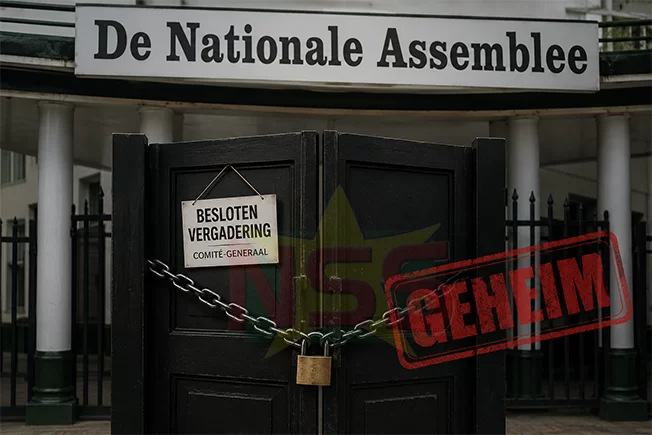
A closed-door committee of the whole meeting of Suriname’s National Assembly, convened to discuss the disappearance of confiscated mercury from the Geyersvlijt police station, has ignited a fundamental debate over the appropriate boundaries of parliamentary secrecy in the South American nation.
Multiple assembly members who participated in the confidential session told reporters that no information shared during the meeting had not already been made public prior to the gathering. This revelation has thrown not just the necessity of holding a closed-door meeting on this topic into question, but also cast renewed scrutiny on the use of the committee of the whole as an exceptional parliamentary tool, which is only supposed to be deployed for uniquely sensitive matters.
The Surinamese government had explicitly pushed for the matter to be handled in a closed committee of the whole, arguing that sensitive details could not be aired in a public parliamentary session. Multiple political factions had already stated ahead of the meeting that members would assess whether secrecy was actually justified after reviewing the content, with a plan to switch the session to public if no confidential information was confirmed. However, no such transition ever took place.
Ultimately, only the mercury disappearance case was addressed during the July 9 meeting. Three other high-priority topics on the agenda — mass fish die-offs, the disappearance of four kilograms of gold from state-owned miner Grassalco, and the work of the national Anti-Corruption Unit — were never taken up, after the meeting adjourned early following a suspension.
According to multiple sources, a narrative corroborated by statements from sitting assembly members, no names of suspects or implicated police officers were mentioned during the discussion of the mercury case, nor was there any mention of arrested police personnel. The only new detail shared was that a Guyanese suspect, who originally smuggled the mercury into Suriname, was only referred to by his initials. The smuggling case itself had already been closed prior to the meeting: the mercury was originally seized at the Burnside police station in Coronie, and the foreign suspect resolved the case out of court. The closed committee only addressed the subsequent disappearance of the already-confiscated mercury from the Geyersvlijt police post.
NDP parliamentarian Ebu Jones walked out of the meeting in protest, saying he could not justify the secrecy because no information was shared that would put national security or any other major public interest at risk if discussed openly. NPS party leader Jerrel Pawiroredjo also confirmed to local outlet Starnieuws that he heard no details during the closed session that Justice and Police Minister Harish Monorath had not already stated publicly.
In contrast, NDP party leader Rabin Parmessar offered a differing assessment of the meeting in comments to Radio ABC. While he could not discuss the specific content of the session due to secrecy rules, Parmessar insisted the minister did share details that could not have been aired in public. He argued the meeting covered extremely urgent security matters tied to active ongoing investigations, noting that the minister would not have been able to elaborate on certain issues in an open setting, while the closed-door format allowed assembly members to ask critical questions that could never be raised publicly. He emphasized that active investigations by the Public Prosecution Service must not be undermined, explaining: When cases are still under investigation, practical and strategic reasons prevent us from going into detail on every aspect. If we did, the investigation would stall.
Even so, Parmessar acknowledged that many people would remain unsatisfied with how the meeting unfolded, given that only one of the four scheduled topics was addressed before adjournment. He declined to answer specific questions about whether the meeting included the names of influential figures or politicians, citing the binding secrecy rules that apply to the committee of the whole.
VHP party leader Asiskumar Gajadien has pushed back on the use of the closed session, arguing that public transparency is not a privilege, but a fundamental democratic principle. He noted that Surinamese society has a right to know how its elected representatives hold the government to account, and how public officials answer for matters of general public interest.
The VHP participated in the July 9 meeting, which was called by the National Assembly speaker at the government’s request, because members expected there would be compelling circumstances that justified a closed-door hearing. “However, practice has proven otherwise,” Gajadien said. “Only one of the scheduled topics was discussed, and during that discussion, no information was presented that justified the closed status of the committee of the whole. On the contrary, all the information shared could have been discussed in a public session without any objection.”
Gajadien also criticized that after it became clear secrecy was unnecessary, there was no willingness to lift the closed-door rule and continue the meeting or the agenda item in public. “This means a major opportunity to live up to the principles of transparency, openness and public accountability was missed,” he said.
The VHP leader has drawn a principled conclusion from the incident: he announced that going forward, his party will no longer participate in any committee of the whole meetings unless convincing proof is provided in advance that a closed-door session is genuinely necessary for compelling legal reasons. “A committee of the whole must never be the default option; it is an exceptional parliamentary instrument that should only be used in exceptional circumstances,” Gajadien said.
In the wake of the meeting, conflicting statements from participating members, the early adjournment, and divided opinions on the need for secrecy have left a fundamental question unanswered. The core issue is not the specific content of the closed discussion — which remains bound by secrecy rules — but whether the public was justly excluded from an open parliamentary debate on the matter.
Openness is the default standard for any parliamentary democracy, and the committee of the whole is only supposed to be an exception for situations where public discussion would genuinely harm national security, active investigations, or other major legal interests. This places a clear responsibility on both the government and the National Assembly to provide convincing justification for why members of the public are excluded from a public hearing.
When multiple participating parliamentarians say no new non-public information was shared during the meeting, while others cite confidential security details that they cannot clarify due to secrecy rules, the justification for the closed session will remain a subject of ongoing public debate. The core question that lingers after the committee of the whole meeting is not what was discussed behind closed doors, but whether secrecy was actually necessary in this case. That question extends far beyond the mercury disappearance case, touching on the openness of the entire parliamentary process and public trust in Suriname’s democratic rule of law.