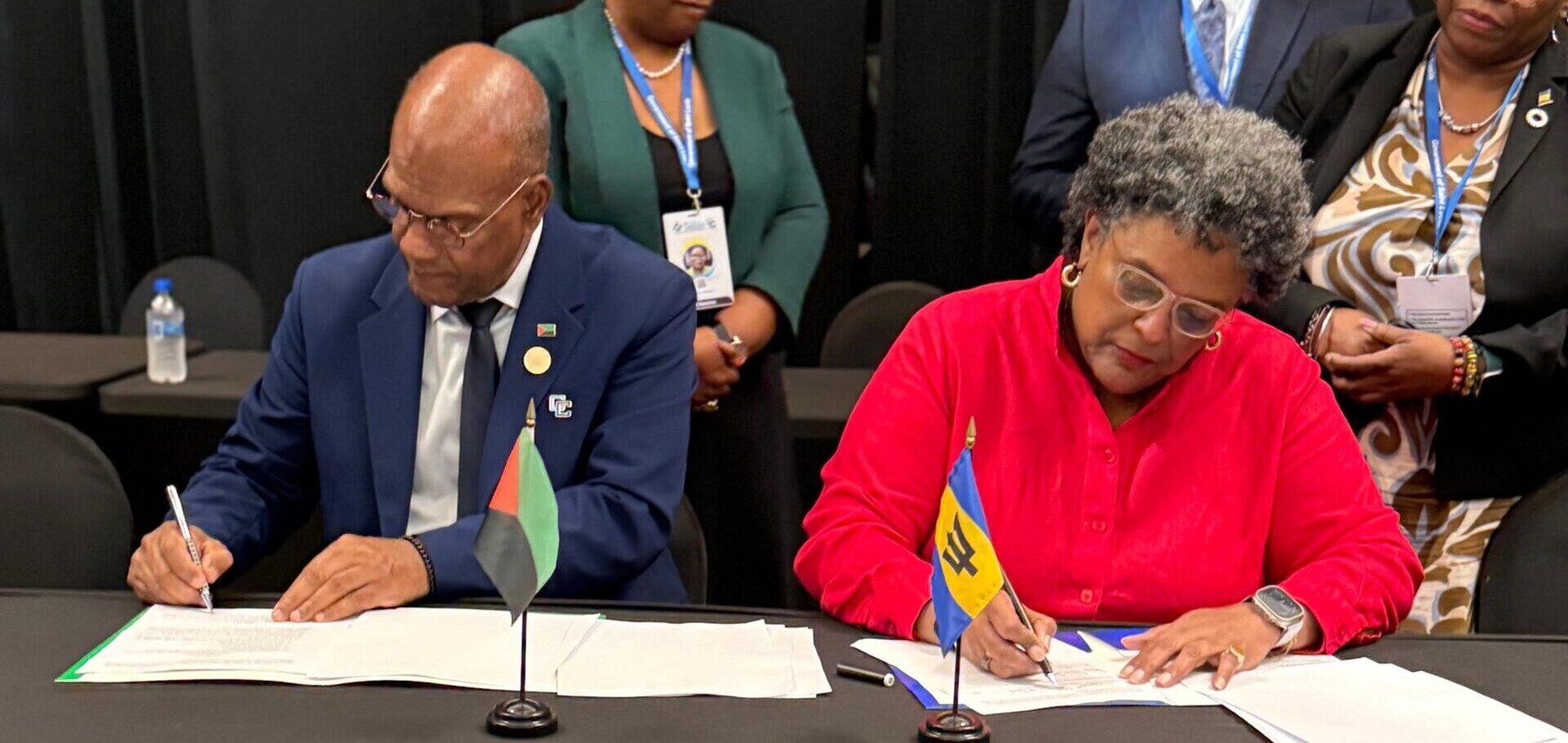
Against the backdrop of growing demand for coordinated regional action in the Caribbean, Martinique and Barbados have cemented a groundbreaking new partnership that paves the way for deeper cross-territory collaboration across multiple critical sectors. The formal signing of the agreement took place July 7 on the margins of the annual CARICOM Summit, marking Martinique’s first high-level participation in the gathering since it gained associate membership in the Caribbean Community (CARICOM) this past February.
The historic document was signed by Serge Letchimy, President of Martinique’s Executive Council, and Mia Amor Mottley, Prime Minister of Barbados, in a ceremony witnessed by regional stakeholders from across the Caribbean bloc.
In an official press statement published by the Territorial Collectivity of Martinique (CTM), local authorities framed the new agreement as a key milestone in Martinique’s bid to embed itself more deeply in regional Caribbean affairs, turning its new associate membership status into tangible, people-centered progress.
For Letchimy, the partnership sends a clear message that Martinique is committed to more than just symbolic participation in CARICOM. “Martinique is not simply taking its seat at the CARICOM table. It is here to build, propose, cooperate, and act. With Barbados, we are opening a new chapter: one of useful, operational, organised and results-driven Caribbean cooperation. We share a common responsibility: to turn our geographical, historical and human proximity into concrete projects for our peoples,” he said in remarks following the signing.
The sweeping cooperation framework covers a broad range of priority areas identified as foundational to the long-term prosperity and stability of Caribbean communities. These include cultural and creative industries, sports exchanges, formal education, vocational skills training, climate and disaster risk management, public health collaboration, sustainable tourism development, fisheries management, and streamlined trade procedures between the two territories.
Officials project that the partnership will unlock new opportunities for youth workforce development, expand cross-border economic ties, boost regional capacity to adapt to climate change, strengthen core productive sectors, and leverage shared cultural heritage as a unifying driver of cooperation and growth.
Unlike many broad regional cooperation pacts that stall after signing, the new agreement includes formal institutional structures designed to ensure accountability and deliver measurable, on-the-ground results. A joint bilateral Cooperation Committee, co-led by senior representatives from both Barbados and CTM, will be tasked with setting annual cooperation priorities, approving work programs, tracking activity progress, evaluating outcomes, and recommending adjustments for future initiatives.
A dedicated Technical Secretariat will also handle day-to-day project tracking and provide logistical support for implementation. To maintain full transparency, the two partners will publish a joint annual report that details completed activities, allocated resource usage, performance metrics, unmet challenges, and planned work for the coming year.
The agreement will remain in force for an initial five-year term, with provisions for renewal through mutual consent, creating a stable, long-term framework for sustained collaboration. For Martinique, the partnership also reaffirms its long-term strategic goal of acting as a collaborative bridge connecting the Caribbean region to Europe, the Americas and Africa, while contributing directly to inclusive regional development and integration.