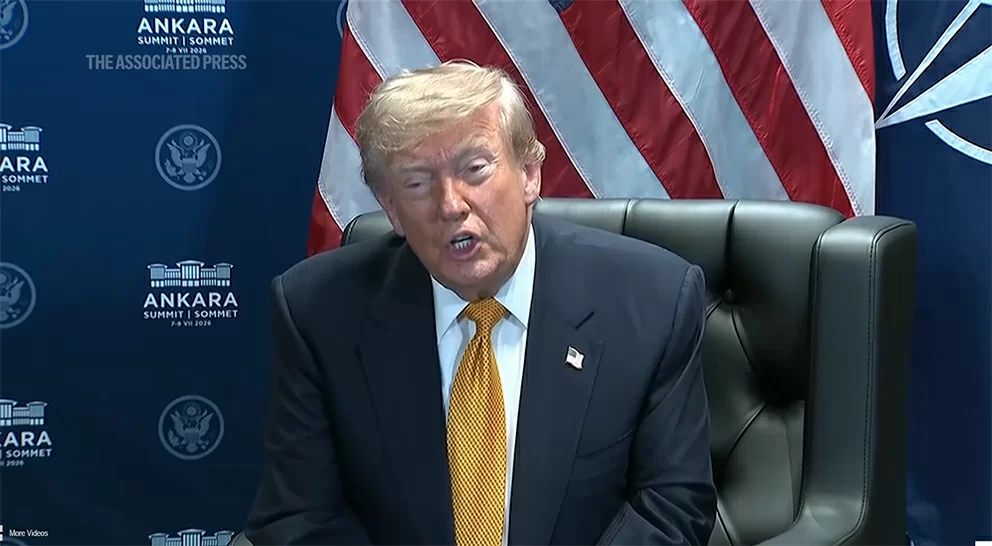
Global financial markets faced sharp volatility on Wednesday, driven by contradictory comments from former U.S. President Donald Trump that cast deep uncertainty over a temporary ceasefire in the Iran conflict. The conflicting signals sent oil prices surging and put broad downward pressure on equity markets worldwide, as investors braced for potential disruptions to global energy supplies that could upend recent progress on taming inflation.
After Trump first stated that the ceasefire between Israel and Iran was “over,” the benchmark S&P 500 initially dropped 1.1%. The index pared its losses later in the trading session after Trump walked back his remarks, clarifying that the recent escalation of violence did not necessarily mean a full-scale regional war would break out. When markets closed, the S&P 500 recorded a 0.3% decline, falling 21.14 points to settle at 7,482.71. The Dow Jones Industrial Average suffered steeper losses, dropping 576.76 points, or 1.1%, to close at 52,348.39. The Nasdaq bucked the downtrend, gaining 51.96 points to finish at 25,870.65, a 0.2% rise after an early session drop.
Oil prices reacted far more strongly to the geopolitical uncertainty than equities. Brent crude, the global benchmark, jumped 5.2% to settle at $78.02 per barrel, at one point pushing above the $80 per barrel threshold. While this remains well below the nearly $120 per barrel peak hit during the height of the conflict earlier this year, the increase marked a stark reversal after oil prices had recently fallen back to pre-war levels.
Investors’ top concern is that a resumption of full-scale conflict could disrupt shipping through the Strait of Hormuz, the strategic chokepoint through which roughly a fifth of global oil supplies pass. A blockade or major disruption would severely curtail crude oil exports from the Persian Gulf, sending energy prices higher across the board. For global economies already working to bring inflation down from multi-decade highs, a new energy-driven inflation surge would upend forecasts. Higher inflation would likely force central banks including the U.S. Federal Reserve to keep interest rates higher for longer, slowing economic growth and weighing on asset valuations.
On Wall Street, the hardest-hit sectors reflected growing expectations of prolonged high interest rates. Homebuilding stocks came under intense selling pressure, as investors priced in higher mortgage rates driven by rising 10-year U.S. Treasury yields. Building materials supplier Builders FirstSource dropped 5.4%, while major homebuilders PulteGroup and D.R. Horton fell 5.4% and 4.6% respectively. Companies with high fuel costs also retreated: American Airlines shares declined 4%, and cruise operator Carnival fell 3.9%.
Large-cap artificial intelligence stocks provided a key buffer against broader market losses, even as the sector has faced recent pressure from valuation concerns and questions about long-term profitability. Chipmaking giant Nvidia gained 3.7%, making it the largest single contributor to the S&P 500’s limited decline. Broadcom rose 4.8%, boosted by news of a new multi-year chip supply agreement with Apple that could be worth more than $30 billion.
In the bond market, Treasury yields moved in line with rising oil prices, as investors priced in persistent inflation. The yield on 10-year U.S. Treasuries hit an intraday high of 4.60% before retreating to 4.57%, up from 4.55% the previous trading day and far above the 3.97% level recorded just before the Iran conflict escalated.
European equity markets reacted sharply to Trump’s initial comments, with major benchmarks posting deep losses. Germany’s DAX and France’s CAC 40 both closed down 2.2% on the day.
Asian markets also saw widespread volatility, though the region offered one notable bright spot for AI investors. South Korea’s Kospi index dropped 5.3%, swinging sharply as investors flipped between optimism and caution for domestic AI stocks. Hong Kong’s Hang Seng Index was an outlier, rising 3%, driven largely by a 13.4% jump in shares of Chinese artificial intelligence startup Zhipu, also known as Z.ai. The startup, which went public in January, was set to see its lock-up period for early large investors expire this week, a development that had sparked fears of major sell-offs that would push share prices down. However, state-run China National Radio reported that nearly 70% of early investors have committed to holding their positions, easing market concerns. Since its IPO, Zhipu’s share price has surged more than 1,300%, underscoring the overwhelming investor demand for AI exposure across Asian markets.