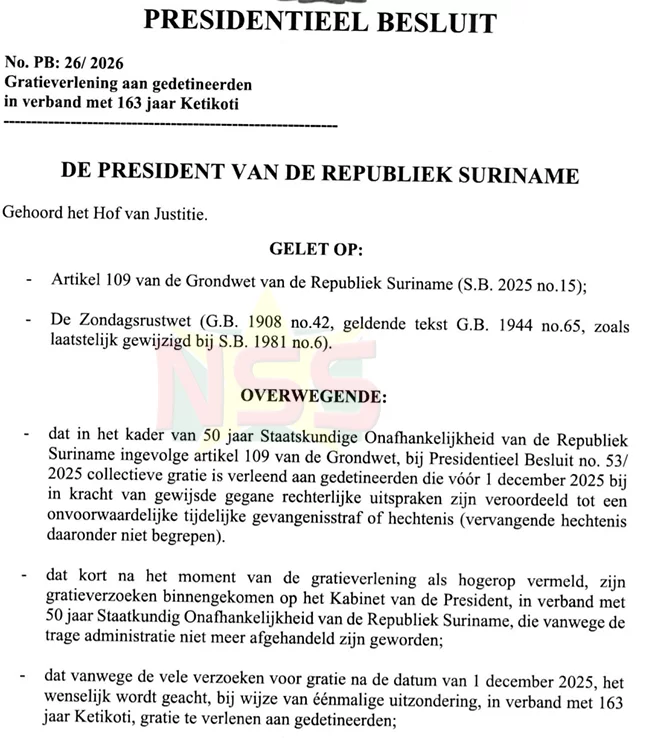
On July 8, 2026, Suriname President Jennifer Simons announced a sweeping collective pardon program for a cohort of the country’s incarcerated population, tied to the national celebration of the 163rd anniversary of Keti Koti — the annual commemoration of the abolition of slavery in Suriname. The multi-tiered sentence reduction scheme applies only to offenders who meet a clear set of eligibility criteria, with severe violent and sexual crimes explicitly excluded from participation.
According to the official presidential decree issued to formalize the measure, pardon eligibility is restricted to inmates who received a final, unappealable court conviction for an unconditional fixed-term prison sentence or custodial sentence between December 2, 2025 and July 1, 2026. The program’s sentence reductions are structured based on the length of an inmate’s remaining sentence, to create a proportional impact:
– Inmates with fewer than two years left on their sentences will receive a 5-month sentence cut
– Those with remaining sentences between two and five years qualify for a 9-month reduction
– Inmates with five to fewer than eight years remaining will see their sentences cut by 15 months
– Offenders with eight or more years left on their sentences are eligible for an 18-month reduction
Even inmates serving life sentences are able to apply for the pardon under specific conditions. The program allows for life sentences to be converted to fixed-term sentences, with the new term length set at either 20 or 50 years depending on which penal code was applied to issue the original conviction.
Notably, the presidential decree permanently bars any inmate convicted of murder or sexual offenses from accessing the pardon program. All other aspects of original court convictions remain fully in force outside of the approved sentence reductions, the document clarifies.
The announcement notes that Suriname previously issued a similar collective pardon to mark the 50th anniversary of the country’s political independence. In the period following that earlier program, a large backlog of clemency requests has built up, with administrative delays preventing many applications from being processed in a timely manner, per the country’s government. This new pardon initiative aims to address that backlog while aligning with the national spirit of reflection and renewal tied to the Keti Koti holiday.