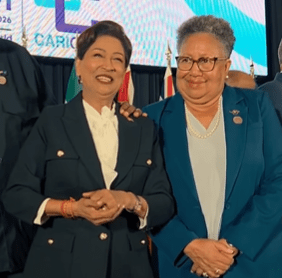
CASTRIES, St. Lucia – July 6, 2026 – A major constitutional dispute has emerged at the 51st Caribbean Community (CARICOM) Heads of Government Summit, after Trinidad and Tobago Prime Minister Kamla Persad-Bissessar formally challenged the legality of incumbent Secretary-General Carla Barnett’s reappointment, framing the objection as a defense of institutional integrity rather than a personal or political attack.
In a 22-page confidential letter shared with regional leaders and obtained by the Caribbean Media Corporation (CMC), Persad-Bissessar laid out detailed legal objections to Barnett’s February 2026 reappointment, which was approved during a heads of government retreat in St. Kitts and Nevis. Barnett, the first woman to hold the CARICOM Secretary-General post, began her first term in August 2021.
The Trinidad and Tobago Prime Minister emphasized that her administration’s position is not intended to sow division within the regional bloc, but to protect the constitutional order that underpins CARICOM’s legitimacy. “Regional unity cannot rest upon expediency and irregular practices masquerading as precedent. It must rest upon adherence to the rules which every Member State has freely accepted and undertaken to uphold,” Persad-Bissessar wrote.
Persad-Bissessar outlined four core violations of the Revised Treaty of Chaguaramas, CARICOM’s founding legal framework. First, she noted that Article 24 of the treaty explicitly grants the power to appoint and reappoint the Secretary-General to the full Conference of Heads of Government, not a closed, informal heads-only retreat. While retreats may facilitate confidential discussion, she argued, they cannot replace the formal constitutional body designated to exercise appointment authority. Even though attendees of the retreat overlap with full Conference membership, she wrote, “Substance prevails over nomenclature. A body cannot acquire treaty powers merely because participants overlap with those who ordinarily constitute the treaty organ.”
Second, Persad-Bissessar pointed out that the official communique issued after the February retreat made no mention of the reappointment decision, depriving member states of advance notice and the opportunity to prepare for deliberation on one of CARICOM’s most senior constitutional posts. She rejected arguments that past unrecorded practices justify the current process, noting “two wrongs do not make a right,” and that the principles of openness and informed participation enshrined in the treaty require explicit agenda notice for such critical decisions.
Third, the Prime Minister highlighted that the mandatory constitutional process requiring a recommendation from the CARICOM Community Council prior to any appointment or reappointment was completely bypassed. Persad-Bissessar stressed that this requirement is not an optional procedural formality, but a core constitutional safeguard, and that reappointment falls under the same rules as a first appointment. “By bypassing the Community Council, the constitutional balance established by the Revised Treaty was displaced, and the Conference purported to exercise a power that had not yet been lawfully engaged,” she wrote.
Fourth, Persad-Bissessar noted that the Office of the CARICOM General Counsel failed to provide adequate legal guidance to ensure compliance with constitutional requirements for representation, agenda setting, and decision-making. She argued that this omission directly contributed to the current controversy over the reappointment’s validity.
To resolve the dispute, Persad-Bissessar has proposed two key interim and long-term measures. First, she called for an immediate expedited advisory opinion from the Trinidad-based Caribbean Court of Justice (CCJ) – CARICOM’s highest judicial body – under Article 212 of the Revised Treaty, to clarify the treaty’s requirements for Secretary-General reappointment. She emphasized that turning to the CCJ is not an act of confrontation, but a commitment to the rule of law that all member states agreed to uphold: “Resorting to the CCJ is not an act of confrontation. It is an affirmation of the very constitutional architecture that Member States created to safeguard the integrity of the Community.”
Second, Persad-Bissessar proposed that Barnett remain in office on a month-to-month basis only until the CCJ issues its ruling, with the extension explicitly stated to not prejudice the legal positions of any member state. She also mandated full recusal for both Barnett and the CARICOM General Counsel from all proceedings related to the CCJ referral: Barnett because she has a direct personal and legal interest in the outcome of the case that creates a conflict of interest and reasonable apprehension of bias, and the General Counsel due to her role as a primary advisor to Barnett. All responsibilities related to the advisory proceedings would be transferred to the CARICOM Deputy Secretary-General or another independent party.
The dispute has become a central agenda item for regional leaders, who began a closed-door retreat on the first working day of their four-day summit, chaired by St. Lucia Prime Minister Phillip J. Pierre. Persad-Bissessar arrived at the summit’s opening ceremony Sunday night after Barnett delivered her opening remarks, and St. Kitts and Nevis Prime Minister Dr. Terrance Drew, who spoke after Barnett’s reappointment in February, publicly praised her stewardship of the Guyana-based CARICOM Secretariat and the regional integration movement. Drew noted that Barnett “have understood the importance of preserving the impartiality of the Secretariat while faithfully implementing the decisions of heads of government,” adding that “that balance has strengthened this community, and for this, I offer, on behalf of all of us, our sincerest gratitude.”
In closing her letter, Persad-Bissessar reaffirmed Trinidad and Tobago’s commitment to strengthening CARICOM institutions, noting that decades of regional cooperation and collective global influence depend on transparent, treaty-compliant governance. “Those achievements can only endure where the institutions of CARICOM are administered transparently and consistently with the Revised Treaty, and with the legal framework to which every Member State has committed itself,” she wrote, adding that an authoritative CCJ ruling would provide the clarity and legitimacy needed for the bloc to move forward together.