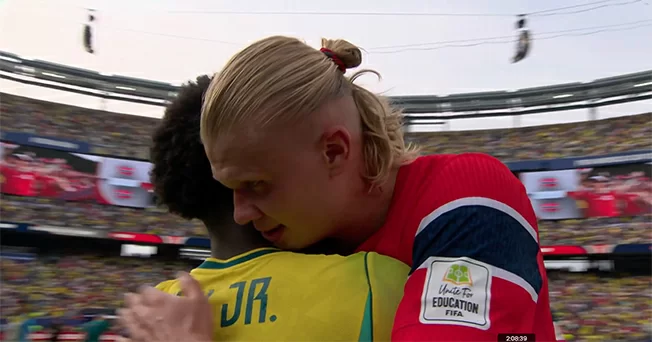
For weeks now, the entire world has had one eye fixed firmly on the FIFA World Cup, a global quadrennial spectacle that stretches far beyond the boundaries of a simple sporting tournament. Across 90 minutes of play, under bright stadium lights and in the living rooms of millions of fans, the World Cup tells a universal story of hope, resilience and grit — themes that resonate more deeply than ever at a moment when global stability feels increasingly fragile.
For billions of Brazilian football fans, the national team’s early exit in the round of 16 hit harder than most could have expected. For decades, Brazil was synonymous with beautiful, fluid football and an aura of invincibility that left opposing teams trembling before they even stepped onto the pitch. While the last three World Cup squads have not lived up to that legendary standard, the unwavering passion of the players and the Brazilian people for the beautiful game and their dream of lifting the trophy remains undimmed. This is the core power of sport: it is never only about triumph. It is about persistence, about getting back up after defeat, and about holding onto belief even when the odds are stacked against you.
If you look beyond the green grass of the tournament pitches, the World Cup’s meaning grows even richer. In Gaza, a region torn apart by months of war and crippling uncertainty, Palestinian fans celebrated Morocco’s historic victories with unbridled joy. Amid the destruction and chaos of daily life, that moment of shared celebration offered a rare breath of peace, a small sliver of joy to hold onto when hope feels scarce. For Gaza’s people, this World Cup became a beacon, a quiet reminder that even in the deepest darkness, light can still break through.
The Iranian national team also arrived at the tournament carrying an extraordinary weight, facing immense obstacles and widespread doubt on their road to Qatar. Yet they stepped onto the global stage as heroes, welcomed home with open arms regardless of their final results. Their journey is a powerful testament to perseverance and national pride, proof that sport can transcend political divides and break down barriers. For the Iranian team and their supporters, the World Cup was never just a series of matches — it was a symbol of hope and shared unity.
Even tiny Cape Verde, a small island nation with barely half a million people, turned the global football spotlight into a stage to prove that courage and determination matter far more than size or global reputation. The underdog side pushed powerhouse Argentina to the absolute limit, turning unknown players into household names and putting their small nation firmly on the global football map. This World Cup has reinforced a timeless truth: respect and recognition are not reserved only for the world’s sporting giants. They belong to every team and every person brave enough to dream big and fight for their goal.
At the same time, this tournament has also been a farewell. For a generation of the world’s biggest football superstars, this is their final appearance on the sport’s biggest global stage. Cristiano Ronaldo chases one last shot at glory with Portugal, while Lionel Messi dances his final World Cup tango with Argentina, bringing a passion to the pitch that will inspire generations of players to come. Neymar’s dream of leading Brazil to a sixth World Cup title crumbled early, a harsh reminder that even the biggest stars face the inherent vulnerability of sport. Meanwhile, Luka Modric continues to inspire his team and his country with tireless dedication, a beacon of experience and strength in a rapidly changing football landscape.
These iconic players, who turned childhood dreams into global legend, are now confronting the quiet reality that their time on the world’s biggest stage is slowly drawing to a close. This makes the World Cup a beautiful paradox: it gives rising new stars a platform to shine, while also bidding farewell to the legends who defined the game for a generation, clearing the way for a new era. It reminds us that all dreams are vulnerable — they can come true, but they can also fall apart. And it is exactly that vulnerability that makes the beautiful game so deeply human, so universally relatable to people across every corner of the globe.
In an era where war, poverty and uncertainty have become daily reality for billions of people around the world, this World Cup has shown that joy, hope and connection can be found anywhere: on the pitch, in packed stadiums, and in the hearts of millions of fans across the world.
Brazil’s early fall, Morocco’s unexpected triumph, Iran’s defiant heroes and Cape Verde’s fearless underdog run are all chapters in this larger story. It is a story that reminds us that football is never only about winning or losing. It is about holding onto belief, and never stopping dreaming. In these divided, uncertain times, it is hope that binds us together, it is hope that pushes us forward, and it is the persistence to keep going that lets us prevail — both on the football pitch, and off it.