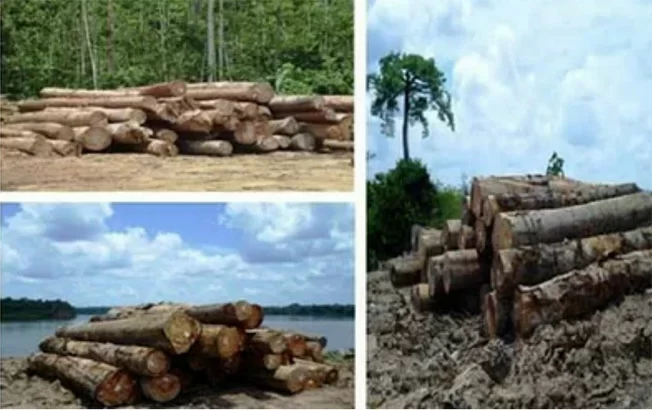
Suriname is home to one of the largest contiguous forest expanses in the world. For decades, the country’s timber industry has been hailed as a core engine of economic growth, export revenue, and local job creation. Yet a disproportionate share of the natural resource’s total economic value continues to leak beyond Suriname’s borders. The debate over unprocessed roundwood exports has reemerged into public discourse following a recent undergraduate graduation study from Anton de Kom University of Suriname, which concludes deep-seated structural bottlenecks within the domestic sawmill industry are preventing local processing of the nation’s timber reserves.
While the core conclusion of this discussion is not new, Sharvan Jagernath’s study – for which he was awarded a Bachelor of Science from the university on Friday – uses up-to-date empirical data to confirm what policymakers, business leaders, and researchers have long observed: Suriname has both abundant timber supplies and sufficient installed processing capacity, but it has failed to maximize the economic benefits of this critical natural asset.
The debate over roundwood exports is far from new, stretching back decades across successive Surinamese administrations. Nearly every government has publicly committed to expanding local timber processing, a policy rooted in simple economic logic: a single tree generates far greater economic value when processed domestically into sawn timber, furniture, window frames, flooring, or other finished products than it does when exported as an unprocessed log.
The underlying principle is straightforward: the more processing steps completed within the country’s borders, the greater the total added value retained for the domestic economy.
A key baseline for this ongoing discussion was established by Suriname’s Foundation for Forest Management and Forest Control (SBB). A 2022 SBB study confirmed the country already maintains enough installed sawmill capacity to process all of its domestic roundwood production locally. Even so, more than half of all harvested timber is still exported as unprocessed roundwood, leading to a logical question: if the capacity exists, why is domestic processing not occurring at scale? Jagernath’s graduation study offers a nuanced answer to this longstanding puzzle.
The research finds that the domestic sawmill sector struggles with a interconnected web of structural challenges, rather than a single easily addressed problem. Many operations rely on outdated processing technology, lack sufficient drying and storage infrastructure, and have limited capacity for secondary wood processing. Compounding these issues, unreliable energy access, exorbitant energy and fuel costs, widespread logistical bottlenecks, and acute shortages of skilled skilled workers leave much of the country’s existing installed capacity underutilized.
Market dynamics also play a major role. Most local sawmills only process a small number of well-known timber species and largely produce standard dimension lumber, creating a mismatch between domestic supply and the specific demands of international buyers. The end result is that while Suriname holds both the raw timber and the physical processing equipment, it lacks the enabling conditions needed to extract maximum returns from its natural asset.
Ultimately, the debate over roundwood exports extends far beyond forest management policy, touching on a fundamental question for Suriname’s economic future: how can the country leverage its abundant natural resource endowment to drive broad-based prosperity? Exporting unprocessed logs generates immediate revenue from raw commodity sales, but all subsequent value-added steps – sawing, drying, planing, finished product manufacturing, and branded export sales – take place in other countries. This means the majority of potential new jobs, tax revenue, skills development, and economic value is transferred to foreign economies.
This economic principle holds across natural resource sectors: a nation’s long-term prosperity depends not on how many raw resources it holds, but on its ability to transform those raw inputs into high-value finished products for domestic and global markets.
Jagernath’s study also makes a critical policy point: a standalone ban on roundwood exports is not a silver bullet for the sector’s challenges. If domestic mills continue to grapple with high production costs, persistent power outages, skilled labor shortages, and limited access to investment capital, a competitive domestic value-added timber industry will not emerge automatically.
Successfully phasing down unprocessed roundwood exports requires far more than new regulatory policy. Targeted investments in reliable energy infrastructure, logistics networks, modern processing technology, workforce training, sustainable certification, new market development, and product innovation are equally critical. Delivering these investments will require coordinated action from both the Surinamese government and domestic and international private sector stakeholders.
With new oil and gas revenue projected to enter the Surinamese economy in coming years, the country faces a broader national development challenge: how can these new resource funds be used to build up other productive sectors of the economy? The timber sector is well positioned to be a key beneficiary of this strategic investment.
Suriname already has the forest resource, the domestic entrepreneurs, and the majority of the processing capacity it needs to build a high-value timber industry. The core challenge remains resolving the structural bottlenecks that have held the sector back for decades. As such, the roundwood export debate touches on a far larger question than forest policy alone: it forces the country to confront how it intends to manage and benefit from all its natural wealth long-term.
In conclusion, existing research confirms Suriname has the forests, the processors, and the installed capacity to process most of its roundwood locally. Jagernath’s new study reinforces that capacity alone is not enough. Without targeted investments in enabling infrastructure, widespread industry modernization, and consistent long-term industrial policy, a large share of Suriname’s timber-related economic value will continue to leak beyond its borders.
The central question hanging over the sector is no longer how much forest Suriname controls – that question has long had a clear answer. The real question now is whether the country can turn its abundant natural wealth into sustained, inclusive domestic economic prosperity.