Suriname’s national telecommunications provider Telesur is facing an escalating crisis of infrastructure sabotage, with its national fiber optic network targeted for deliberate vandalism for the third time in just four days.
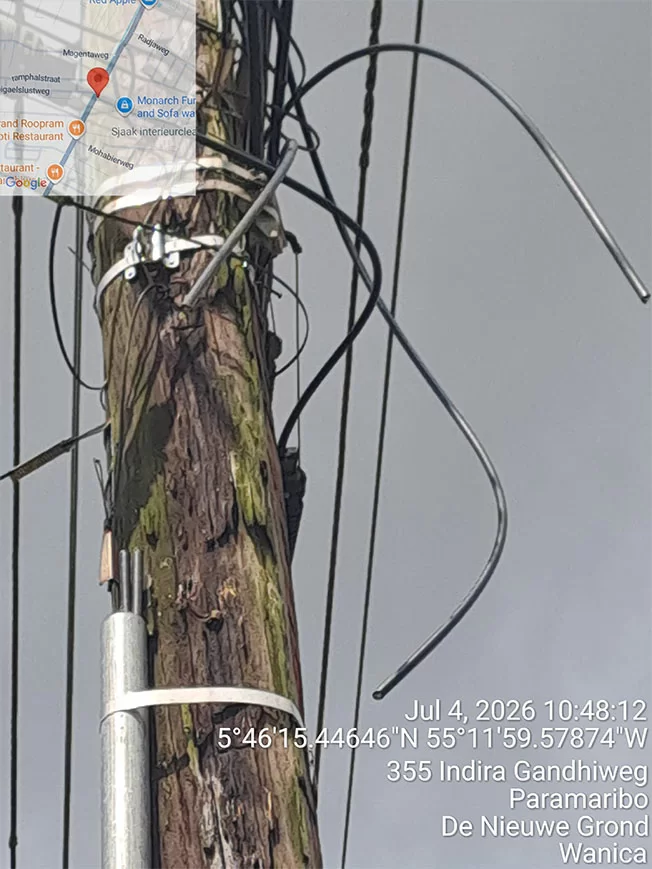
In the most recent attack, perpetrators intentionally sliced through critical fiber optic cables running along the Indira Gandhiweg highway. The damage has triggered widespread disruptions to mobile and internet services for hundreds of residential and commercial customers across multiple districts, including the surrounding Indira Gandhiweg area, Sitalweg, and Livorno-Beekhuizen. Company officials have labeled the string of attacks a deeply worrying development and issued an urgent appeal to the public to report any suspicious activity near key telecom infrastructure immediately.
According to data released by Telesur, every vandalized fiber cable costs a minimum of $3,000 in emergency repair and replacement work, a financial burden that accumulates rapidly after repeated attacks. Beyond the direct monetary costs, the damage leaves hundreds of customers completely cut off from essential communication services for hours or even days, disrupting work, education, emergency access, and daily life.
To address the growing threat, Telesur has reported every incident to local police and other relevant regulatory and law enforcement agencies. Working alongside these authorities, the provider has developed a formal action plan focused on three core goals: tracking down and prosecuting the perpetrators, stopping new attacks before they occur, and strengthening physical security for the country’s sprawling telecom network.
Even with these new safeguards in place, Telesur warns the situation remains deeply concerning. The company has invested consistently in upgrading security measures, expanding surveillance of key routes, and speeding up repair response times, but executives acknowledge that full-time, constant monitoring of a fiber network spanning hundreds of kilometers across the country is logistically and financially impossible.
“Our team is doing everything within our power to contain this problem, but we cannot solve it alone without support from the public and our law enforcement partners,” said Doric Ramlakhan, Telesur’s chief executive officer. “Sometimes, it feels like mopping the floor with the tap still running – as soon as we finish repairing damage in one location, another attack pops up somewhere else on the network.”
Ramlakhan emphasized that Telesur invests millions of dollars every year to expand and modernize Suriname’s fiber optic network, with the goal of delivering fast, reliable telecommunications services to communities across the country, supporting national economic and social development. “Every cut cable doesn’t just add thousands of dollars in unexpected repair costs – it creates major inconvenience for our customers and slows the progress of our entire nation,” he explained. “This infrastructure isn’t just an investment by Telesur – it’s a public good that benefits every single person in Suriname. We’re asking the public to protect what we have all built together. This network belongs to all of us.”
In closing, the company reiterated its call for all citizens to stay vigilant for any unusual or suspicious activity near telecommunications sites or cable routes. Anyone who observes potential suspicious behavior is urged to contact local police or other competent authorities immediately. “Only by working together can we stop repeated attacks on this vital national infrastructure,” Ramlakhan said. “We’re asking every person in Suriname to help us guard what belongs to all of us.”