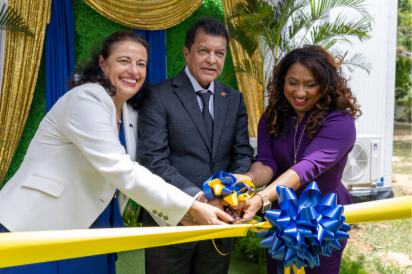
On Friday, July 3, 2026, the Caribbean Public Health Agency (CARPHA) achieved a transformative breakthrough for regional public health resilience with the official opening of its state-of-the-art CARPHA Regional Emergency Operations Centre (CREOC) at the agency’s Port of Spain headquarters in Trinidad and Tobago. The inauguration ceremony was led by three key stakeholders: Trinidad and Tobago’s Minister of Health, The Honourable Dr. Lackram Bodoe; European Union Ambassador to Trinidad and Tobago, Her Excellency Cécile Tassin; and CARPHA Executive Director Dr. Lisa Indar.
Funded entirely through European Union investment under the 11th European Development Fund (EDF) Programme, designed specifically to strengthen health security and prevent transboundary communicable disease outbreaks across the Caribbean, the CREOC will function as the central coordination hub for all public health emergency-related activities across CARPHA’s 26 member states. These activities span preparedness planning, on-the-ground response, post-event recovery, and long-term resilience capacity building.
Speaking at the launch, Dr. Bodoe emphasized the collective nature of 21st-century public health challenges, noting that no Caribbean nation — regardless of its available budget or infrastructure — can successfully contain fast-spreading health threats in isolation. “Our greatest strength comes from cross-border partnership and shared commitment,” he remarked.
Dr. Indar echoed this sentiment, highlighting the unique vulnerability of Small Island Developing States that make up the Caribbean region. With deeply interconnected economies, open borders, and closely linked communities, public health risks can sweep across multiple island nations in days. “This new operations centre will drastically improve our ability to spot emerging threats early, unify regional action, and protect the health and well-being of all Caribbean people,” she said.
Ambassador Tassin reaffirmed the EU’s long-term commitment to Caribbean health security, adding that the CREOC stands as more than just a new facility. “It is a symbol of the Caribbean’s collective determination to protect its people through solidarity, proactive preparedness, and shared technical expertise,” she stated.
Designed to align fully with the World Health Organization’s global Public Health Emergency Operations Centre (PHEOC) Framework, the CREOC has been classified as a Type C Emergency Operations Centre — the highest tier of operational capability recognized under WHO’s global classification system. This top-tier classification means the hub is uniquely equipped to coordinate complex, multi-country public health emergencies while providing critical support to national emergency operations centres across every Caribbean nation.
The new facility expands and enhances CARPHA’s core capabilities in several key areas: continuous monitoring of emerging public health threats, aligned coordination of regional preparedness and response work, streamlined real-time information sharing between member states, evidence-based regional risk assessment reporting, rapid mobilization of specialized technical expertise, and data-backed support for decision-making during urgent situations.
Powered by CARPHA’s locally tailored Regional Integrated Early Warning Surveillance and Response System (RIEWSS), the CREOC provides the robust physical and digital infrastructure needed to detect threats earlier than ever before, improve cross-regional situational awareness, and accelerate coordinated, evidence-based emergency responses across the entire Caribbean. When paired with standardized timeliness metrics and integrated multisectoral response mechanisms, the centre allows CARPHA to serve member states far more effectively by cutting down coordination delays and speeding up action when every minute matters.
As the region’s permanent central coordination hub, the CREOC will deepen collaboration between national ministries of health, national disaster management agencies, regional intergovernmental institutions, and global international partners. During public health events, it will also coordinate deployment of specialized rapid response teams, manage cross-border emergency logistics, lead unified regional risk communication, and maintain a shared, real-time operating picture for all stakeholders.
The creation of the CREOC draws directly on hard lessons learned from recent regional crises that exposed gaps in fragmented national response systems. These events include the global COVID-19 pandemic, recurring large-scale dengue outbreaks, and climate-fueled extreme weather events such as Hurricanes Melissa and Beryl, all of which underscored the urgent need for coordinated regional action to contain transboundary threats.
To adapt to the full range of possible scenarios, the CREOC operates on a scalable activation model that adjusts from routine daily surveillance and monitoring to full-scale regional emergency activation. This flexibility allows CARPHA to rapidly expand its coordination capacity as a situation evolves, whether responding to an infectious disease outbreak, a severe weather event with public health consequences, an environmental or chemical incident, a large-scale mass gathering, or any other event with regional or global public health implications.
In addition to improving regional response capacity, the CREOC strengthens Caribbean nations’ ability to meet their obligations under the International Health Regulations (2005), by boosting regional surveillance systems, information management protocols, emergency coordination, and overall operational readiness.
Friday’s inauguration marks a key milestone in CARPHA’s ongoing mission to advance regional health security and ensure all Caribbean countries are equipped to handle both current and future emerging public health threats.