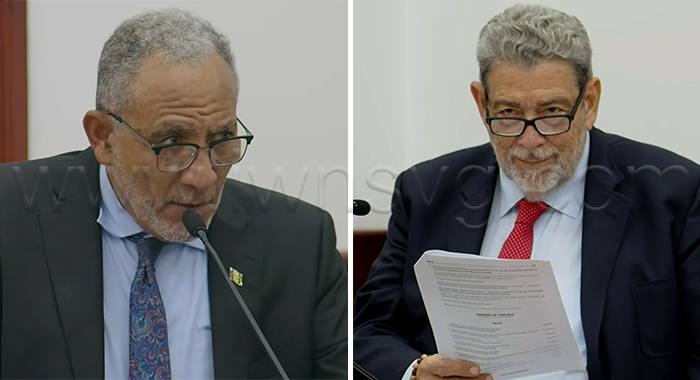
When the Unity Labour Party (ULP) administration of St. Vincent and the Grenadines lost power in November’s general election, it left behind a constrained fiscal landscape that has limited the borrowing capacity of the new government led by Prime Minister and Finance Minister Godwin Friday. Speaking before Parliament this Thursday, Friday addressed questions from the opposition, shedding new light on the country’s current financing arrangements, revealing that the two major external loans the new administration has signed off on this year were first initiated and negotiated by the previous ULP government.
Beyond these two external lines of credit, the country has raised Eastern Caribbean (EC) $30.4 million through domestic bond issuances between April and June of this year, as the government continues to rely on a blended strategy of international project financing and local debt to cover both capital investments and ongoing operating expenses.
The first of the finalized external loans is a $46,715,100 facility from the Caribbean Development Bank (CDB) earmarked for the Canouan Airport Rehabilitation Project. Negotiated initially by the former government, the loan carries a 5% annual interest rate, a 21-year repayment term, and a three-year grace period for principal payments. It is also paired with a $125,000 CDB grant to support project execution. The comprehensive upgrade will address long-standing structural damage to the airport’s runway—including cracking, potholes, surface wear, and cumulative harm from severe weather events—along with updating drainage systems, airfield lighting, coastal protection infrastructure, and delivering new purpose-built facilities for fire services and air traffic control. Friday explained that the current poor condition of the runway restricts aircraft operations, limiting both the type and size of planes that can use the airport. Once complete, the upgrades will allow larger, modern jetliners such as the Airbus A320 to operate from Canouan, boosting direct air connectivity to major regional and international travel hubs.
The second loan is a $20 million budget support and disaster risk management facility from the OPEC Fund for International Development (OFID), carrying favorable terms of 1.25% annual interest, a 21-year maturity, and a five-year grace period. This loan is a repurposed portion of an original $30 million OFID loan that the ULP administration signed in October 2023, which was initially meant to co-finance a new modern national hospital alongside the World Bank. Before the November general election, the previous ULP government scrapped that original financing arrangement and opted for a new loan agreement with Taiwan instead. Friday’s administration entered negotiations with OFID to repurpose the original commitment, requesting that the full $30 million be reallocated, but OFID only approved a $20 million repurposing. The Loan Authorisation Bill for this facility was tabled before Parliament on Thursday to secure formal legislative approval for the new borrowing arrangement.
Turning to domestic borrowing, Friday reported that the $30.4 million raised in local government bonds between April and June was issued via private placement across domestic and regional markets, with three tranches maturing in 6, 8, and 10 years, carrying semi-annual coupon rates of 5.75%, 6.5%, and 7.25% respectively. The prime minister noted that these issuance terms align with the government’s broader debt management strategy, which prioritizes extending the average maturity profile of the country’s domestic debt portfolio to reduce refinancing risk.
Of the total proceeds from the domestic bond issue, approximately EC$6.38 million—equal to 19% of total government capital spending in the second quarter of the year—has been allocated to new capital projects, while the remaining EC$23.66 million has been directed to cover ongoing current government expenditure. In a supplementary question to the prime minister, former prime minister Ralph Gonsalves, leader of the opposition ULP, requested a detailed breakdown of how much of the domestic bond issuance was allocated to the 7.25% coupon tranche, along with specific amortization terms for that portion of the debt. Friday responded that the granular details were not immediately available on the floor of Parliament, but committed to sharing the information at a later date.