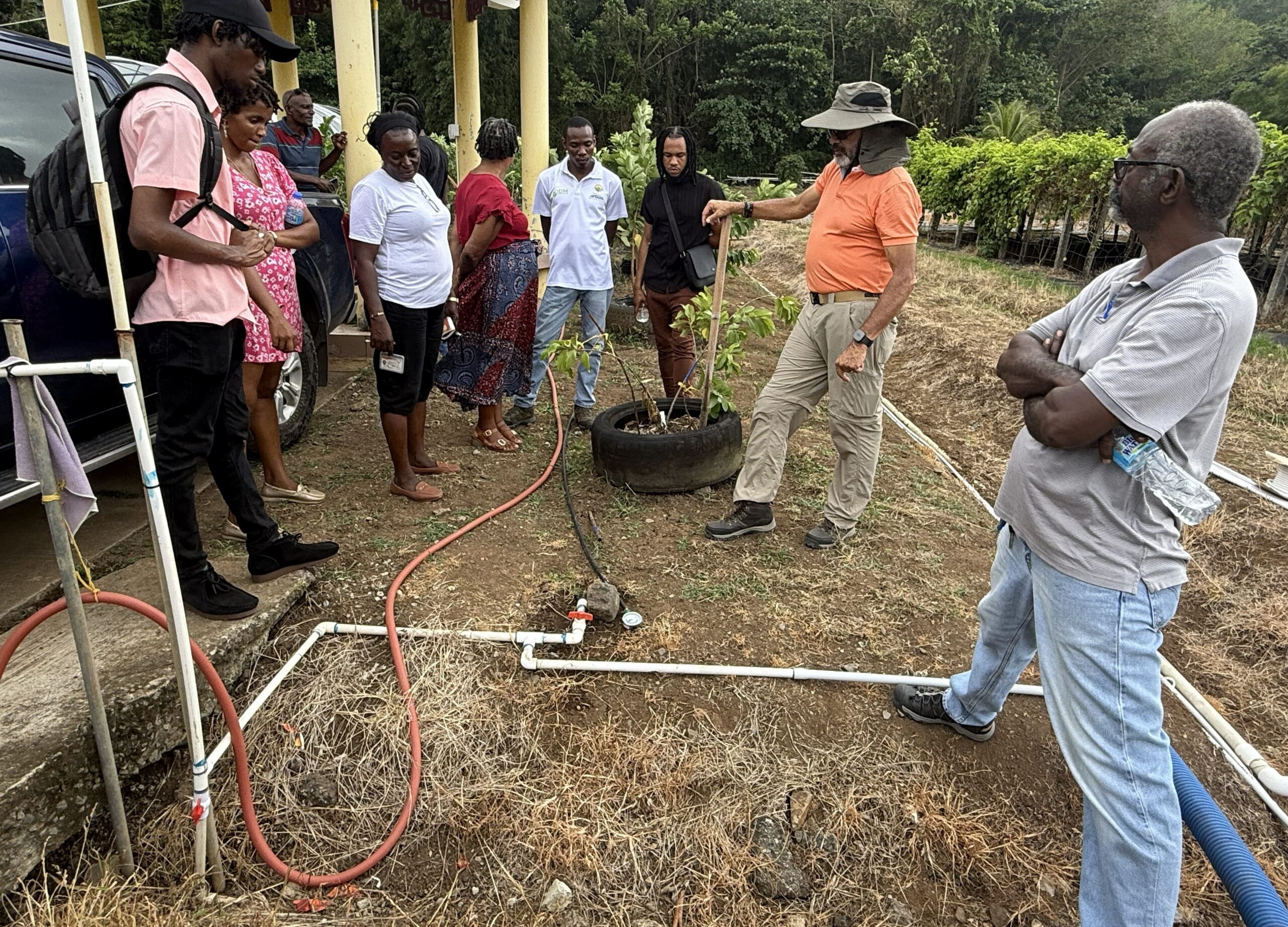
Against a backdrop of growing climate uncertainty, small island agricultural communities are increasingly facing pressure to adapt their growing practices to shifting conditions. For the Caribbean nation of Saint Lucia, that adaptation is getting a boost from a targeted new capacity-building initiative that equips local farmers with practical, climate-smart farming techniques.
Organized jointly by the United Nations Food and Agriculture Organization (FAO) and Saint Lucia’s Ministry of Agriculture, Fisheries, Food Security and Rural Development, a series of hands-on professional training workshops focused on integrated crop management, with a specific focus on improving irrigation, fertigation and nutrient strategies to boost yields and build long-term farm resilience. Titled “Practical Integrated Crop Management: Improving Crop Performance through Irrigation, Fertigation and Nutrient Management”, the workshops were held earlier this month across two locations: Soufrière in the southwest and Union in the north, to serve farming communities across the island.
In total, 38 stakeholders took part in the sessions, representing a cross-section of Saint Lucia’s agricultural sector: small-scale and commercial farmers, plant nursery operators, government agricultural officers, extension service personnel, technical specialists, ministry support staff, and representatives from both public and private agricultural entities. Hosting the training in two geographically distinct regions of the island was a deliberate choice, FAO officials explained, that made the program far more accessible to participants from across the country while also allowing attendees to test how these modern practices work across Saint Lucia’s varied local growing conditions.
Led by FAO Horticulture Specialist Marcko Theodoracopoulos and FAO Plant Production and Protection Specialist Anne Desrochers, who also serves as the project’s Lead Technical Officer, the workshops dug into the interconnected relationships between irrigation scheduling, fertigation application, crop nutrition requirements, plant growth stages, and unique local field conditions. Attendees learned how to weave all these factors into cohesive, effective daily farm management plans.
Practical skill-building formed the core of the program. Participants received step-by-step instruction on how to design, operate, and maintain drip irrigation systems, covering critical operational details from filtration system maintenance and regular line flushing to leak prevention and water flow and pressure management. A major section of the training was dedicated to addressing the unique challenges of running irrigation systems on Saint Lucia’s famously hilly terrain, where changes in elevation can disrupt water pressure and lead to uneven distribution of both water and crop nutrients.
Additional training modules covered the installation and calibration of Venturi fertiliser injectors, proper fertiliser preparation, and adjusting injection rates to match crop needs. Farmers learned actionable techniques to prevent common system blockages, prepare concentrated fertiliser stock solutions, and use electrical conductivity and pH measurements to fine-tune fertigation applications and reduce crop stress caused by inconsistent nutrient or water access.
Live, hands-on demonstrations held on working commercial farms let participants observe irrigation and fertigation systems in real operating conditions. Attendees got the chance to troubleshoot common mechanical and operational problems firsthand, and discuss how to adapt these technologies to fit the specific size, terrain, and crop needs of their own farms.
Desrochers noted that holding sessions across both the northern and southern regions of the island made the training far more relevant to participants’ on-the-ground experiences. “Delivering the training in the North and South allowed participants to relate the technical information directly to the conditions they manage on their farms,” she explained. “Irrigation and fertigation systems must be adapted to each site, particularly where terrain, water access and pressure vary. Strengthening farmers’ and extension officers’ capacity to make these adjustments is essential for ensuring that the technologies provided through the project are used effectively and sustainably.”
Feedback from participating farmers has been overwhelmingly positive. Erbert Lionel, a local farmer who attended the Soufrière session, called the program both engaging and deeply valuable. “On behalf of the farmers, I would like to sincerely thank FAO for helping us better understand these practices and how to combine them to achieve better results,” he said.
Anderson Emillaire, who participated in the Union workshop, added that the session reinforced existing farming knowledge while introducing innovative new approaches. “We really appreciate the knowledge provided during the session. Even where some of the topics were familiar, it was helpful to revisit them, and we would welcome more training as the project progresses,” he said.
This crop management training forms one component of a broader FAO technical mission to Saint Lucia. During the mission, FAO specialists joined Ministry of Agriculture officials to visit farms that are already benefiting from the project, to assess progress on land preparation, greenhouse construction, water access development, irrigation needs assessment, and the installation of new project-funded technologies. Farmers also received customized one-on-one guidance on bed layout, contour alignment for sloped terrain, drainage system design, water flow and pressure adjustment, and the placement of mainlines and driplines ahead of upcoming installation work.
The mission also included an inspection of a recently refurbished biological control laboratory that was commissioned as part of the same overall project. Once fully operational, the facility is expected to strengthen Saint Lucia’s domestic capacity to produce and deploy natural biological pest control agents, as part of the country’s broader push to expand integrated pest management and reduce agricultural reliance on chemical pesticides.