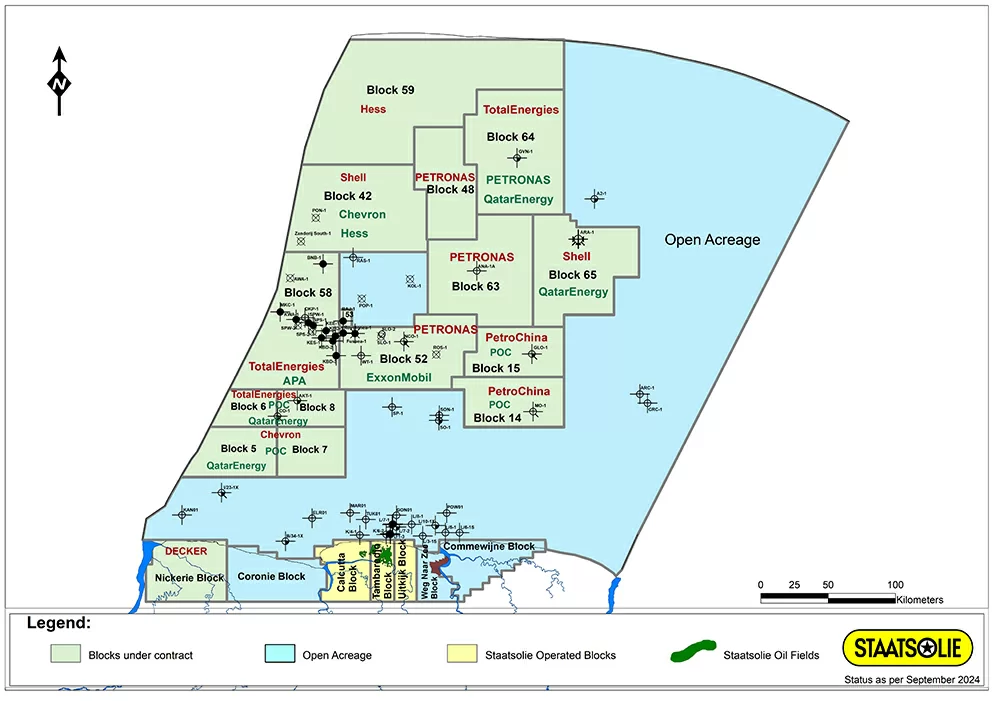
Malaysian energy giant Petronas has announced two new hydrocarbon discoveries and the successful completion of an appraisal project at its offshore Block 52 concession in Suriname, pushing the company’s total count of successful wells in the South American country to eight. Combined, these recent operational achievements add more than one billion barrels of oil equivalent in recoverable hydrocarbon reserves to the company’s portfolio.
The first of the new finds, the Caiman-1 exploration well, was drilled to a total depth of 5,065 meters in waters just 90 meters deep, and intersected multiple oil-bearing sandstone formations. The second discovery, the Swartzia Aspasia Complex-1 (SAC-1) well, uncovered gas-bearing reservoirs at 610 meters depth, with drill stem testing confirming strong, consistent gas flow from the find. The Roystonea-2 appraisal well, meanwhile, successfully verified the scale and resource quality of the oil-bearing reservoirs first identified near the earlier Roystonea-1 discovery, de-risking the project for future development.
Petronas holds an 80% working stake in Block 52, while the remaining 20% is owned by Paradise Oil Company, a local subsidiary of Suriname’s national oil firm Staatsolie. Across Suriname, the Malaysian energy major holds interests in eight separate offshore blocks, covering Blocks 9, 10, 48, 52, 53, 63, 64 and 66.
Mohd Jukris Abdul Wahab, Chief Operating Officer and Executive Vice President of Petronas Upstream, emphasized the strategic significance of the latest operational successes. “With eight successful wells and more than one billion barrels of oil equivalent in recoverable reserves now under our belt in Suriname, this achievement underscores our technical expertise, disciplined project execution, and the strength of our local partnerships here,” he said. “Block 52 sits within the highly prospective ‘Golden Lane’ of the Suriname-Guyana basin, and we remain committed to unlocking these resources to deliver long-term sustainable value for both Suriname and Petronas.”
The string of recent discoveries is cementing Suriname’s reputation as an emerging deepwater production hub within the broader Suriname-Guyana basin, one of the world’s most active new hydrocarbon exploration regions. Separately, Petronas and its partners have already declared the Sloanea gas field commercially viable, with a final investment decision for the project scheduled for the end of 2026.
Beyond upstream resource development, Petronas has also invested in broad-based local capacity building in Suriname. The company runs a scholarship program that supports Surinamese students to pursue higher education at Universiti Teknologi Petronas, its flagship technical university based in Malaysia.