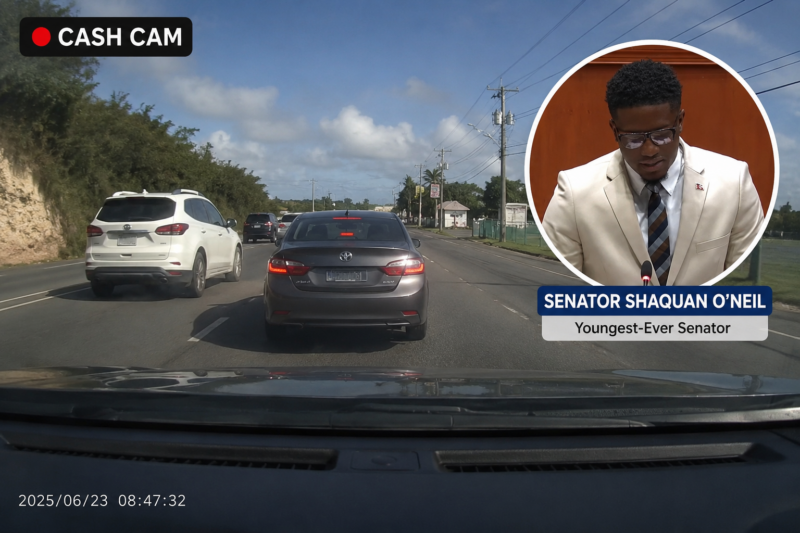
In his first address to the Upper House of Antigua and Barbuda during Monday’s plenary debate on the 2026 Fatal Accidents Bill, the nation’s youngest sitting lawmaker Senator Shaquan O’Neil has put forward a bold proposal to roll out widespread dashboard camera adoption across the country, framing the accessible technology as a critical tool to reverse a troubling upward trend in road collisions. O’Neil argued that dash cams do more than just record driving incidents — they generate concrete, admissible evidence that law enforcement can use to swiftly identify and prosecute reckless motorists who put other road users at risk, particularly repeat offenders who engage in dangerous behavior like excessive speeding and unsafe multiple-vehicle overtaking on high-traffic routes including Airport Road, All Saints Road and Factory Road. “When vehicle owners install dash cams, they aren’t just protecting themselves — they become active partners to police in cracking down on dangerous speeding that endangers entire communities,” O’Neil told assembled senators. The young senator emphasized that technological solutions like dash cams must be paired with long-term, targeted investments in road safety education to drive sustained change, noting that interventions should prioritize young and male drivers, a demographic that has consistently accounted for a disproportionate share of traffic injuries and fatalities. To back up his call for urgent action, O’Neil cited official data from the Royal Police Force’s Traffic Department, which shows a steady year-over-year rise in road collisions across the nation: incidents climbed from 2,448 in 2023 to 2,610 in 2024, and reached 2,749 in 2025. Beyond the human cost, O’Neil highlighted the widespread economic burden that reckless driving imposes on all motorists, pointing to regional insurance data showing that regional insurers paid out a total of $86.6 million in vehicle-related accident claims in 2024 alone. Those costs, he stressed, are ultimately passed through to responsible drivers in the form of inflated annual insurance premiums, making reckless driving a problem that hits every motorist’s wallet. Turning to the Fatal Accidents Bill that was the subject of Monday’s debate, O’Neil acknowledged that the new legislation represents an important step forward by strengthening financial compensation for families who have lost loved ones to fatal road crashes. However, he reminded the chamber that no amount of financial support can fill the gap left by a lost life, and called for policy makers to expand support to include dedicated emotional and mental health services for bereaved families alongside the increased compensation. “No sum of money can bring a family member back — not a million, not two million, not ten million,” he said. “Our response to road fatalities has to address both the financial and emotional devastation that these incidents leave behind.”