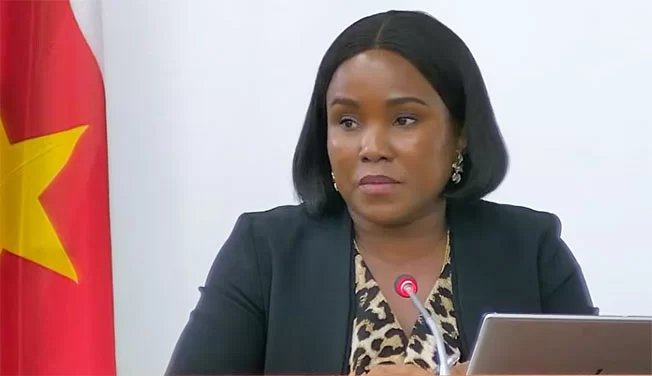
As Suriname grapples with a persistent 5.1% budget deficit, a senior opposition parliamentarian has issued a urgent call for the Santokhi government to undertake a sweeping audit of national public spending, reallocate unused funds to high-need areas, and root out long-standing systemic financial inefficiencies plaguing the country’s public sector.
Silvana Afonsoea, a member of the National Democratic Party (NDP) and serves on the legislature’s committee of rapporteurs, laid out her proposals during the second reading of the country’s annual national budget. She argues that current budget practices essentially hand the ruling administration a blank check to take on unsustainable new debt, a path she says will only worsen the country’s already fragile fiscal position.
Afonsoea’s core proposal centers on a mandatory mid-year review of all government departmental budgets. She points to a widespread pattern of unspent allocations across multiple ministries, many of which lack the operational capacity to deliver all the projects included in their annual budget plans. Under her framework, any funding earmarked for projects that cannot be executed within the current fiscal year would be drastically cut, reduced to zero, and reconsidered for inclusion in the following year’s budget.
Beyond ministry-level spending, the NDP lawmaker also leveled sharp criticism at the country’s state-owned enterprises (parastatal entities), many of which continue to receive taxpayer funding without meeting basic financial transparency requirements. Afonsoea notes that a number of these parastatals have failed to submit audited annual financial statements, leaving legislators and the public unable to assess their true financial health. She insists that any state-owned company that does not regularize its financial records should be cut off from new government funding until it complies with transparency rules. She also highlighted the imbalance where some parastatals hold large reserve funds while the parent government departments that oversee them struggle with crippling budget shortfalls.
Afonsoea also turned attention to the widespread issue of double public sector salaries, a long-reported problem in Suriname’s public administration. She called on the government to launch a full investigation into how many parastatal directors collect full salaries as civil servants or appear on multiple public payrolls at once, calling the practice indefensible when public school teachers often wait months to receive their owed pay.
All funds freed up by these cost-cutting and efficiency reforms, she argues, should be redirected to the sectors that need it most: the country’s struggling public health system, underfunded public education, and crumbling national infrastructure. Specific priorities she named include expanding access to medication for patients covered by the country’s basic care card, improving school facilities, retaining skilled nursing staff, and delivering long-delayed infrastructure upgrades.
“In our private lives, we all have to set priorities when money is tight. It is long past time the government does the same,” Afonsoea argued. “Only through this kind of targeted overhaul can we bring down the budget deficit and put every taxpayer dollar to work where it serves the public best.”