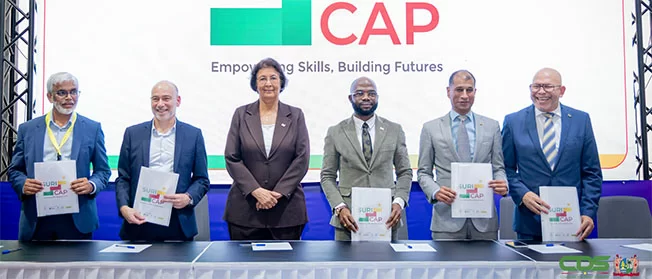
On the sidelines of the 6th Suriname Energy, Oil & Gas Summit & Exhibition (SEOGS 2026) hosted at Paramaribo’s Roeli’s Event Venue, a landmark public-private partnership was formally launched Wednesday to address a growing skilled labor gap across Suriname’s expanding economic sectors. The Suriname government, state-owned energy firm Staatsolie, and global energy major TotalEnergies have signed a Memorandum of Understanding (MoU) to establish the Suriname Capacity Building Program (SURICAP), a comprehensive initiative designed to strengthen vocational education and technical training across the country.
The signing ceremony was attended by Suriname President Jennifer Simons, senior leadership from both energy companies, and three cabinet ministers overseeing key portfolios: Patrick Brunings of the Ministry of Oil, Gas and Environment, André Misiekaba of the Ministry of Public Health, Welfare and Labor, and Dirk Currie of the Ministry of Education, Science and Culture.
In her opening remarks at the Local Content Forum, where the agreement was signed, President Simons emphasized that the initiative extends far beyond Suriname’s fast-growing oil and gas industry. The program is framed as a core pillar of the country’s long-term sustainable development strategy, which aims to elevate the role of vocational training in national education policy. “We need academic researchers and we will continue to invest in their training, but our country has an equally critical need for well-trained skilled tradespeople,” Simons told attendees.
The president also issued a public call to young people who have dropped out of secondary education to re-enroll in vocational training programs, noting that modern technical trades increasingly offer competitive, livable wages and strong career trajectories. Beyond economic benefits, she framed expanded vocational education as a key tool to expand economic opportunity for youth and reduce community crime rates, according to official statements from the Suriname Communication Service.
For TotalEnergies, the partnership represents a strategic investment in Suriname’s future workforce, rather than a standard corporate social responsibility project. Artur Nunes da Silva, TotalEnergies’ country director for Suriname, explained that SURICAP was designed to directly align education curricula with the evolving needs of the national labor market. In addition to updating training programs, the initiative will fund continuous professional development for vocational instructors and upgrade outdated training facilities across the country, ensuring graduates leave with the technical skills that employers across all sectors are actively seeking. “This is an investment in the future of Suriname’s young people, who will form the backbone of the country’s energy transition and economic expansion,” Nunes da Silva noted.
Staatsolie CEO Annand Jagesar echoed this outlook, pointing out that the boom in Suriname’s oil and gas sector already creates ripple effects that drive growth across other parts of the national economy. As a result, SURICAP’s training programs will not focus exclusively on energy sector roles, but will also expand technical training for fast-growing non-energy sectors, including hospitality and tourism, and mechanized commercial agriculture. Jagesar encouraged young Surinamese to embrace curiosity and proactivity in their training, noting: “Don’t be afraid to ask questions. That’s how people grow, and that’s how Suriname can continue to move forward.”
Cabinet ministers outlined the practical next steps for rolling out the initiative during the forum. Minister Misiekaba announced planned investments in three existing public institutions: the Foundation for Labor Mobilization & Development, the Foundation for Productive Work Units, and the Suriname Hospitality and Tourism Training Centre. These upgrades will strengthen the infrastructure these organizations need to better prepare students for entry into the workforce.
Minister Brunings framed the partnership as a model for effective collaboration between the public sector and private industry to address national development gaps. Meanwhile, Minister Currie emphasized that expanding the reach and quality of vocational education will require a broader cultural shift among parents, educators, and school administrators, who have often prioritized traditional academic pathways over skilled trades. Currie noted that the reimagined vocational education framework will center character building, craft mastery, and holistic personal development to set students up for long-term success.