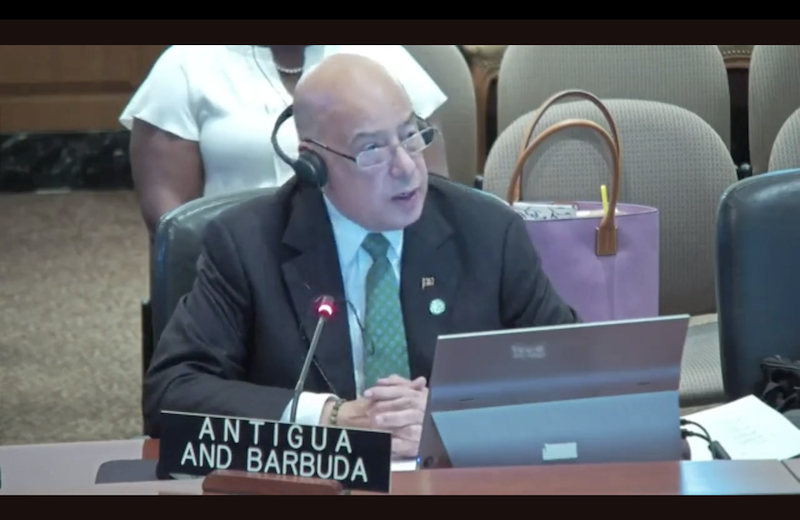
Against a backdrop of rising global pressure on multilateral cooperation, the 56th Regular Session of the Organization of American States (OAS) General Assembly opened in Panama City, Panama, where Sir Ronald Sanders, Head of Delegation and Ambassador of Antigua and Barbuda, delivered a compelling, values-driven address outlining key priorities for the inter-American body.
In his opening remarks, Ambassador Sanders made a clear case for the OAS’s irreplaceable role in the Western Hemisphere. As the only regional institution that brings together nearly all independent American states for consistent dialogue, collaborative problem-solving and collective action, he emphasized that no alternative body can fill the space the OAS occupies. With unilateral action increasingly replacing coordinated global problem-solving across the world, he reaffirmed Antigua and Barbuda’s steadfast commitment to the core principles laid out in the OAS Charter. “We will continue to support this Organization in practice, by applying its rules consistently, safeguarding its independence, and ensuring that it serves all Member States fairly,” Sanders stated.
Shifting focus to institutional governance and reform, the ambassador underscored that the institutional independence of the OAS Secretary General and the broader Secretariat stands as a fundamental Charter principle, critical to maintaining the organization’s internal institutional balance. He noted that accountability is equally vital to the OAS’s effective functioning, but stressed that any oversight must be carried out through pre-established mechanisms, aligned with Charter procedures, and guided by collective decisions made by all member states. On the topic of long-term institutional reform, Sanders left no room for ambiguity: reform efforts must prioritize strengthening the organization as a whole, and any changes must move forward through the collective, jointly agreed procedures set by member states, with the end goal of building a more effective OAS rather than undermining its capacity.
Turning to the ongoing humanitarian and security crisis in Haiti, Sanders described the extreme levels of violence and instability faced by ordinary Haitians as unacceptable, highlighting that women and girls across the country remain at disproportionate and grave risk. He confirmed Antigua and Barbuda’s full backing for the UN-authorized Multinational Gang Suppression Force, pointing out that the deployment comes at the formal request of Haiti’s own national authorities. The ambassador called on all American states to mount a coordinated, collective response to transnational criminal networks operating within Haiti’s borders, arguing that drug trafficking, illicit cross-border financial flows, illegal weapons movements, and the movement of criminal actors must be disrupted and halted entirely. He urged global stakeholders to identify, sanction, and prosecute any individuals or entities that finance and back gang activity, regardless of whether they operate inside or outside of Haiti. “We must act together to restore security and democratic governance, in the interest of Haiti and of the Hemisphere as a whole,” Sanders said.
In closing, Sanders laid out his vision for the future of the OAS: a strong, independent, adequately resourced organization that truly represents all peoples of the Americas. The permanent, inclusive forum for dialogue that the OAS provides — a rules-based space where governments can engage with mutual respect even when they hold differing positions — must be strengthened, not weakened, he argued. In final remarks, Sanders reaffirmed that this commitment to collective, multilateral action through a reformed, inclusive OAS is the clear right path forward for the region.