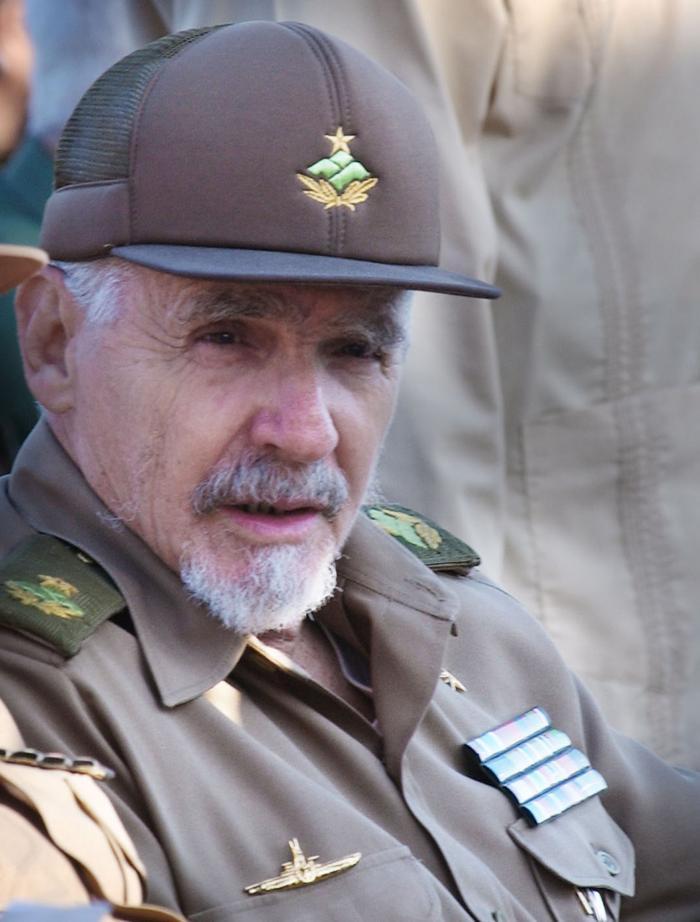
Cuba’s top Party, state and government leadership has announced with deep sadness that iconic Cuban Revolution Commander Ramiro Valdés Menéndez, a decorated Hero of the Republic of Cuba and Hero of Labor, passed away on the morning of Sunday, June 21, 2026.
Born in Artemisa in April 1932, Valdés Menéndez grew up in a working-class household shaped by his mother’s deep commitment to the legacies of Cuban independence leaders Carlos Manuel de Céspedes and José Martí. Raised amid the inequalities of pre-revolutionary capitalist Cuba, he developed unshakable patriotic values from an early age. As a young adult working as a lineman’s apprentice, he first cut his political teeth organizing to fight unfair working conditions for electrical sector employees.
When Fulgencio Batista launched his 1952 military coup, Valdés Menéndez was working in the sugar cane fields of a local mill. He did not hesitate to join the growing resistance movement against the Batista dictatorship, aligning himself with Fidel Castro and a cohort of fellow young revolutionaries from his home province of Artemisa. Just over a year later, he took part in the landmark July 26, 1953 attacks on the Moncada Barracks and the Carlos Manuel de Céspedes Barracks, a turning point that ignited the Cuban Revolution.
From that moment forward, Valdés Menéndez stood on the front lines of every phase of the revolutionary struggle, alongside Fidel Castro Ruz and Raúl Castro Ruz, to whom he maintained lifelong, unwavering loyalty and admiration. He carried his revolutionary credentials through every chapter of the movement: as a surviving Moncada attacker, a political prisoner imprisoned on the Isle of Pines, an exiled organizer in Mexico, a member of the historic Granma expedition that relaunched the revolution in 1956, and second-in-command of Column No. 8 under the legendary Ernesto “Che” Guevara in the Sierra Maestra mountains.
By the time the revolution claimed victory on January 1, 1959, Valdés Menéndez had already earned his rank of Commander through years of frontline combat. In the decades that followed, he went on to hold a long list of senior military and government positions that shaped modern Cuba. These included Second Chief of La Cabaña, Military Chief of Cuba’s central region, and head of state security organs during the pivotal 1961 Bay of Pigs mercenary invasion. He later served as Minister of the Interior, First Deputy Minister of the Revolutionary Armed Forces (FAR), Aide to the Commander-in-Chief, President of the SIME Electronics Industrial Group, Minister of Information Technology and Communications, Vice President of the Councils of State and Ministers, and Deputy Prime Minister — a post he held until his death.
A founding member of the Central Committee of the Communist Party of Cuba and its Political Bureau, Valdés Menéndez also served for decades as a deputy to the National Assembly of People’s Power. Among his most notable high-stakes missions was leading the effort to search for, locate, exhume, and repatriate to Cuba the remains of Che Guevara and his fellow revolutionary fighters who died in Bolivia in 1967. Over his decades of service, his extraordinary contributions to the Cuban nation were recognized with dozens of state orders and highest decorations.
In announcing his passing, Cuban leadership emphasized that Valdés Menéndez leaves behind a decades-long record of exceptional, selfless service to the Cuban people. His life and example will remain a lasting paradigm for future generations of Cubans, remembered as a steadfast revolutionary, fearless combatant, and unwavering patriot whose solid convictions and unlimited devotion to his country defined a lifetime of commitment to Cuba’s sovereignty and people.