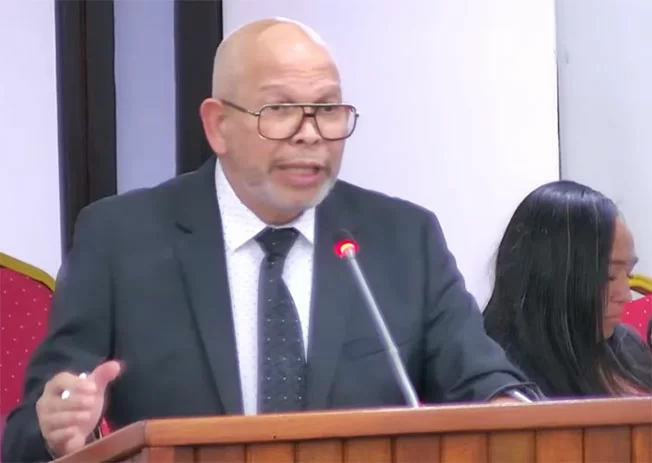
Suriname’s Minister of Education, Science and Culture Dirk Currie is calling for sweeping increases in public investment in the education sector, pointing out that the South American-Caribbean nation already lags far behind regional peers in education spending, putting its long-term development at risk.
As outlined in the country’s 2026 draft budget, just SRD 7.48 billion — equivalent to 9.7% of total government expenditure — is earmarked for education. That figure remains well below the Caribbean regional average of roughly 15% of public spending, and puts Suriname at the lower end of investment rankings across the region. When measured as a share of gross domestic product (GDP), the gap is equally stark: Suriname allocates approximately 3% of GDP to education, compared to a regional average of 4.9%. Neighboring and peer nations including Belize, Guyana and Dominica all invest more than 5% of their total GDP in the education sector, while Belize and Dominica devote 21% of total government outlays to the sector, and Jamaica allocates nearly 19%.
To address this persistent underinvestment, Currie has proposed enshrining a mandatory spending target in national law, requiring that between 20% and 25% of annual state revenue be allocated to education, science and culture. Speaking during budget deliberations in the National Assembly, Currie emphasized that Suriname’s long-term growth will not be driven solely by projected new oil and gas revenues — it will depend above all on the quality of the nation’s human capital.
“Education is not an expense line, it is an investment in our country’s future,” Currie told parliament. The minister argues that a legal mandate is critical to insulate education funding from shifting political priorities and economic volatility, creating the long-term certainty needed to invest in infrastructure upgrades, updated learning materials, teacher training, digital transformation and overall quality improvements across the education system.
With Suriname preparing to enter a new economic era driven by expanding oil and gas production, Currie warned that the nation could squander this historic opportunity without a sufficiently skilled, educated workforce. “Natural resources alone do not make a nation prosperous. In the end, it is people that make the difference,” he said. Beyond securing stable funding, the minister hopes his proposal will spark a broad national conversation about the central role education should play in Suriname’s public financial priorities, framing sustained investment in the sector as a non-negotiable foundation for the country’s long-term development.